

p-orbitals in bonding with metals;
the stabilization of low oxidation
states, including the zero state, is a
consequence of this. This also accounts for its toxicity, which is due
to the binding of the CO to the iron
in haemoglobin, thereby blocking
the uptake of oxygen.
103
carbyne
c
O
C
_ _
C
_ _
C
_ _
O
_ _
O C
_ _
O
_ _
C O
_ _
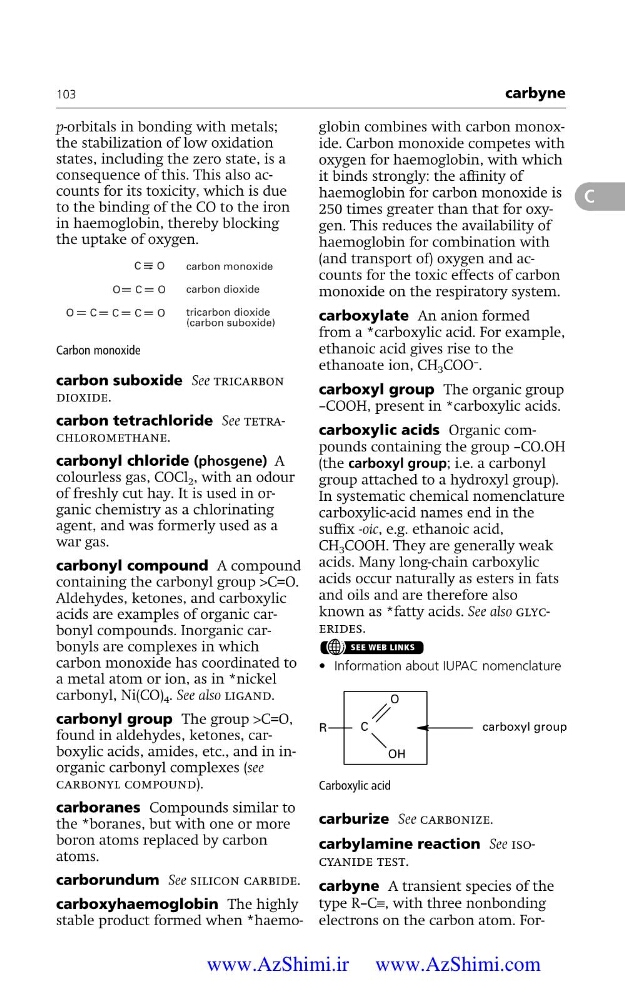
carbon monoxide
carbon dioxide
tricarbon dioxide
(carbon suboxide)
Carbon monoxide
C
O
OH
R
carboxyl group
Carboxylic acid
carbon suboxide See tricarbon
dioxide.
carbon tetrachloride See tetrachloromethane.
carbonyl chloride (phosgene) A
colourless gas, COCl 2 , with an odour
of freshly cut hay. It is used in organic chemistry as a chlorinating
agent, and was formerly used as a
war gas.
carbonyl compound A compound
containing the carbonyl group >C=O.
Aldehydes, ketones, and carboxylic
acids are examples of organic carbonyl compounds. Inorganic carbonyls are complexes in which
carbon monoxide has coordinated to
a metal atom or ion, as in *nickel
carbonyl, Ni(CO) 4 . See also ligand.
carbonyl group The group >C=O,
found in aldehydes, ketones, carboxylic acids, amides, etc., and in inorganic carbonyl complexes (see
carbonyl compound).
carboranes Compounds similar to
the *boranes, but with one or more
boron atoms replaced by carbon
atoms.
carborundum See silicon carbide.
carboxyhaemoglobin The highly
stable product formed when *haemoglobin combines with carbon monoxide. Carbon monoxide competes with
oxygen for haemoglobin, with which
it binds strongly: the afÜnity of
haemoglobin for carbon monoxide is
250 times greater than that for oxygen. This reduces the availability of
haemoglobin for combination with
(and transport of) oxygen and accounts for the toxic effects of carbon
monoxide on the respiratory system.
carboxylate An anion formed
from a *carboxylic acid. For example,
ethanoic acid gives rise to the
ethanoate ion, CH 3 COO
– .
carboxyl group The organic group
–COOH, present in *carboxylic acids.
carboxylic acids Organic compounds containing the group –CO.OH
(the carboxyl group; i.e. a carbonyl
group attached to a hydroxyl group).
In systematic chemical nomenclature
carboxylic-acid names end in the
sufÜx -oic, e.g. ethanoic acid,
CH 3 COOH. They are generally weak
acids. Many long-chain carboxylic
acids occur naturally as esters in fats
and oils and are therefore also
known as *fatty acids. See also glycerides.
A
• Information about IUPAC nomenclature
carburize See carbonize.
carbylamine reaction See isocyanide test.
carbyne A transient species of the
type R–C≡, with three nonbonding
electrons on the carbon atom. Forwww.AzShimi.ir www.AzShimi.com
the stabilization of low oxidation
states, including the zero state, is a
consequence of this. This also accounts for its toxicity, which is due
to the binding of the CO to the iron
in haemoglobin, thereby blocking
the uptake of oxygen.
103
carbyne
c
O
C
_ _
C
_ _
C
_ _
O
_ _
O C
_ _
O
_ _
C O
_ _
carbon monoxide
carbon dioxide
tricarbon dioxide
(carbon suboxide)
Carbon monoxide
C
O
OH
R
carboxyl group
Carboxylic acid
carbon suboxide See tricarbon
dioxide.
carbon tetrachloride See tetrachloromethane.
carbonyl chloride (phosgene) A
colourless gas, COCl 2 , with an odour
of freshly cut hay. It is used in organic chemistry as a chlorinating
agent, and was formerly used as a
war gas.
carbonyl compound A compound
containing the carbonyl group >C=O.
Aldehydes, ketones, and carboxylic
acids are examples of organic carbonyl compounds. Inorganic carbonyls are complexes in which
carbon monoxide has coordinated to
a metal atom or ion, as in *nickel
carbonyl, Ni(CO) 4 . See also ligand.
carbonyl group The group >C=O,
found in aldehydes, ketones, carboxylic acids, amides, etc., and in inorganic carbonyl complexes (see
carbonyl compound).
carboranes Compounds similar to
the *boranes, but with one or more
boron atoms replaced by carbon
atoms.
carborundum See silicon carbide.
carboxyhaemoglobin The highly
stable product formed when *haemoglobin combines with carbon monoxide. Carbon monoxide competes with
oxygen for haemoglobin, with which
it binds strongly: the afÜnity of
haemoglobin for carbon monoxide is
250 times greater than that for oxygen. This reduces the availability of
haemoglobin for combination with
(and transport of) oxygen and accounts for the toxic effects of carbon
monoxide on the respiratory system.
carboxylate An anion formed
from a *carboxylic acid. For example,
ethanoic acid gives rise to the
ethanoate ion, CH 3 COO
– .
carboxyl group The organic group
–COOH, present in *carboxylic acids.
carboxylic acids Organic compounds containing the group –CO.OH
(the carboxyl group; i.e. a carbonyl
group attached to a hydroxyl group).
In systematic chemical nomenclature
carboxylic-acid names end in the
sufÜx -oic, e.g. ethanoic acid,
CH 3 COOH. They are generally weak
acids. Many long-chain carboxylic
acids occur naturally as esters in fats
and oils and are therefore also
known as *fatty acids. See also glycerides.
A
• Information about IUPAC nomenclature
carburize See carbonize.
carbylamine reaction See isocyanide test.
carbyne A transient species of the
type R–C≡, with three nonbonding
electrons on the carbon atom. Forwww.AzShimi.ir www.AzShimi.com