

Copyright © Glencoe/McGraw-Hill, a division of The McGraw-Hill Companies, Inc.
Solving Problems: A Chemistry Handbook
Chemistry: Matter and Change
51
SOLVING PROBLEMS:
A CHEMISTRY HANDBOOK
CHAPTER
5
Practice Problems
14. Write electron-dot structures for the following elements.
a. nitrogen
b. aluminum
c. neon
d. strontium
e. antimony
f. iodine
g. lead
h. cesium
15. What electron-dot structure is shared by all noble gases except
helium?
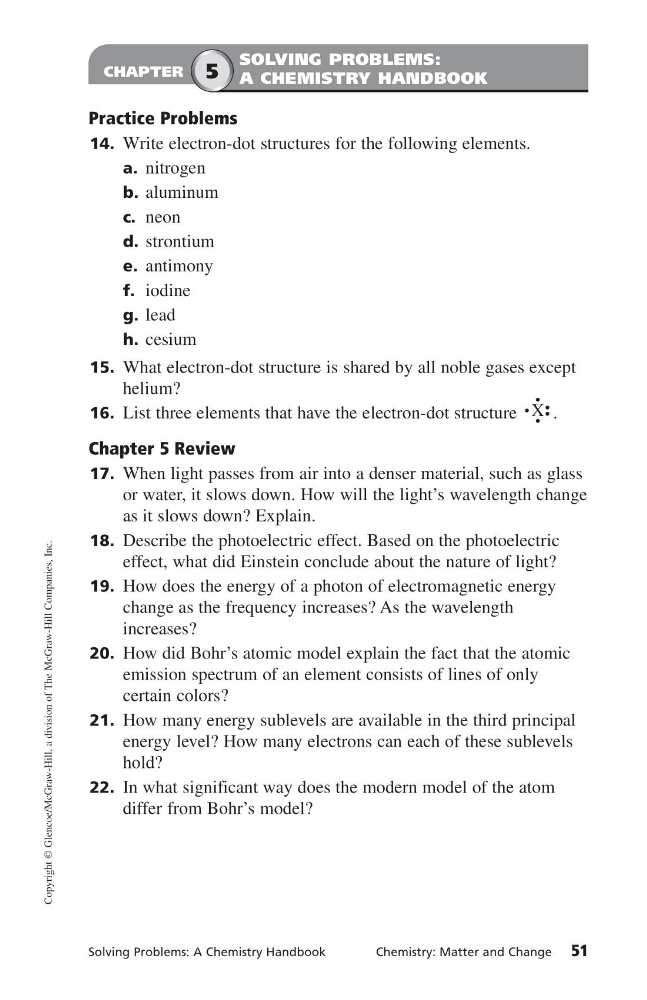
16. List three elements that have the electron-dot structure
.
Chapter 5 Review
17. When light passes from air into a denser material, such as glass
or water, it slows down. How will the light’s wavelength change
as it slows down? Explain.
18. Describe the photoelectric effect. Based on the photoelectric
effect, what did Einstein conclude about the nature of light?
19. How does the energy of a photon of electromagnetic energy
change as the frequency increases? As the wavelength
increases?
20. How did Bohr’s atomic model explain the fact that the atomic
emission spectrum of an element consists of lines of only
certain colors?
21. How many energy sublevels are available in the third principal
energy level? How many electrons can each of these sublevels
hold?
22. In what significant way does the modern model of the atom
differ from Bohr’s model?
X
Solving Problems: A Chemistry Handbook
Chemistry: Matter and Change
51
SOLVING PROBLEMS:
A CHEMISTRY HANDBOOK
CHAPTER
5
Practice Problems
14. Write electron-dot structures for the following elements.
a. nitrogen
b. aluminum
c. neon
d. strontium
e. antimony
f. iodine
g. lead
h. cesium
15. What electron-dot structure is shared by all noble gases except
helium?
16. List three elements that have the electron-dot structure
.
Chapter 5 Review
17. When light passes from air into a denser material, such as glass
or water, it slows down. How will the light’s wavelength change
as it slows down? Explain.
18. Describe the photoelectric effect. Based on the photoelectric
effect, what did Einstein conclude about the nature of light?
19. How does the energy of a photon of electromagnetic energy
change as the frequency increases? As the wavelength
increases?
20. How did Bohr’s atomic model explain the fact that the atomic
emission spectrum of an element consists of lines of only
certain colors?
21. How many energy sublevels are available in the third principal
energy level? How many electrons can each of these sublevels
hold?
22. In what significant way does the modern model of the atom
differ from Bohr’s model?
X