

Copyright © Glencoe/McGraw-Hill, a division of The McGraw-Hill Companies, Inc.
50 Chemistry: Matter and Change
Solving Problems: A Chemistry Handbook
SOLVING PROBLEMS:
A CHEMISTRY HANDBOOK
CHAPTER
5
is 1s 2 2s 2 , but only the two 2s electrons are valence electrons, so the
electron-dot structure for beryllium is
. The electron-dot structure for boron, with three electrons in the second energy level
(1s 2 2s 2 2p 1 ), is
. The electron configuration of oxygen is
1s 2 2s 2 2p 4 , and its electron-dot structure is
. A new principal
energy level begins with sodium, whose electron configuration is
1s 2 2s 2 2p 6 3s 1 . Sodium’s electron-dot structure is
because only
the 3s electron is a valence electron. The other electrons are in inner
energy levels.
Example Problem 5-2
Writing Electron-Dot Structures
Write an electron-dot structure for a neutral atom of arsenic, an
element used in semiconductor materials because of its electron configuration.
Begin by writing the electron configuration of arsenic. Use noblegas notation to emphasize the arrangement of electrons in the
highest principal energy level. Arsenic is in the fourth period of the
periodic table, so the preceding noble gas is argon. Thus, arsenic’s
electron configuration will begin with the symbol [Ar]. Arsenic has
15 electrons more than argon.
Using the energy sublevel diagram, you can see that the nineteenth
electron begins the fourth principal energy level. After the 4s sublevel is filled with two electrons, ten electrons fill the 3d sublevel,
which is slightly higher in energy than the 4s sublevel. After the 3d
sublevel is filled, the remaining three electrons will be in orbitals in
the 4p sublevel. Thus, the electron configuration for arsenic is
[Ar]4s 2 3d 10 4p 3 .
Before writing the electron-dot structure for arsenic, note that
arsenic’s ten 3d electrons are not in the highest principal energy
level. Therefore, they are not regarded as valence electrons. Only the
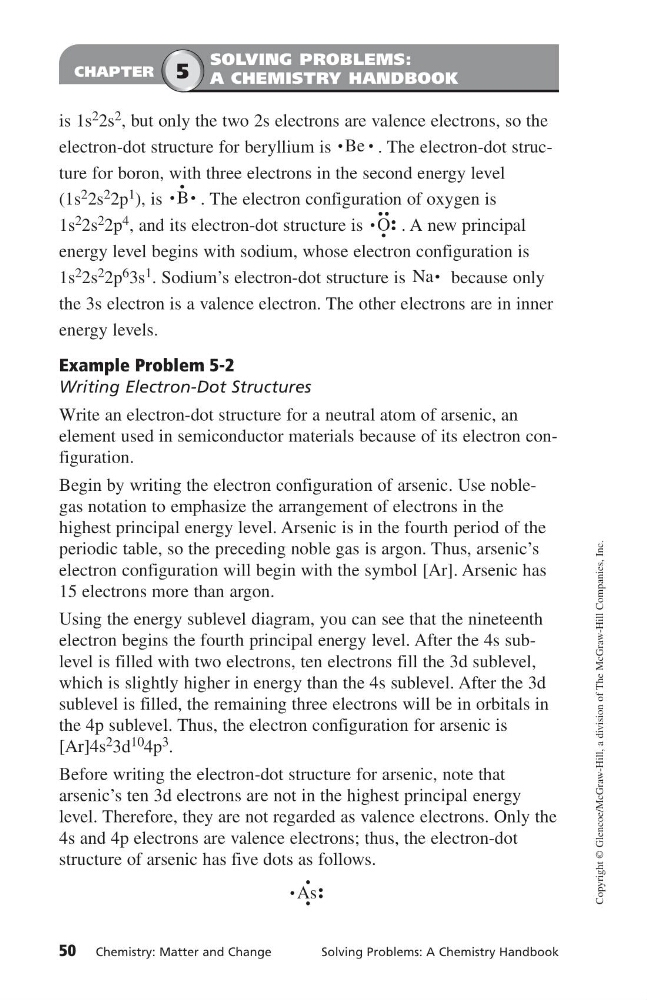
4s and 4p electrons are valence electrons; thus, the electron-dot
structure of arsenic has five dots as follows.
As
Na
O
B
Be
50 Chemistry: Matter and Change
Solving Problems: A Chemistry Handbook
SOLVING PROBLEMS:
A CHEMISTRY HANDBOOK
CHAPTER
5
is 1s 2 2s 2 , but only the two 2s electrons are valence electrons, so the
electron-dot structure for beryllium is
. The electron-dot structure for boron, with three electrons in the second energy level
(1s 2 2s 2 2p 1 ), is
. The electron configuration of oxygen is
1s 2 2s 2 2p 4 , and its electron-dot structure is
. A new principal
energy level begins with sodium, whose electron configuration is
1s 2 2s 2 2p 6 3s 1 . Sodium’s electron-dot structure is
because only
the 3s electron is a valence electron. The other electrons are in inner
energy levels.
Example Problem 5-2
Writing Electron-Dot Structures
Write an electron-dot structure for a neutral atom of arsenic, an
element used in semiconductor materials because of its electron configuration.
Begin by writing the electron configuration of arsenic. Use noblegas notation to emphasize the arrangement of electrons in the
highest principal energy level. Arsenic is in the fourth period of the
periodic table, so the preceding noble gas is argon. Thus, arsenic’s
electron configuration will begin with the symbol [Ar]. Arsenic has
15 electrons more than argon.
Using the energy sublevel diagram, you can see that the nineteenth
electron begins the fourth principal energy level. After the 4s sublevel is filled with two electrons, ten electrons fill the 3d sublevel,
which is slightly higher in energy than the 4s sublevel. After the 3d
sublevel is filled, the remaining three electrons will be in orbitals in
the 4p sublevel. Thus, the electron configuration for arsenic is
[Ar]4s 2 3d 10 4p 3 .
Before writing the electron-dot structure for arsenic, note that
arsenic’s ten 3d electrons are not in the highest principal energy
level. Therefore, they are not regarded as valence electrons. Only the
4s and 4p electrons are valence electrons; thus, the electron-dot
structure of arsenic has five dots as follows.
As
Na
O
B
Be