

SOLVING PROBLEMS:
A CHEMISTRY HANDBOOK
Appendix A
Copyright © Glencoe/McGraw-Hill, a division of The McGraw-Hill Companies, Inc.
320 Chemistry: Matter and Change
Solving Problems: A Chemistry Handbook
SOLVING PROBLEMS:
A CHEMISTRY HANDBOOK
Appendix B
Most scientific calculators have a button labeled
and, in most
cases, the number is simply entered and the log button is pushed to
display the log of the number. Note that there is the same number of
digits after the decimal in the log as there are significant figures in
the original number entered.
log 5.34 ϫ 10 5 ϭ log 5.34 ϩ log10 5 ϭ 0.728 ϩ 5 ϭ 5.728
Suppose the pH of aqueous ammonia equals 9.54 and you are
asked to find the concentration of the hydrogen ions in that solution.
By definition, pH ϭ Ϫlog [H ϩ ]. Compare this to the general equation for the common log.
Equation for pH:
pH ϭ Ϫlog [H ϩ ]
General equation:
y ϭ log 10 n
To solve the equation for [H ϩ ], you must follow the reverse process
and calculate the antilogarithm (antilog) of Ϫ9.54 to find [H ϩ ].
Antilogs are the reverse of logs. To find the antilog, use a scientific calculator to input the value of the log. Then, use the inverse
function and press the log button.
If n ϭ antilog y, then y ϭ 10 n .
Thus, [H ϩ ] ϭ antilog(Ϫ9.54) ϭ 10 Ϫ9.54 ϭ 10 0.46 ϩ(Ϫ10)
ϭ 10 0.46 ϫ 10 Ϫ10
ϭ 2.9 ϫ 10 Ϫ10 M
Check the instruction manual for your calculator. The exact procedure to calculate logs and antilogs may vary.
log
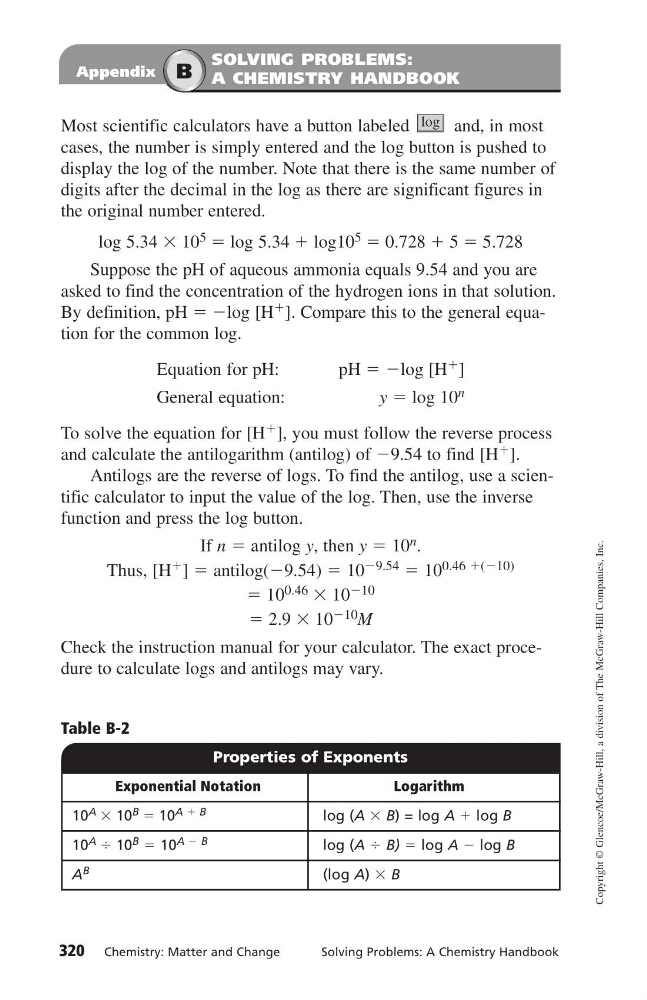
Properties of Exponents
Exponential Notation
Logarithm
10 A ϫ 10 B ϭ 10 A ϩ B
log (A ϫ B) = log A ϩ log B
10 A Ϭ 10 B ϭ 10 A Ϫ B
log (A Ϭ B) ϭ log A Ϫ log B
A B
(log A) ϫ B
Table B-2
A CHEMISTRY HANDBOOK
Appendix A
Copyright © Glencoe/McGraw-Hill, a division of The McGraw-Hill Companies, Inc.
320 Chemistry: Matter and Change
Solving Problems: A Chemistry Handbook
SOLVING PROBLEMS:
A CHEMISTRY HANDBOOK
Appendix B
Most scientific calculators have a button labeled
and, in most
cases, the number is simply entered and the log button is pushed to
display the log of the number. Note that there is the same number of
digits after the decimal in the log as there are significant figures in
the original number entered.
log 5.34 ϫ 10 5 ϭ log 5.34 ϩ log10 5 ϭ 0.728 ϩ 5 ϭ 5.728
Suppose the pH of aqueous ammonia equals 9.54 and you are
asked to find the concentration of the hydrogen ions in that solution.
By definition, pH ϭ Ϫlog [H ϩ ]. Compare this to the general equation for the common log.
Equation for pH:
pH ϭ Ϫlog [H ϩ ]
General equation:
y ϭ log 10 n
To solve the equation for [H ϩ ], you must follow the reverse process
and calculate the antilogarithm (antilog) of Ϫ9.54 to find [H ϩ ].
Antilogs are the reverse of logs. To find the antilog, use a scientific calculator to input the value of the log. Then, use the inverse
function and press the log button.
If n ϭ antilog y, then y ϭ 10 n .
Thus, [H ϩ ] ϭ antilog(Ϫ9.54) ϭ 10 Ϫ9.54 ϭ 10 0.46 ϩ(Ϫ10)
ϭ 10 0.46 ϫ 10 Ϫ10
ϭ 2.9 ϫ 10 Ϫ10 M
Check the instruction manual for your calculator. The exact procedure to calculate logs and antilogs may vary.
log
Properties of Exponents
Exponential Notation
Logarithm
10 A ϫ 10 B ϭ 10 A ϩ B
log (A ϫ B) = log A ϩ log B
10 A Ϭ 10 B ϭ 10 A Ϫ B
log (A Ϭ B) ϭ log A Ϫ log B
A B
(log A) ϫ B
Table B-2