

Copyright © Glencoe/McGraw-Hill, a division of The McGraw-Hill Companies, Inc.
Solving Problems: A Chemistry Handbook
Chemistry: Matter and Change
319
SOLVING PROBLEMS:
A CHEMISTRY HANDBOOK
Appendix
A
Logarithms and Antilogarithms
When you perform calculations, such as using the half-life of carbon
to determine the age of a prehistoric skull or the pH of household
products, you may need to use the log or antilog function on your
calculator. A logarithm (log) is the power or exponent to which a
number, called a base, must be raised in order to obtain a given positive number. This textbook uses common logarithms based on a base
of ten. Therefore, the common log of any number is the power to
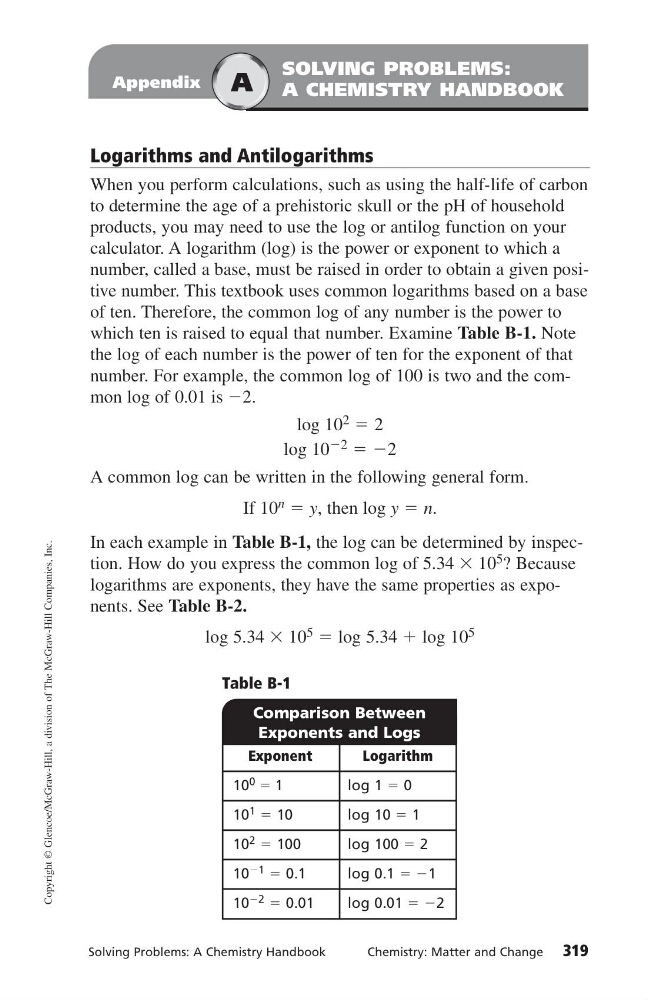
which ten is raised to equal that number. Examine Table B-1. Note
the log of each number is the power of ten for the exponent of that
number. For example, the common log of 100 is two and the common log of 0.01 is Ϫ2.
log 10 2 ϭ 2
log 10 Ϫ2 ϭ Ϫ2
A common log can be written in the following general form.
If 10 n ϭ y, then log y ϭ n.
In each example in Table B-1, the log can be determined by inspection. How do you express the common log of 5.34 ϫ 10 5 ? Because
logarithms are exponents, they have the same properties as exponents. See Table B-2.
log 5.34 ϫ 10 5 ϭ log 5.34 ϩ log 10 5
Comparison Between
Exponents and Logs
Exponent
Logarithm
10 0 ϭ 1
log 1 ϭ 0
10 1 ϭ 10
log 10 ϭ 1
10 2 ϭ 100
log 100 ϭ 2
10 Ϫ1 ϭ 0.1
log 0.1 ϭ Ϫ1
10 Ϫ2 ϭ 0.01
log 0.01 ϭ Ϫ2
Table B-1
Solving Problems: A Chemistry Handbook
Chemistry: Matter and Change
319
SOLVING PROBLEMS:
A CHEMISTRY HANDBOOK
Appendix
A
Logarithms and Antilogarithms
When you perform calculations, such as using the half-life of carbon
to determine the age of a prehistoric skull or the pH of household
products, you may need to use the log or antilog function on your
calculator. A logarithm (log) is the power or exponent to which a
number, called a base, must be raised in order to obtain a given positive number. This textbook uses common logarithms based on a base
of ten. Therefore, the common log of any number is the power to
which ten is raised to equal that number. Examine Table B-1. Note
the log of each number is the power of ten for the exponent of that
number. For example, the common log of 100 is two and the common log of 0.01 is Ϫ2.
log 10 2 ϭ 2
log 10 Ϫ2 ϭ Ϫ2
A common log can be written in the following general form.
If 10 n ϭ y, then log y ϭ n.
In each example in Table B-1, the log can be determined by inspection. How do you express the common log of 5.34 ϫ 10 5 ? Because
logarithms are exponents, they have the same properties as exponents. See Table B-2.
log 5.34 ϫ 10 5 ϭ log 5.34 ϩ log 10 5
Comparison Between
Exponents and Logs
Exponent
Logarithm
10 0 ϭ 1
log 1 ϭ 0
10 1 ϭ 10
log 10 ϭ 1
10 2 ϭ 100
log 100 ϭ 2
10 Ϫ1 ϭ 0.1
log 0.1 ϭ Ϫ1
10 Ϫ2 ϭ 0.01
log 0.01 ϭ Ϫ2
Table B-1