

Copyright © Glencoe/McGraw-Hill, a division of The McGraw-Hill Companies, Inc.
Solving Problems: A Chemistry Handbook
Chemistry: Matter and Change
243
SOLVING PROBLEMS:
A CHEMISTRY HANDBOOK
CHAPTER 23
Photosynthesis and Respiration Sunlight is the source of
energy for nearly all living things. During the process of photosynthesis, plants, algae, and some kinds of bacteria use the energy in
sunlight to build carbohydrate molecules from carbon dioxide and
water. Animals and some other organisms cannot photosynthesize.
They take in carbohydrates by eating plants or other animals. The
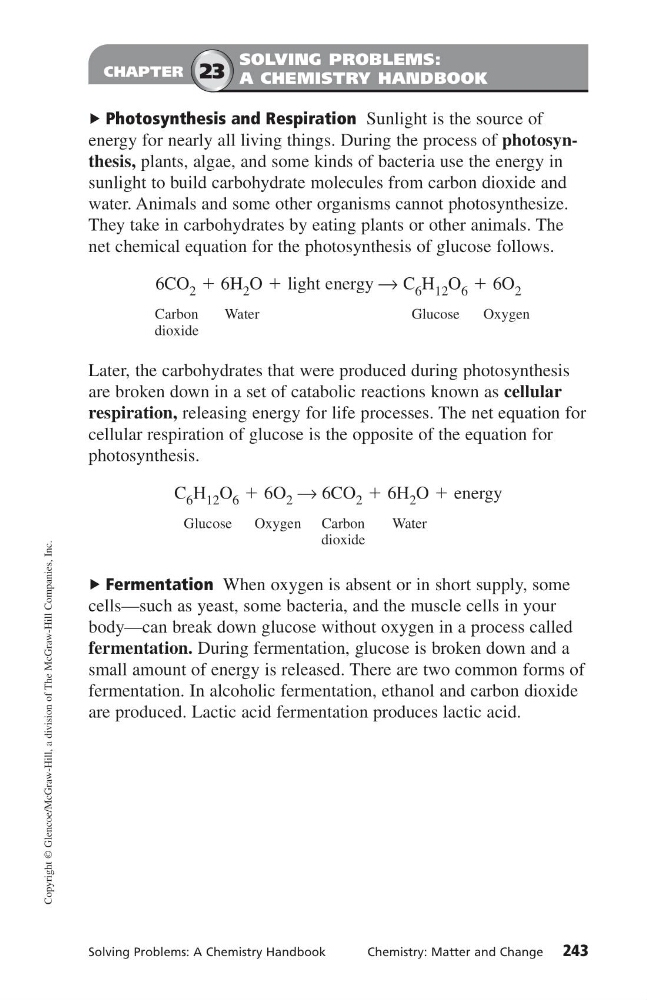
net chemical equation for the photosynthesis of glucose follows.
6CO 2 ϩ 6H 2 O ϩ light energy 0 C 6 H 12 O 6 ϩ 6O 2
Carbon
Water
Glucose
Oxygen
dioxide
Later, the carbohydrates that were produced during photosynthesis
are broken down in a set of catabolic reactions known as cellular
respiration, releasing energy for life processes. The net equation for
cellular respiration of glucose is the opposite of the equation for
photosynthesis.
C 6 H 12 O 6 ϩ 6O 2 0 6CO 2 ϩ 6H 2 O ϩ energy
Glucose
Oxygen Carbon
Water
dioxide
Fermentation When oxygen is absent or in short supply, some
cells—such as yeast, some bacteria, and the muscle cells in your
body—can break down glucose without oxygen in a process called
fermentation. During fermentation, glucose is broken down and a
small amount of energy is released. There are two common forms of
fermentation. In alcoholic fermentation, ethanol and carbon dioxide
are produced. Lactic acid fermentation produces lactic acid.
▲
▲
Solving Problems: A Chemistry Handbook
Chemistry: Matter and Change
243
SOLVING PROBLEMS:
A CHEMISTRY HANDBOOK
CHAPTER 23
Photosynthesis and Respiration Sunlight is the source of
energy for nearly all living things. During the process of photosynthesis, plants, algae, and some kinds of bacteria use the energy in
sunlight to build carbohydrate molecules from carbon dioxide and
water. Animals and some other organisms cannot photosynthesize.
They take in carbohydrates by eating plants or other animals. The
net chemical equation for the photosynthesis of glucose follows.
6CO 2 ϩ 6H 2 O ϩ light energy 0 C 6 H 12 O 6 ϩ 6O 2
Carbon
Water
Glucose
Oxygen
dioxide
Later, the carbohydrates that were produced during photosynthesis
are broken down in a set of catabolic reactions known as cellular
respiration, releasing energy for life processes. The net equation for
cellular respiration of glucose is the opposite of the equation for
photosynthesis.
C 6 H 12 O 6 ϩ 6O 2 0 6CO 2 ϩ 6H 2 O ϩ energy
Glucose
Oxygen Carbon
Water
dioxide
Fermentation When oxygen is absent or in short supply, some
cells—such as yeast, some bacteria, and the muscle cells in your
body—can break down glucose without oxygen in a process called
fermentation. During fermentation, glucose is broken down and a
small amount of energy is released. There are two common forms of
fermentation. In alcoholic fermentation, ethanol and carbon dioxide
are produced. Lactic acid fermentation produces lactic acid.
▲
▲