

Copyright © Glencoe/McGraw-Hill, a division of The McGraw-Hill Companies, Inc.
Solving Problems: A Chemistry Handbook
Chemistry: Matter and Change
241
SOLVING PROBLEMS:
A CHEMISTRY HANDBOOK
CHAPTER 23
23.4 Nucleic Acids
The sequence of amino acids in a protein is determined by the
genetic information coded into long-chain polymers called nucleic
acids. The monomers that make up nucleic acids are called
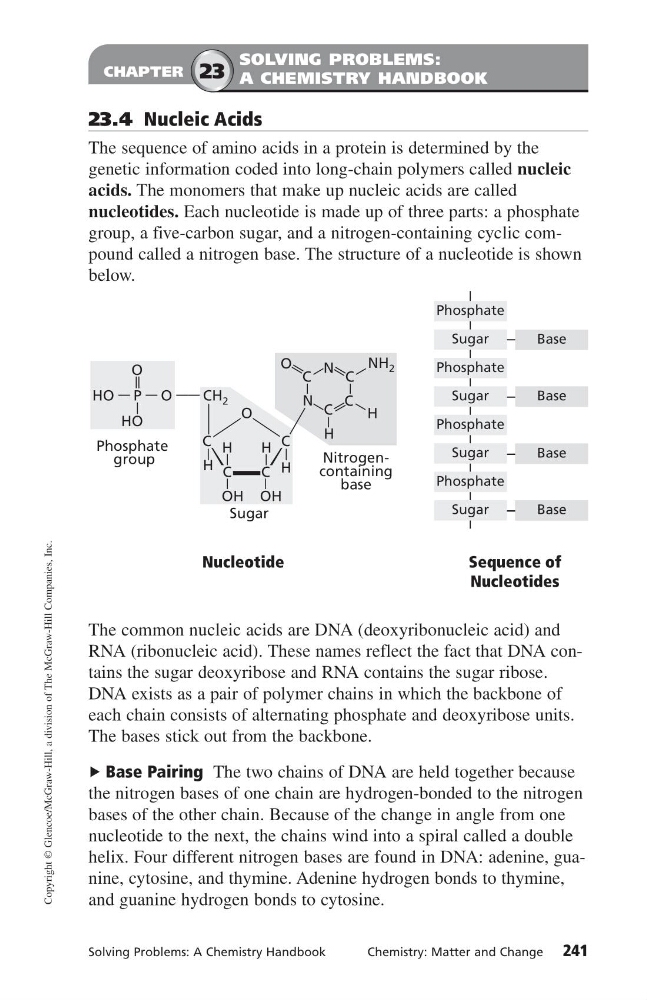
nucleotides. Each nucleotide is made up of three parts: a phosphate
group, a five-carbon sugar, and a nitrogen-containing cyclic compound called a nitrogen base. The structure of a nucleotide is shown
below.
The common nucleic acids are DNA (deoxyribonucleic acid) and
RNA (ribonucleic acid). These names reflect the fact that DNA contains the sugar deoxyribose and RNA contains the sugar ribose.
DNA exists as a pair of polymer chains in which the backbone of
each chain consists of alternating phosphate and deoxyribose units.
The bases stick out from the backbone.
Base Pairing The two chains of DNA are held together because
the nitrogen bases of one chain are hydrogen-bonded to the nitrogen
bases of the other chain. Because of the change in angle from one
nucleotide to the next, the chains wind into a spiral called a double
helix. Four different nitrogen bases are found in DNA: adenine, guanine, cytosine, and thymine. Adenine hydrogen bonds to thymine,
and guanine hydrogen bonds to cytosine.
▲
Nucleotide
Sequence of
Nucleotides
Sugar
—
—
OH OH
H
H
H
H
O
HO
HO — P — O —— CH 2
—
O
C
C
C
C
C
H
N
C
N
NH 2
C
C
H
— —
—
—
Phosphate
group
Nitrogencontaining
base
Phosphate
Sugar
Base
Base
Base
Base
Phosphate
Sugar
Phosphate
Sugar
Phosphate
Sugar
— —
O
Solving Problems: A Chemistry Handbook
Chemistry: Matter and Change
241
SOLVING PROBLEMS:
A CHEMISTRY HANDBOOK
CHAPTER 23
23.4 Nucleic Acids
The sequence of amino acids in a protein is determined by the
genetic information coded into long-chain polymers called nucleic
acids. The monomers that make up nucleic acids are called
nucleotides. Each nucleotide is made up of three parts: a phosphate
group, a five-carbon sugar, and a nitrogen-containing cyclic compound called a nitrogen base. The structure of a nucleotide is shown
below.
The common nucleic acids are DNA (deoxyribonucleic acid) and
RNA (ribonucleic acid). These names reflect the fact that DNA contains the sugar deoxyribose and RNA contains the sugar ribose.
DNA exists as a pair of polymer chains in which the backbone of
each chain consists of alternating phosphate and deoxyribose units.
The bases stick out from the backbone.
Base Pairing The two chains of DNA are held together because
the nitrogen bases of one chain are hydrogen-bonded to the nitrogen
bases of the other chain. Because of the change in angle from one
nucleotide to the next, the chains wind into a spiral called a double
helix. Four different nitrogen bases are found in DNA: adenine, guanine, cytosine, and thymine. Adenine hydrogen bonds to thymine,
and guanine hydrogen bonds to cytosine.
▲
Nucleotide
Sequence of
Nucleotides
Sugar
—
—
OH OH
H
H
H
H
O
HO
HO — P — O —— CH 2
—
O
C
C
C
C
C
H
N
C
N
NH 2
C
C
H
— —
—
—
Phosphate
group
Nitrogencontaining
base
Phosphate
Sugar
Base
Base
Base
Base
Phosphate
Sugar
Phosphate
Sugar
Phosphate
Sugar
— —
O