

Copyright © Glencoe/McGraw-Hill, a division of The McGraw-Hill Companies, Inc.
Solving Problems: A Chemistry Handbook
Chemistry: Matter and Change
237
The Chemistry of Life
The Chemistry of Life
SOLVING PROBLEMS:
A CHEMISTRY HANDBOOK
CHAPTER
23
23.1 Proteins
A protein is an organic polymer composed of amino acids bonded
together in one or more chains. An amino acid has a central carbon
atom, to which are bonded a carboxyl group, an amino group, a
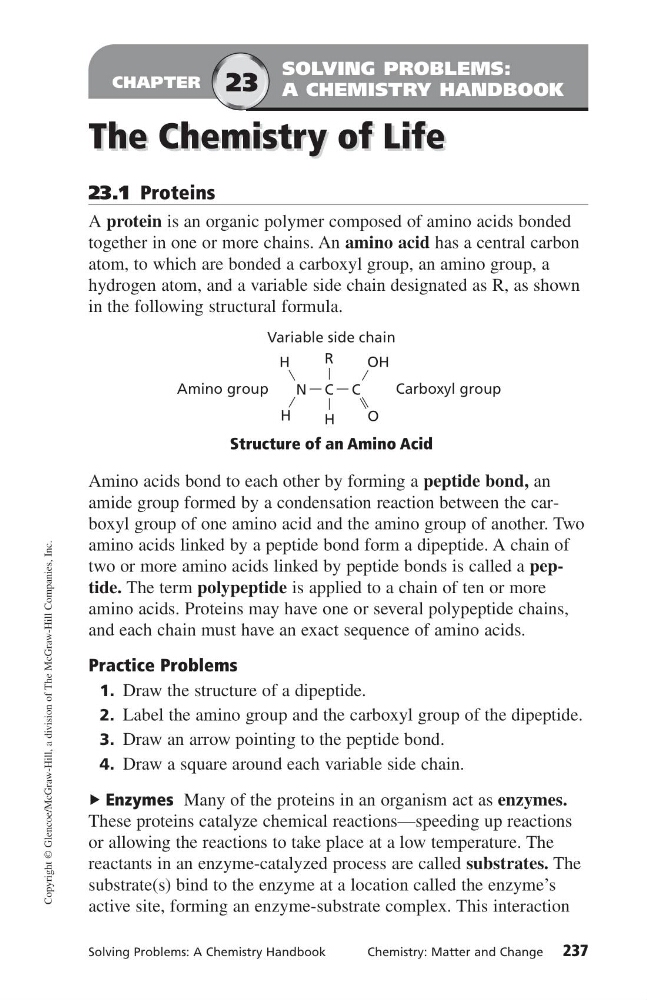
hydrogen atom, and a variable side chain designated as R, as shown
in the following structural formula.
Amino acids bond to each other by forming a peptide bond, an
amide group formed by a condensation reaction between the carboxyl group of one amino acid and the amino group of another. Two
amino acids linked by a peptide bond form a dipeptide. A chain of
two or more amino acids linked by peptide bonds is called a peptide. The term polypeptide is applied to a chain of ten or more
amino acids. Proteins may have one or several polypeptide chains,
and each chain must have an exact sequence of amino acids.
Practice Problems
1. Draw the structure of a dipeptide.
2. Label the amino group and the carboxyl group of the dipeptide.
3. Draw an arrow pointing to the peptide bond.
4. Draw a square around each variable side chain.
Enzymes Many of the proteins in an organism act as enzymes.
These proteins catalyze chemical reactions—speeding up reactions
or allowing the reactions to take place at a low temperature. The
reactants in an enzyme-catalyzed process are called substrates. The
substrate(s) bind to the enzyme at a location called the enzyme’s
active site, forming an enzyme-substrate complex. This interaction
▲
Variable side chain
Structure of an Amino Acid
Amino group
Carboxyl group
H
R
H
O
H
N
OH
C C
Solving Problems: A Chemistry Handbook
Chemistry: Matter and Change
237
The Chemistry of Life
The Chemistry of Life
SOLVING PROBLEMS:
A CHEMISTRY HANDBOOK
CHAPTER
23
23.1 Proteins
A protein is an organic polymer composed of amino acids bonded
together in one or more chains. An amino acid has a central carbon
atom, to which are bonded a carboxyl group, an amino group, a
hydrogen atom, and a variable side chain designated as R, as shown
in the following structural formula.
Amino acids bond to each other by forming a peptide bond, an
amide group formed by a condensation reaction between the carboxyl group of one amino acid and the amino group of another. Two
amino acids linked by a peptide bond form a dipeptide. A chain of
two or more amino acids linked by peptide bonds is called a peptide. The term polypeptide is applied to a chain of ten or more
amino acids. Proteins may have one or several polypeptide chains,
and each chain must have an exact sequence of amino acids.
Practice Problems
1. Draw the structure of a dipeptide.
2. Label the amino group and the carboxyl group of the dipeptide.
3. Draw an arrow pointing to the peptide bond.
4. Draw a square around each variable side chain.
Enzymes Many of the proteins in an organism act as enzymes.
These proteins catalyze chemical reactions—speeding up reactions
or allowing the reactions to take place at a low temperature. The
reactants in an enzyme-catalyzed process are called substrates. The
substrate(s) bind to the enzyme at a location called the enzyme’s
active site, forming an enzyme-substrate complex. This interaction
▲
Variable side chain
Structure of an Amino Acid
Amino group
Carboxyl group
H
R
H
O
H
N
OH
C C