

Copyright © Glencoe/McGraw-Hill, a division of The McGraw-Hill Companies, Inc.
230 Chemistry: Matter and Change
Solving Problems: A Chemistry Handbook
SOLVING PROBLEMS:
A CHEMISTRY HANDBOOK
CHAPTER 22
A ketone is an organic compound in which the carbon of the
carbonyl group is bonded to two other carbon atoms. Ketones are
polar and have many properties similar to those of aldehydes. They
often make good solvents. Ketones are named by changing the -e at
the end of the alkane name to -one. A number is used to indicate the
position of the carbon atom that is double-bonded to the oxygen.
Example Problem 22-5
Naming Aldehydes and Ketones
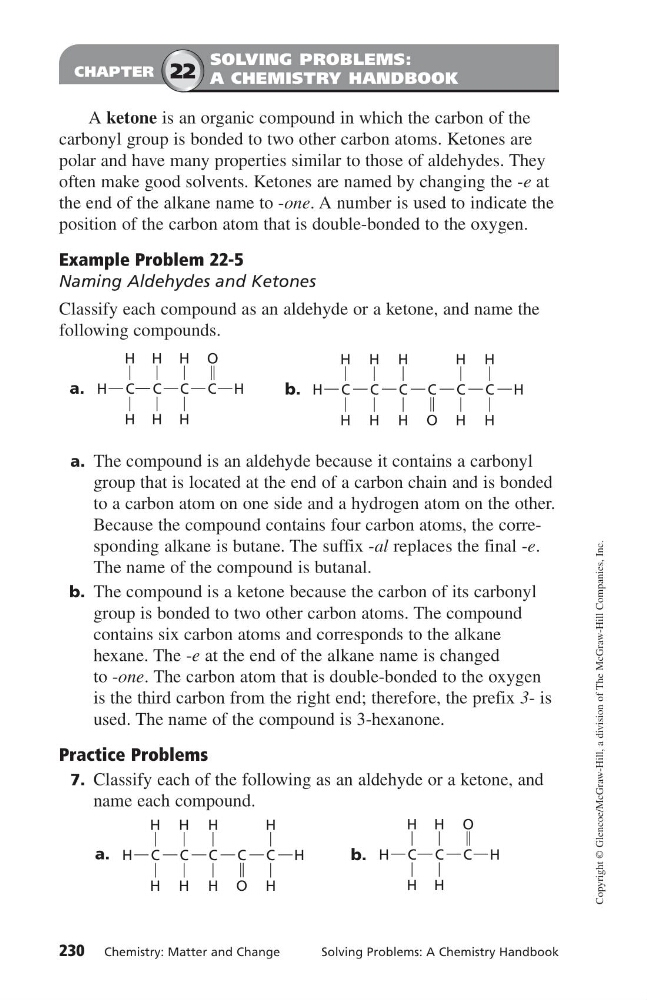
Classify each compound as an aldehyde or a ketone, and name the
following compounds.
a. The compound is an aldehyde because it contains a carbonyl
group that is located at the end of a carbon chain and is bonded
to a carbon atom on one side and a hydrogen atom on the other.
Because the compound contains four carbon atoms, the corresponding alkane is butane. The suffix -al replaces the final -e.
The name of the compound is butanal.
b. The compound is a ketone because the carbon of its carbonyl
group is bonded to two other carbon atoms. The compound
contains six carbon atoms and corresponds to the alkane
hexane. The -e at the end of the alkane name is changed
to -one. The carbon atom that is double-bonded to the oxygen
is the third carbon from the right end; therefore, the prefix 3- is
used. The name of the compound is 3-hexanone.
Practice Problems
7. Classify each of the following as an aldehyde or a ketone, and
name each compound.
H C
H
H
C
H
H O
C H
a. H C
H
H
C
H
H
C
H
H
C
O
C
H
H
H
b.
H C
H
H
C C
H
H
H
H O
C H
a.
H C
H
H
C
H
H
C
H
H
C
O
C
H
H
C
H
H
H
b.
230 Chemistry: Matter and Change
Solving Problems: A Chemistry Handbook
SOLVING PROBLEMS:
A CHEMISTRY HANDBOOK
CHAPTER 22
A ketone is an organic compound in which the carbon of the
carbonyl group is bonded to two other carbon atoms. Ketones are
polar and have many properties similar to those of aldehydes. They
often make good solvents. Ketones are named by changing the -e at
the end of the alkane name to -one. A number is used to indicate the
position of the carbon atom that is double-bonded to the oxygen.
Example Problem 22-5
Naming Aldehydes and Ketones
Classify each compound as an aldehyde or a ketone, and name the
following compounds.
a. The compound is an aldehyde because it contains a carbonyl
group that is located at the end of a carbon chain and is bonded
to a carbon atom on one side and a hydrogen atom on the other.
Because the compound contains four carbon atoms, the corresponding alkane is butane. The suffix -al replaces the final -e.
The name of the compound is butanal.
b. The compound is a ketone because the carbon of its carbonyl
group is bonded to two other carbon atoms. The compound
contains six carbon atoms and corresponds to the alkane
hexane. The -e at the end of the alkane name is changed
to -one. The carbon atom that is double-bonded to the oxygen
is the third carbon from the right end; therefore, the prefix 3- is
used. The name of the compound is 3-hexanone.
Practice Problems
7. Classify each of the following as an aldehyde or a ketone, and
name each compound.
H C
H
H
C
H
H O
C H
a. H C
H
H
C
H
H
C
H
H
C
O
C
H
H
H
b.
H C
H
H
C C
H
H
H
H O
C H
a.
H C
H
H
C
H
H
C
H
H
C
O
C
H
H
C
H
H
H
b.