

Copyright © Glencoe/McGraw-Hill, a division of The McGraw-Hill Companies, Inc.
Solving Problems: A Chemistry Handbook
Chemistry: Matter and Change
227
SOLVING PROBLEMS:
A CHEMISTRY HANDBOOK
CHAPTER 22
Practice Problems
2. Write a balanced chemical equation for each of the following
substitution reactions.
a. Ethane reacts with bromine to form hydrogen bromide and
an alkyl halide with one bromine atom.
b. Benzene reacts with fluorine to produce fluorobenzene and a
molecule of hydrogen fluoride.
22.2 Alcohols, Ethers, and Amines
An oxygen-hydrogen group covalently bonded to a carbon atom is
called a hydroxyl group. An organic compound in which a hydroxyl
group replaces a hydrogen atom of a hydrocarbon is called an
alcohol. Alcohols are polar and can form hydrogen bonds. As a
result, they have much higher boiling points than hydrocarbons of
similar shape and size. Alcohols are named using the name of the
alkane, with the final -e replaced by -ol.
The position of the hydroxyl group along the alkane chain is
indicated by means of a number and a hyphen at the beginning of
the name. If there is more than one hydroxyl group, prefixes such as
di- and tri- are placed just before the -ol in the name, and the -e is
not dropped from the alkane name.
Example Problem 22-3
Naming Alcohols
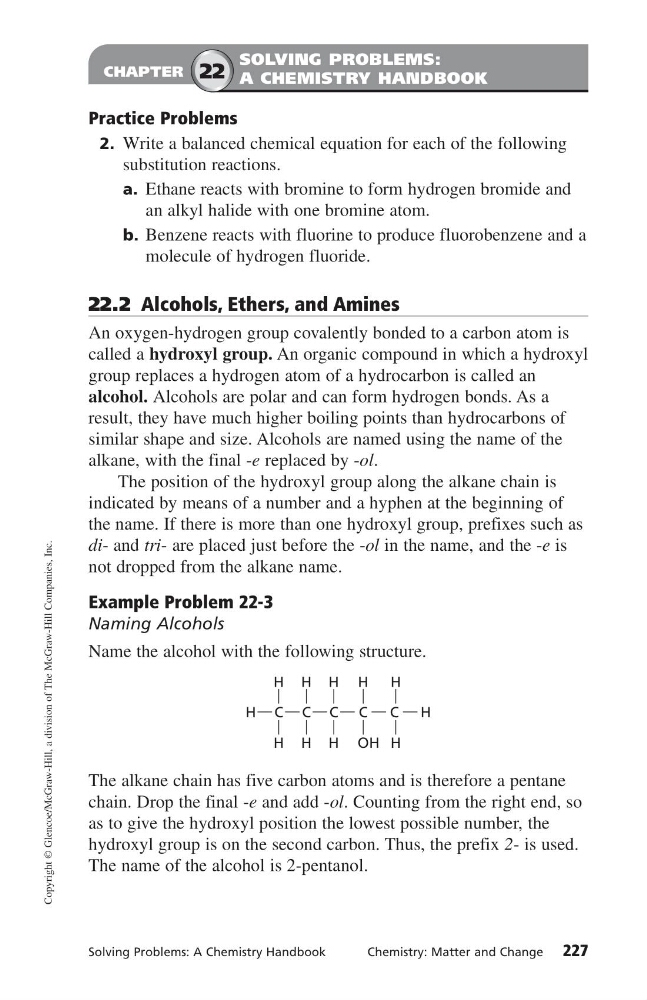
Name the alcohol with the following structure.
The alkane chain has five carbon atoms and is therefore a pentane
chain. Drop the final -e and add -ol. Counting from the right end, so
as to give the hydroxyl position the lowest possible number, the
hydroxyl group is on the second carbon. Thus, the prefix 2- is used.
The name of the alcohol is 2-pentanol.
H C
H
H
C C
H
H
OH
H
H
H
H
H
C
C H
Solving Problems: A Chemistry Handbook
Chemistry: Matter and Change
227
SOLVING PROBLEMS:
A CHEMISTRY HANDBOOK
CHAPTER 22
Practice Problems
2. Write a balanced chemical equation for each of the following
substitution reactions.
a. Ethane reacts with bromine to form hydrogen bromide and
an alkyl halide with one bromine atom.
b. Benzene reacts with fluorine to produce fluorobenzene and a
molecule of hydrogen fluoride.
22.2 Alcohols, Ethers, and Amines
An oxygen-hydrogen group covalently bonded to a carbon atom is
called a hydroxyl group. An organic compound in which a hydroxyl
group replaces a hydrogen atom of a hydrocarbon is called an
alcohol. Alcohols are polar and can form hydrogen bonds. As a
result, they have much higher boiling points than hydrocarbons of
similar shape and size. Alcohols are named using the name of the
alkane, with the final -e replaced by -ol.
The position of the hydroxyl group along the alkane chain is
indicated by means of a number and a hyphen at the beginning of
the name. If there is more than one hydroxyl group, prefixes such as
di- and tri- are placed just before the -ol in the name, and the -e is
not dropped from the alkane name.
Example Problem 22-3
Naming Alcohols
Name the alcohol with the following structure.
The alkane chain has five carbon atoms and is therefore a pentane
chain. Drop the final -e and add -ol. Counting from the right end, so
as to give the hydroxyl position the lowest possible number, the
hydroxyl group is on the second carbon. Thus, the prefix 2- is used.
The name of the alcohol is 2-pentanol.
H C
H
H
C C
H
H
OH
H
H
H
H
H
C
C H