

Copyright © Glencoe/McGraw-Hill, a division of The McGraw-Hill Companies, Inc.
214 Chemistry: Matter and Change
Solving Problems: A Chemistry Handbook
SOLVING PROBLEMS:
A CHEMISTRY HANDBOOK
CHAPTER 21
lowest number to the first branch point in the chain. If the first
branch points have the same number from either end of the parent chain, assign the lower number to the first branch where
there is a difference in the numbering from the two ends.
3. Name the hydrocarbon groups attached to the parent chain
(called substituent groups) by substituting -yl for -ane. For
example, the group —CH 3 is called methyl, and —CH 2 CH 3 is
called ethyl.
4. If the same substituent group occurs more than once, use a prefix (di-, tri-, tetra-, etc.) before its name to indicate how many
times it appears. Use numbers to show where each group is
attached to the parent chain.
5. When different groups are attached to the parent chain, name
the groups in alphabetical order (ignoring any prefixes).
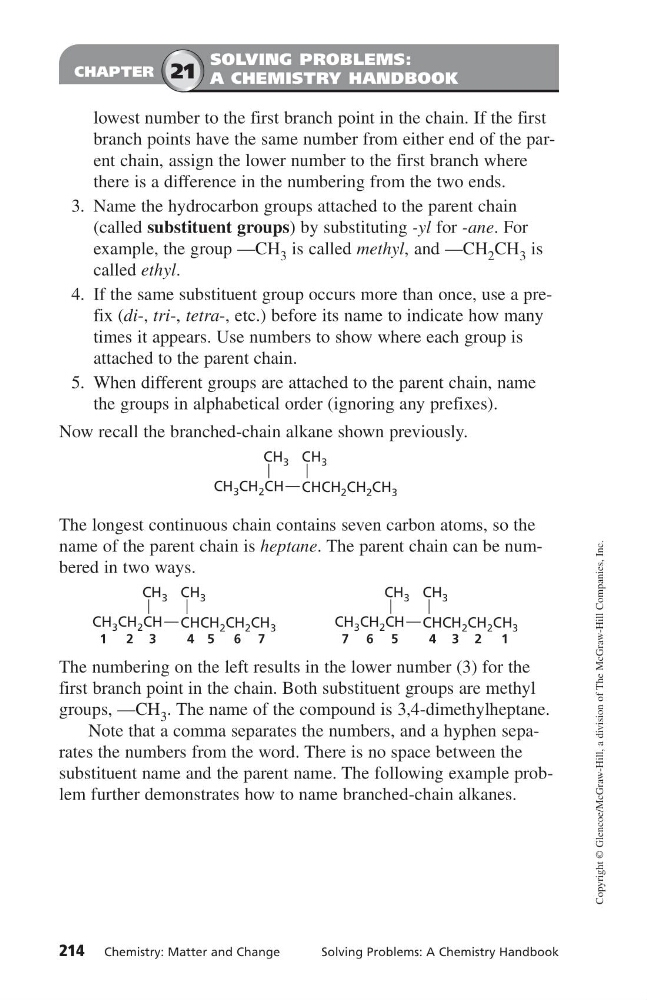
Now recall the branched-chain alkane shown previously.
The longest continuous chain contains seven carbon atoms, so the
name of the parent chain is heptane. The parent chain can be numbered in two ways.
The numbering on the left results in the lower number (3) for the
first branch point in the chain. Both substituent groups are methyl
groups, —CH 3 . The name of the compound is 3,4-dimethylheptane.
Note that a comma separates the numbers, and a hyphen separates the numbers from the word. There is no space between the
substituent name and the parent name. The following example problem further demonstrates how to name branched-chain alkanes.
CH 3 CH 2 CH CHCH 2 CH 2 CH 3
CH 3
CH 3
CH 3 CH 2 CH CHCH 2 CH 2 CH 3
CH 3
CH 3
1 2 3
4 5 6 7
7 6 5
4 3 2 1
CH 3 CH 2 CH CHCH 2 CH 2 CH 3
CH 3
CH 3
214 Chemistry: Matter and Change
Solving Problems: A Chemistry Handbook
SOLVING PROBLEMS:
A CHEMISTRY HANDBOOK
CHAPTER 21
lowest number to the first branch point in the chain. If the first
branch points have the same number from either end of the parent chain, assign the lower number to the first branch where
there is a difference in the numbering from the two ends.
3. Name the hydrocarbon groups attached to the parent chain
(called substituent groups) by substituting -yl for -ane. For
example, the group —CH 3 is called methyl, and —CH 2 CH 3 is
called ethyl.
4. If the same substituent group occurs more than once, use a prefix (di-, tri-, tetra-, etc.) before its name to indicate how many
times it appears. Use numbers to show where each group is
attached to the parent chain.
5. When different groups are attached to the parent chain, name
the groups in alphabetical order (ignoring any prefixes).
Now recall the branched-chain alkane shown previously.
The longest continuous chain contains seven carbon atoms, so the
name of the parent chain is heptane. The parent chain can be numbered in two ways.
The numbering on the left results in the lower number (3) for the
first branch point in the chain. Both substituent groups are methyl
groups, —CH 3 . The name of the compound is 3,4-dimethylheptane.
Note that a comma separates the numbers, and a hyphen separates the numbers from the word. There is no space between the
substituent name and the parent name. The following example problem further demonstrates how to name branched-chain alkanes.
CH 3 CH 2 CH CHCH 2 CH 2 CH 3
CH 3
CH 3
CH 3 CH 2 CH CHCH 2 CH 2 CH 3
CH 3
CH 3
1 2 3
4 5 6 7
7 6 5
4 3 2 1
CH 3 CH 2 CH CHCH 2 CH 2 CH 3
CH 3
CH 3