

Copyright © Glencoe/McGraw-Hill, a division of The McGraw-Hill Companies, Inc.
Solving Problems: A Chemistry Handbook
Chemistry: Matter and Change
213
Hydrocarbons
Hydrocarbons
SOLVING PROBLEMS:
A CHEMISTRY HANDBOOK
CHAPTER
21
21.1 Alkanes
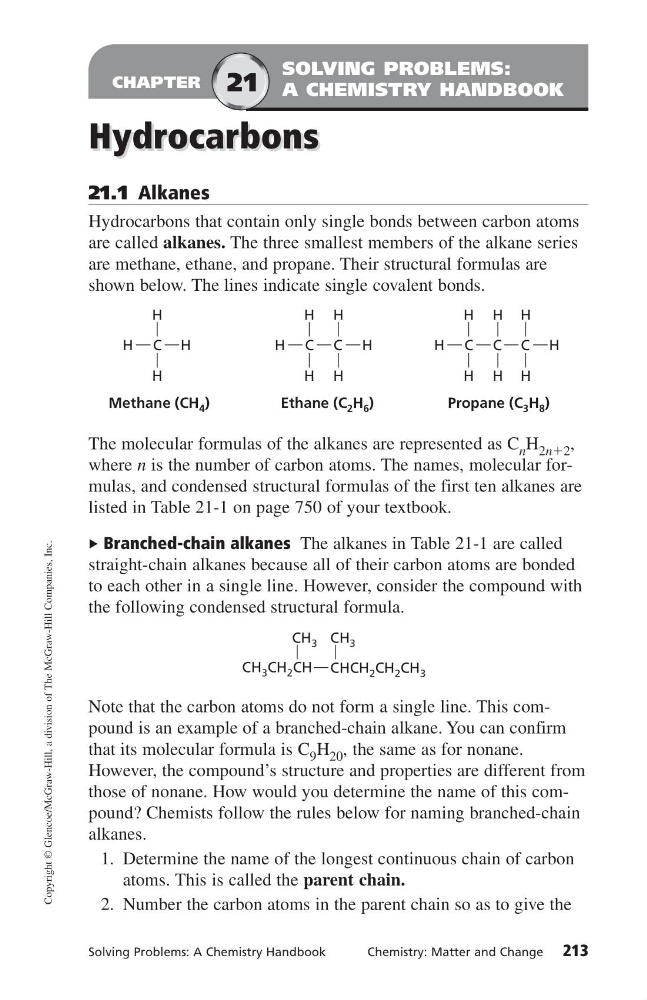
Hydrocarbons that contain only single bonds between carbon atoms
are called alkanes. The three smallest members of the alkane series
are methane, ethane, and propane. Their structural formulas are
shown below. The lines indicate single covalent bonds.
The molecular formulas of the alkanes are represented as C n H 2nϩ2 ,
where n is the number of carbon atoms. The names, molecular formulas, and condensed structural formulas of the first ten alkanes are
listed in Table 21-1 on page 750 of your textbook.
Branched-chain alkanes The alkanes in Table 21-1 are called
straight-chain alkanes because all of their carbon atoms are bonded
to each other in a single line. However, consider the compound with
the following condensed structural formula.
Note that the carbon atoms do not form a single line. This compound is an example of a branched-chain alkane. You can confirm
that its molecular formula is C 9 H 20 , the same as for nonane.
However, the compound’s structure and properties are different from
those of nonane. How would you determine the name of this compound? Chemists follow the rules below for naming branched-chain
alkanes.
1. Determine the name of the longest continuous chain of carbon
atoms. This is called the parent chain.
2. Number the carbon atoms in the parent chain so as to give the
CH 3 CH 2 CH CHCH 2 CH 2 CH 3
CH 3
CH 3
▲
Methane (CH 4 )
H
H
C
H
H
Ethane (C 2 H 6 )
P r opane (C 3 H 8 )
H
C
C
H
H
H
H
H
H
C
C
H
H
H
H
H
C
H
H
Solving Problems: A Chemistry Handbook
Chemistry: Matter and Change
213
Hydrocarbons
Hydrocarbons
SOLVING PROBLEMS:
A CHEMISTRY HANDBOOK
CHAPTER
21
21.1 Alkanes
Hydrocarbons that contain only single bonds between carbon atoms
are called alkanes. The three smallest members of the alkane series
are methane, ethane, and propane. Their structural formulas are
shown below. The lines indicate single covalent bonds.
The molecular formulas of the alkanes are represented as C n H 2nϩ2 ,
where n is the number of carbon atoms. The names, molecular formulas, and condensed structural formulas of the first ten alkanes are
listed in Table 21-1 on page 750 of your textbook.
Branched-chain alkanes The alkanes in Table 21-1 are called
straight-chain alkanes because all of their carbon atoms are bonded
to each other in a single line. However, consider the compound with
the following condensed structural formula.
Note that the carbon atoms do not form a single line. This compound is an example of a branched-chain alkane. You can confirm
that its molecular formula is C 9 H 20 , the same as for nonane.
However, the compound’s structure and properties are different from
those of nonane. How would you determine the name of this compound? Chemists follow the rules below for naming branched-chain
alkanes.
1. Determine the name of the longest continuous chain of carbon
atoms. This is called the parent chain.
2. Number the carbon atoms in the parent chain so as to give the
CH 3 CH 2 CH CHCH 2 CH 2 CH 3
CH 3
CH 3
▲
Methane (CH 4 )
H
H
C
H
H
Ethane (C 2 H 6 )
P r opane (C 3 H 8 )
H
C
C
H
H
H
H
H
H
C
C
H
H
H
H
H
C
H
H