

Copyright © Glencoe/McGraw-Hill, a division of The McGraw-Hill Companies, Inc.
174 Chemistry: Matter and Change
Solving Problems: A Chemistry Handbook
SOLVING PROBLEMS:
A CHEMISTRY HANDBOOK
CHAPTER 17
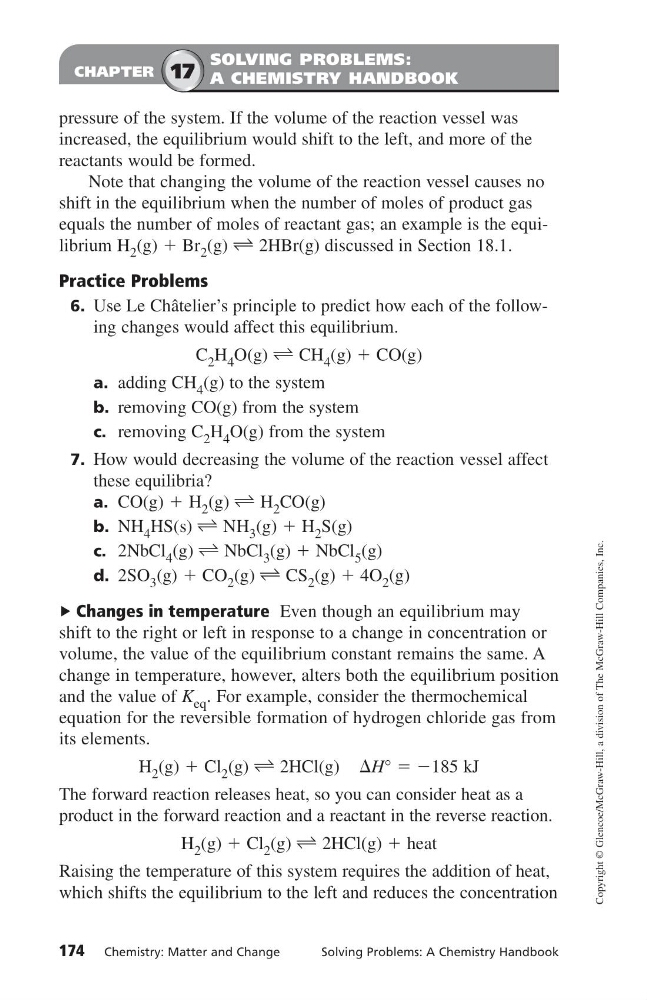
pressure of the system. If the volume of the reaction vessel was
increased, the equilibrium would shift to the left, and more of the
reactants would be formed.
Note that changing the volume of the reaction vessel causes no
shift in the equilibrium when the number of moles of product gas
equals the number of moles of reactant gas; an example is the equilibrium H 2 (g) ϩ Br 2 (g) 3 2HBr(g) discussed in Section 18.1.
Practice Problems
6. Use Le Châtelier’s principle to predict how each of the following changes would affect this equilibrium.
C 2 H 4 O(g) 3 CH 4 (g) ϩ CO(g)
a. adding CH 4 (g) to the system
b. removing CO(g) from the system
c. removing C 2 H 4 O(g) from the system
7. How would decreasing the volume of the reaction vessel affect
these equilibria?
a. CO(g) ϩ H 2 (g) 3 H 2 CO(g)
b. NH 4 HS(s) 3 NH 3 (g) ϩ H 2 S(g)
c. 2NbCl 4 (g) 3 NbCl 3 (g) ϩ NbCl 5 (g)
d. 2SO 3 (g) ϩ CO 2 (g) 3 CS 2 (g) ϩ 4O 2 (g)
Changes in temperature Even though an equilibrium may
shift to the right or left in response to a change in concentration or
volume, the value of the equilibrium constant remains the same. A
change in temperature, however, alters both the equilibrium position
and the value of K eq . For example, consider the thermochemical
equation for the reversible formation of hydrogen chloride gas from
its elements.
H 2 (g) ϩ Cl 2 (g) 3 2HCl(g) ⌬H° ϭ Ϫ185 kJ
The forward reaction releases heat, so you can consider heat as a
product in the forward reaction and a reactant in the reverse reaction.
H 2 (g) ϩ Cl 2 (g) 3 2HCl(g) ϩ heat
Raising the temperature of this system requires the addition of heat,
which shifts the equilibrium to the left and reduces the concentration
▲
174 Chemistry: Matter and Change
Solving Problems: A Chemistry Handbook
SOLVING PROBLEMS:
A CHEMISTRY HANDBOOK
CHAPTER 17
pressure of the system. If the volume of the reaction vessel was
increased, the equilibrium would shift to the left, and more of the
reactants would be formed.
Note that changing the volume of the reaction vessel causes no
shift in the equilibrium when the number of moles of product gas
equals the number of moles of reactant gas; an example is the equilibrium H 2 (g) ϩ Br 2 (g) 3 2HBr(g) discussed in Section 18.1.
Practice Problems
6. Use Le Châtelier’s principle to predict how each of the following changes would affect this equilibrium.
C 2 H 4 O(g) 3 CH 4 (g) ϩ CO(g)
a. adding CH 4 (g) to the system
b. removing CO(g) from the system
c. removing C 2 H 4 O(g) from the system
7. How would decreasing the volume of the reaction vessel affect
these equilibria?
a. CO(g) ϩ H 2 (g) 3 H 2 CO(g)
b. NH 4 HS(s) 3 NH 3 (g) ϩ H 2 S(g)
c. 2NbCl 4 (g) 3 NbCl 3 (g) ϩ NbCl 5 (g)
d. 2SO 3 (g) ϩ CO 2 (g) 3 CS 2 (g) ϩ 4O 2 (g)
Changes in temperature Even though an equilibrium may
shift to the right or left in response to a change in concentration or
volume, the value of the equilibrium constant remains the same. A
change in temperature, however, alters both the equilibrium position
and the value of K eq . For example, consider the thermochemical
equation for the reversible formation of hydrogen chloride gas from
its elements.
H 2 (g) ϩ Cl 2 (g) 3 2HCl(g) ⌬H° ϭ Ϫ185 kJ
The forward reaction releases heat, so you can consider heat as a
product in the forward reaction and a reactant in the reverse reaction.
H 2 (g) ϩ Cl 2 (g) 3 2HCl(g) ϩ heat
Raising the temperature of this system requires the addition of heat,
which shifts the equilibrium to the left and reduces the concentration
▲