

Copyright © Glencoe/McGraw-Hill, a division of The McGraw-Hill Companies, Inc.
Solving Problems: A Chemistry Handbook
Chemistry: Matter and Change
173
SOLVING PROBLEMS:
A CHEMISTRY HANDBOOK
CHAPTER 17
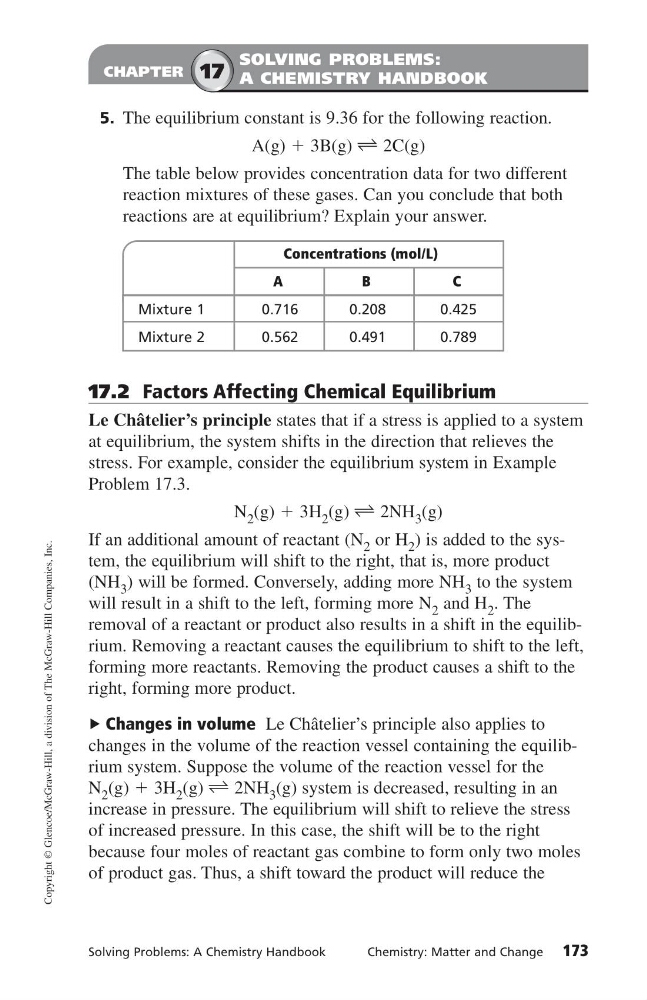
5. The equilibrium constant is 9.36 for the following reaction.
A(g) ϩ 3B(g) 3 2C(g)
The table below provides concentration data for two different
reaction mixtures of these gases. Can you conclude that both
reactions are at equilibrium? Explain your answer.
17.2 Factors Affecting Chemical Equilibrium
Le Châtelier’s principle states that if a stress is applied to a system
at equilibrium, the system shifts in the direction that relieves the
stress. For example, consider the equilibrium system in Example
Problem 17.3.
N 2 (g) ϩ 3H 2 (g) 3 2NH 3 (g)
If an additional amount of reactant (N 2 or H 2 ) is added to the system, the equilibrium will shift to the right, that is, more product
(NH 3 ) will be formed. Conversely, adding more NH 3 to the system
will result in a shift to the left, forming more N 2 and H 2 . The
removal of a reactant or product also results in a shift in the equilibrium. Removing a reactant causes the equilibrium to shift to the left,
forming more reactants. Removing the product causes a shift to the
right, forming more product.
Changes in volume Le Châtelier’s principle also applies to
changes in the volume of the reaction vessel containing the equilibrium system. Suppose the volume of the reaction vessel for the
N 2 (g) ϩ 3H 2 (g) 3 2NH 3 (g) system is decreased, resulting in an
increase in pressure. The equilibrium will shift to relieve the stress
of increased pressure. In this case, the shift will be to the right
because four moles of reactant gas combine to form only two moles
of product gas. Thus, a shift toward the product will reduce the
▲
Concentrations (mol/L)
A
B
C
Mixture 1
0.716
0.208
0.425
Mixture 2
0.562
0.491
0.789
Solving Problems: A Chemistry Handbook
Chemistry: Matter and Change
173
SOLVING PROBLEMS:
A CHEMISTRY HANDBOOK
CHAPTER 17
5. The equilibrium constant is 9.36 for the following reaction.
A(g) ϩ 3B(g) 3 2C(g)
The table below provides concentration data for two different
reaction mixtures of these gases. Can you conclude that both
reactions are at equilibrium? Explain your answer.
17.2 Factors Affecting Chemical Equilibrium
Le Châtelier’s principle states that if a stress is applied to a system
at equilibrium, the system shifts in the direction that relieves the
stress. For example, consider the equilibrium system in Example
Problem 17.3.
N 2 (g) ϩ 3H 2 (g) 3 2NH 3 (g)
If an additional amount of reactant (N 2 or H 2 ) is added to the system, the equilibrium will shift to the right, that is, more product
(NH 3 ) will be formed. Conversely, adding more NH 3 to the system
will result in a shift to the left, forming more N 2 and H 2 . The
removal of a reactant or product also results in a shift in the equilibrium. Removing a reactant causes the equilibrium to shift to the left,
forming more reactants. Removing the product causes a shift to the
right, forming more product.
Changes in volume Le Châtelier’s principle also applies to
changes in the volume of the reaction vessel containing the equilibrium system. Suppose the volume of the reaction vessel for the
N 2 (g) ϩ 3H 2 (g) 3 2NH 3 (g) system is decreased, resulting in an
increase in pressure. The equilibrium will shift to relieve the stress
of increased pressure. In this case, the shift will be to the right
because four moles of reactant gas combine to form only two moles
of product gas. Thus, a shift toward the product will reduce the
▲
Concentrations (mol/L)
A
B
C
Mixture 1
0.716
0.208
0.425
Mixture 2
0.562
0.491
0.789