

Copyright © Glencoe/McGraw-Hill, a division of The McGraw-Hill Companies, Inc.
Solving Problems: A Chemistry Handbook
Chemistry: Matter and Change
167
SOLVING PROBLEMS:
A CHEMISTRY HANDBOOK
CHAPTER 16
Practice Problems
9. The rate law for a reaction A ϩ B 0 AB is rate ϭ k[A][B].
What happens to the rate if the concentration of B is tripled
while [A] remains the same? If the concentration of A is halved
while [B] remains the same?
10. The rate law for a reaction 2X ϩ Y 0 X 2 Y is rate ϭ k[X][Y] 2 .
What happens to the rate if the concentration of X is doubled
while [Y] remains the same? If the concentration of Y is tripled
while [X] remains the same?
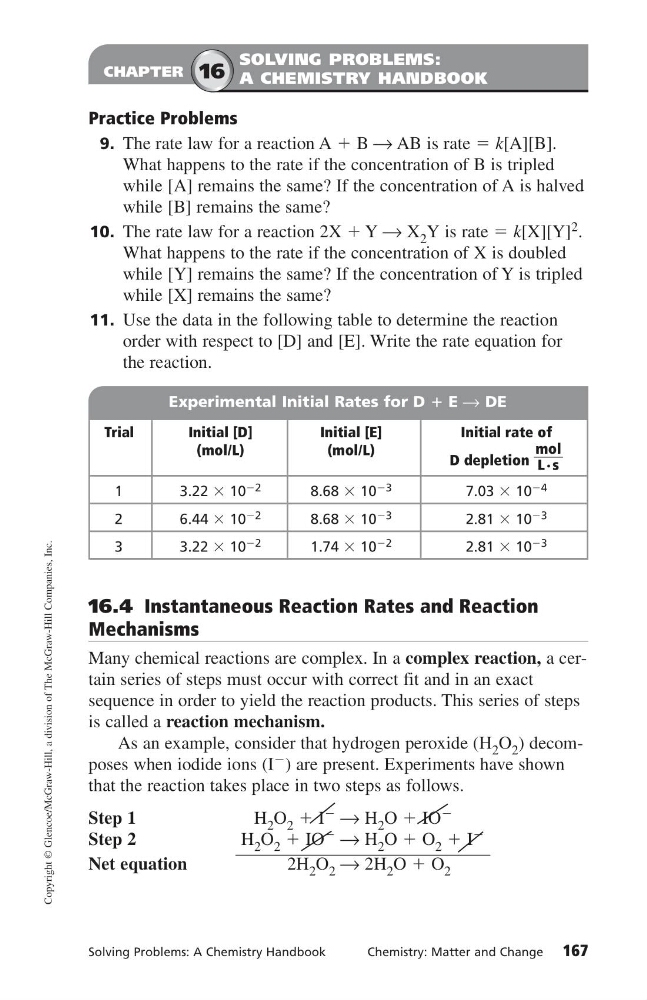
11. Use the data in the following table to determine the reaction
order with respect to [D] and [E]. Write the rate equation for
the reaction.
16.4 Instantaneous Reaction Rates and Reaction
Mechanisms
Many chemical reactions are complex. In a complex reaction, a certain series of steps must occur with correct fit and in an exact
sequence in order to yield the reaction products. This series of steps
is called a reaction mechanism.
As an example, consider that hydrogen peroxide (H 2 O 2 ) decomposes when iodide ions (I Ϫ ) are present. Experiments have shown
that the reaction takes place in two steps as follows.
Step 1
H 2 O 2 ϩ I Ϫ 0 H 2 O ϩ IO Ϫ
Step 2
H 2 O 2 ϩ IO Ϫ 0 H 2 O ϩ O 2 ϩ I Ϫ
Net equation
2H 2 O 2 0 2H 2 O ϩ O 2
Experimental Initial Rates for D ؉ E 0 DE
Trial
Initial [D]
Initial [E]
Initial rate of
(mol/L)
(mol/L)
D depletion ᎏ
m
L и
o
s
l
ᎏ
1
3 . 22 ϫ 10 Ϫ2
8.68 ϫ 10 Ϫ3
7.03 ϫ 10 Ϫ4
2
6 . 44 ϫ 10 Ϫ2
8.68 ϫ 10 Ϫ3
2.81 ϫ 10 Ϫ3
3
3 . 22 ϫ 10 Ϫ2
1.74 ϫ 10 Ϫ2
2.81 ϫ 10 Ϫ3
Solving Problems: A Chemistry Handbook
Chemistry: Matter and Change
167
SOLVING PROBLEMS:
A CHEMISTRY HANDBOOK
CHAPTER 16
Practice Problems
9. The rate law for a reaction A ϩ B 0 AB is rate ϭ k[A][B].
What happens to the rate if the concentration of B is tripled
while [A] remains the same? If the concentration of A is halved
while [B] remains the same?
10. The rate law for a reaction 2X ϩ Y 0 X 2 Y is rate ϭ k[X][Y] 2 .
What happens to the rate if the concentration of X is doubled
while [Y] remains the same? If the concentration of Y is tripled
while [X] remains the same?
11. Use the data in the following table to determine the reaction
order with respect to [D] and [E]. Write the rate equation for
the reaction.
16.4 Instantaneous Reaction Rates and Reaction
Mechanisms
Many chemical reactions are complex. In a complex reaction, a certain series of steps must occur with correct fit and in an exact
sequence in order to yield the reaction products. This series of steps
is called a reaction mechanism.
As an example, consider that hydrogen peroxide (H 2 O 2 ) decomposes when iodide ions (I Ϫ ) are present. Experiments have shown
that the reaction takes place in two steps as follows.
Step 1
H 2 O 2 ϩ I Ϫ 0 H 2 O ϩ IO Ϫ
Step 2
H 2 O 2 ϩ IO Ϫ 0 H 2 O ϩ O 2 ϩ I Ϫ
Net equation
2H 2 O 2 0 2H 2 O ϩ O 2
Experimental Initial Rates for D ؉ E 0 DE
Trial
Initial [D]
Initial [E]
Initial rate of
(mol/L)
(mol/L)
D depletion ᎏ
m
L и
o
s
l
ᎏ
1
3 . 22 ϫ 10 Ϫ2
8.68 ϫ 10 Ϫ3
7.03 ϫ 10 Ϫ4
2
6 . 44 ϫ 10 Ϫ2
8.68 ϫ 10 Ϫ3
2.81 ϫ 10 Ϫ3
3
3 . 22 ϫ 10 Ϫ2
1.74 ϫ 10 Ϫ2
2.81 ϫ 10 Ϫ3