

Copyright © Glencoe/McGraw-Hill, a division of The McGraw-Hill Companies, Inc.
166 Chemistry: Matter and Change
Solving Problems: A Chemistry Handbook
SOLVING PROBLEMS:
A CHEMISTRY HANDBOOK
CHAPTER 16
Example Problem 16-2
Determining Rate Laws
Use the data in the table below to determine the form of the rate law
for the following reaction.
2NO(g) ϩ H 2 (g) 0 N 2 (g) ϩ 2H 2 O(g)
The general rate law for this type of reaction is as follows.
Rate ϭ k[A] m [B] n
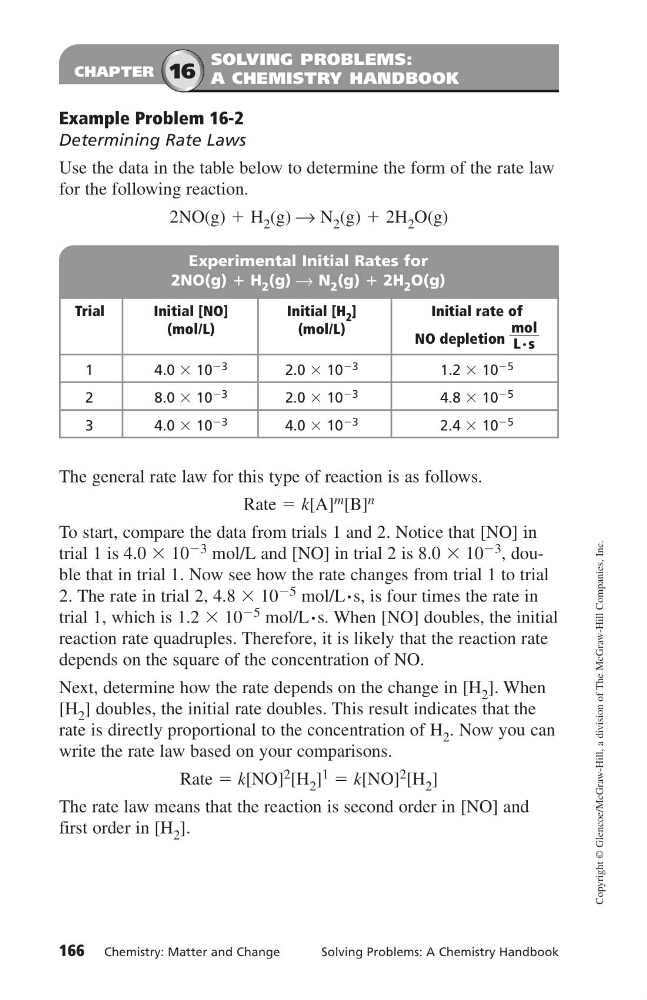
To start, compare the data from trials 1 and 2. Notice that [NO] in
trial 1 is 4.0 ϫ 10 Ϫ3 mol/L and [NO] in trial 2 is 8.0 ϫ 10 Ϫ3 , double that in trial 1. Now see how the rate changes from trial 1 to trial
2. The rate in trial 2, 4.8 ϫ 10 Ϫ5 mol/L и s, is four times the rate in
trial 1, which is 1.2 ϫ 10 Ϫ5 mol/L и s. When [NO] doubles, the initial
reaction rate quadruples. Therefore, it is likely that the reaction rate
depends on the square of the concentration of NO.
Next, determine how the rate depends on the change in [H 2 ]. When
[H 2 ] doubles, the initial rate doubles. This result indicates that the
rate is directly proportional to the concentration of H 2 . Now you can
write the rate law based on your comparisons.
Rate ϭ k[NO] 2 [H 2 ] 1 ϭ k[NO] 2 [H 2 ]
The rate law means that the reaction is second order in [NO] and
first order in [H 2 ].
Experimental Initial Rates for
2NO(g) ؉ H 2 (g) 0 N 2 (g) ؉ 2H 2 O(g)
Trial
Initial [NO]
Initial [H 2 ]
Initial rate of
(mol/L)
(mol/L)
NO depletion ᎏ
m
L и
o
s
l
ᎏ
1
4.0 ϫ 10 Ϫ3
2.0 ϫ 10 Ϫ3
1.2 ϫ 10 Ϫ5
2
8.0 ϫ 10 Ϫ3
2.0 ϫ 10 Ϫ3
4.8 ϫ 10 Ϫ5
3
4.0 ϫ 10 Ϫ3
4.0 ϫ 10 Ϫ3
2.4 ϫ 10 Ϫ5
166 Chemistry: Matter and Change
Solving Problems: A Chemistry Handbook
SOLVING PROBLEMS:
A CHEMISTRY HANDBOOK
CHAPTER 16
Example Problem 16-2
Determining Rate Laws
Use the data in the table below to determine the form of the rate law
for the following reaction.
2NO(g) ϩ H 2 (g) 0 N 2 (g) ϩ 2H 2 O(g)
The general rate law for this type of reaction is as follows.
Rate ϭ k[A] m [B] n
To start, compare the data from trials 1 and 2. Notice that [NO] in
trial 1 is 4.0 ϫ 10 Ϫ3 mol/L and [NO] in trial 2 is 8.0 ϫ 10 Ϫ3 , double that in trial 1. Now see how the rate changes from trial 1 to trial
2. The rate in trial 2, 4.8 ϫ 10 Ϫ5 mol/L и s, is four times the rate in
trial 1, which is 1.2 ϫ 10 Ϫ5 mol/L и s. When [NO] doubles, the initial
reaction rate quadruples. Therefore, it is likely that the reaction rate
depends on the square of the concentration of NO.
Next, determine how the rate depends on the change in [H 2 ]. When
[H 2 ] doubles, the initial rate doubles. This result indicates that the
rate is directly proportional to the concentration of H 2 . Now you can
write the rate law based on your comparisons.
Rate ϭ k[NO] 2 [H 2 ] 1 ϭ k[NO] 2 [H 2 ]
The rate law means that the reaction is second order in [NO] and
first order in [H 2 ].
Experimental Initial Rates for
2NO(g) ؉ H 2 (g) 0 N 2 (g) ؉ 2H 2 O(g)
Trial
Initial [NO]
Initial [H 2 ]
Initial rate of
(mol/L)
(mol/L)
NO depletion ᎏ
m
L и
o
s
l
ᎏ
1
4.0 ϫ 10 Ϫ3
2.0 ϫ 10 Ϫ3
1.2 ϫ 10 Ϫ5
2
8.0 ϫ 10 Ϫ3
2.0 ϫ 10 Ϫ3
4.8 ϫ 10 Ϫ5
3
4.0 ϫ 10 Ϫ3
4.0 ϫ 10 Ϫ3
2.4 ϫ 10 Ϫ5