

Copyright © Glencoe/McGraw-Hill, a division of The McGraw-Hill Companies, Inc.
162 Chemistry: Matter and Change
Solving Problems: A Chemistry Handbook
SOLVING PROBLEMS:
A CHEMISTRY HANDBOOK
CHAPTER 16
Example Problem 16-1
Calculating Average Reaction Rate
Nitrogen monoxide reacts with chlorine gas to form the gaseous
substance nitrosyl chloride according to the following equation.
2NO(g) ϩ Cl 2 (g) 0 2NOCl(g)
At the beginning of the reaction, the concentration of chlorine gas is
0.00640 mol/L. After 30.0 s, the chlorine concentration has
decreased to 0.00295 mol/L. Calculate the average rate of the reaction over this time in terms of the disappearance of chlorine.
First, write the mathematical expression for the average rate based
on the rate of disappearance of the reactant Cl 2 .
Average reaction rate ϭ Ϫ
ϭ Ϫ
Next, substitute the data into the equation.
Average reaction rate ϭ Ϫ
ϭ Ϫ
Average reaction rate ϭ Ϫ
ϭ 0.000115
Cl 2
Practice Problems
Use the following information to solve the problems below.
In aqueous solution, bromine reacts with formic acid (HCOOH) to
produce hydrogen bromide and carbon dioxide gas.
Br 2 (aq) ϩ HCOOH(aq) 0 2HBr(aq) ϩ CO 2 (g)
mol
ᎏ
L и s
Ϫ0.00345 mol/L
ᎏᎏ
30.0 s
0.00295 mol/L Ϫ 0.00640 mol/L
ᎏᎏᎏᎏ
30.0 s Ϫ 0 s
[Cl 2 ] 2 Ϫ [Cl 2 ] 1
ᎏᎏ
t 2 Ϫ t 1
[Cl 2 ] 2 Ϫ [Cl 2 ] 1
ᎏᎏ
t 2 Ϫ t 1
⌬[Cl 2 ]
ᎏ
⌬t
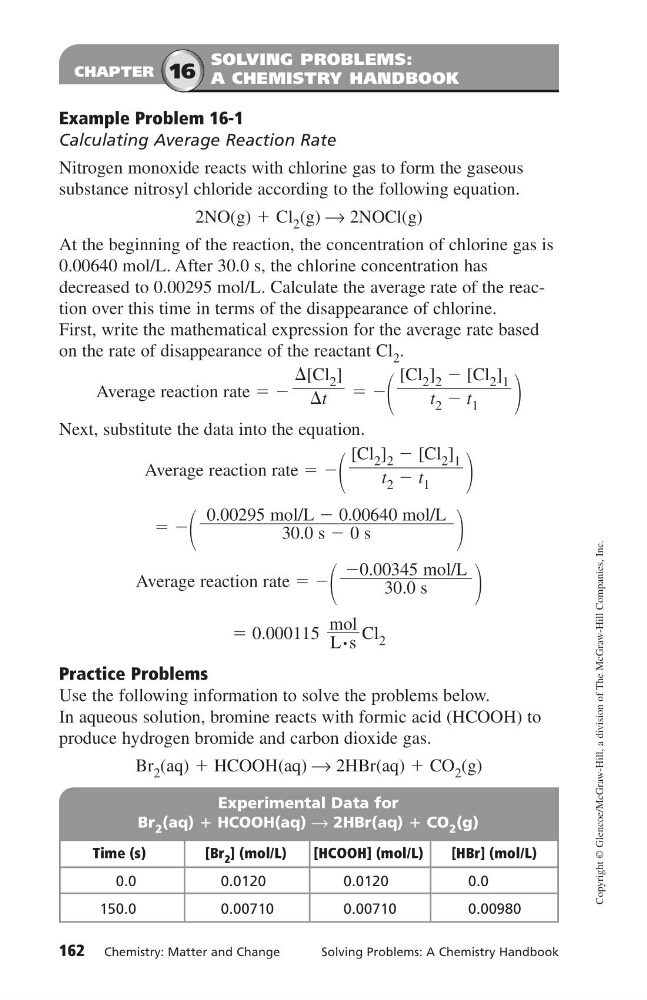
Experimental Data for
Br 2 (aq) ؉ HCOOH(aq) 0 2HBr(aq) ؉ CO 2 (g)
Time (s)
[Br 2 ] (mol/L)
[HCOOH] (mol/L)
[HBr] (mol/L)
0.0
0.0120
0.0120
0.0
150.0
0.00710
0.00710
0.00980
162 Chemistry: Matter and Change
Solving Problems: A Chemistry Handbook
SOLVING PROBLEMS:
A CHEMISTRY HANDBOOK
CHAPTER 16
Example Problem 16-1
Calculating Average Reaction Rate
Nitrogen monoxide reacts with chlorine gas to form the gaseous
substance nitrosyl chloride according to the following equation.
2NO(g) ϩ Cl 2 (g) 0 2NOCl(g)
At the beginning of the reaction, the concentration of chlorine gas is
0.00640 mol/L. After 30.0 s, the chlorine concentration has
decreased to 0.00295 mol/L. Calculate the average rate of the reaction over this time in terms of the disappearance of chlorine.
First, write the mathematical expression for the average rate based
on the rate of disappearance of the reactant Cl 2 .
Average reaction rate ϭ Ϫ
ϭ Ϫ
Next, substitute the data into the equation.
Average reaction rate ϭ Ϫ
ϭ Ϫ
Average reaction rate ϭ Ϫ
ϭ 0.000115
Cl 2
Practice Problems
Use the following information to solve the problems below.
In aqueous solution, bromine reacts with formic acid (HCOOH) to
produce hydrogen bromide and carbon dioxide gas.
Br 2 (aq) ϩ HCOOH(aq) 0 2HBr(aq) ϩ CO 2 (g)
mol
ᎏ
L и s
Ϫ0.00345 mol/L
ᎏᎏ
30.0 s
0.00295 mol/L Ϫ 0.00640 mol/L
ᎏᎏᎏᎏ
30.0 s Ϫ 0 s
[Cl 2 ] 2 Ϫ [Cl 2 ] 1
ᎏᎏ
t 2 Ϫ t 1
[Cl 2 ] 2 Ϫ [Cl 2 ] 1
ᎏᎏ
t 2 Ϫ t 1
⌬[Cl 2 ]
ᎏ
⌬t
Experimental Data for
Br 2 (aq) ؉ HCOOH(aq) 0 2HBr(aq) ؉ CO 2 (g)
Time (s)
[Br 2 ] (mol/L)
[HCOOH] (mol/L)
[HBr] (mol/L)
0.0
0.0120
0.0120
0.0
150.0
0.00710
0.00710
0.00980