

Copyright © Glencoe/McGraw-Hill, a division of The McGraw-Hill Companies, Inc.
Solving Problems: A Chemistry Handbook
Chemistry: Matter and Change
161
Reaction Rates
Reaction Rates
SOLVING PROBLEMS:
A CHEMISTRY HANDBOOK
CHAPTER
16
16.1 A Model for Reaction Rates
To determine the average rate of a process, you must know how
much a quantity changes over time. The Greek letter delta (⌬) is the
mathematical symbol for “change in.”
Average rate of a process ϭ
ϭ
Average Reaction Rates Consider a reaction between carbon
monoxide and nitrogen dioxide gas to form nitrogen monoxide and
carbon dioxide.
CO(g) ϩ NO 2 (g) 0 NO(g) ϩ CO 2 (g)
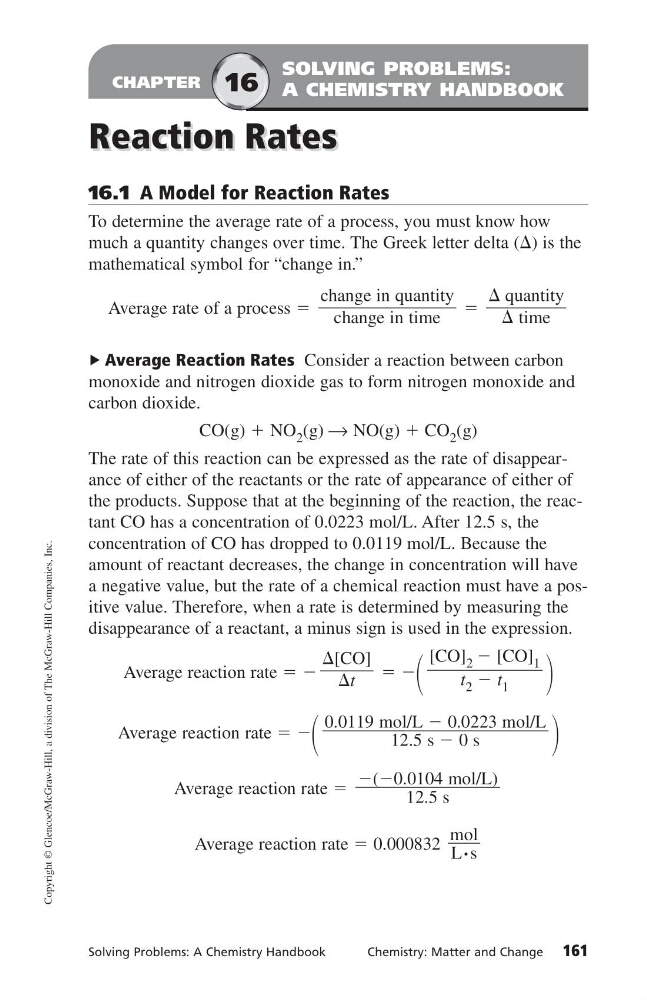
The rate of this reaction can be expressed as the rate of disappearance of either of the reactants or the rate of appearance of either of
the products. Suppose that at the beginning of the reaction, the reactant CO has a concentration of 0.0223 mol/L. After 12.5 s, the
concentration of CO has dropped to 0.0119 mol/L. Because the
amount of reactant decreases, the change in concentration will have
a negative value, but the rate of a chemical reaction must have a positive value. Therefore, when a rate is determined by measuring the
disappearance of a reactant, a minus sign is used in the expression.
Average reaction rate ϭ Ϫ
ϭ Ϫ
Average reaction rate ϭ Ϫ
Average reaction rate ϭ
Average reaction rate ϭ 0.000832
mol
ᎏ
L и s
Ϫ(Ϫ0.0104 mol/L)
ᎏᎏᎏ
12.5 s
0.0119 mol/L Ϫ 0.0223 mol/L
ᎏᎏᎏᎏ
12.5 s Ϫ 0 s
[CO] 2 Ϫ [CO] 1
ᎏᎏ
t 2 Ϫ t 1
⌬[CO]
ᎏ
⌬t
▲
⌬ quantity
ᎏᎏ
⌬ time
change in quantity
ᎏᎏ
change in time
Solving Problems: A Chemistry Handbook
Chemistry: Matter and Change
161
Reaction Rates
Reaction Rates
SOLVING PROBLEMS:
A CHEMISTRY HANDBOOK
CHAPTER
16
16.1 A Model for Reaction Rates
To determine the average rate of a process, you must know how
much a quantity changes over time. The Greek letter delta (⌬) is the
mathematical symbol for “change in.”
Average rate of a process ϭ
ϭ
Average Reaction Rates Consider a reaction between carbon
monoxide and nitrogen dioxide gas to form nitrogen monoxide and
carbon dioxide.
CO(g) ϩ NO 2 (g) 0 NO(g) ϩ CO 2 (g)
The rate of this reaction can be expressed as the rate of disappearance of either of the reactants or the rate of appearance of either of
the products. Suppose that at the beginning of the reaction, the reactant CO has a concentration of 0.0223 mol/L. After 12.5 s, the
concentration of CO has dropped to 0.0119 mol/L. Because the
amount of reactant decreases, the change in concentration will have
a negative value, but the rate of a chemical reaction must have a positive value. Therefore, when a rate is determined by measuring the
disappearance of a reactant, a minus sign is used in the expression.
Average reaction rate ϭ Ϫ
ϭ Ϫ
Average reaction rate ϭ Ϫ
Average reaction rate ϭ
Average reaction rate ϭ 0.000832
mol
ᎏ
L и s
Ϫ(Ϫ0.0104 mol/L)
ᎏᎏᎏ
12.5 s
0.0119 mol/L Ϫ 0.0223 mol/L
ᎏᎏᎏᎏ
12.5 s Ϫ 0 s
[CO] 2 Ϫ [CO] 1
ᎏᎏ
t 2 Ϫ t 1
⌬[CO]
ᎏ
⌬t
▲
⌬ quantity
ᎏᎏ
⌬ time
change in quantity
ᎏᎏ
change in time