

Copyright © Glencoe/McGraw-Hill, a division of The McGraw-Hill Companies, Inc.
156 Chemistry: Matter and Change
Solving Problems: A Chemistry Handbook
SOLVING PROBLEMS:
A CHEMISTRY HANDBOOK
CHAPTER 15
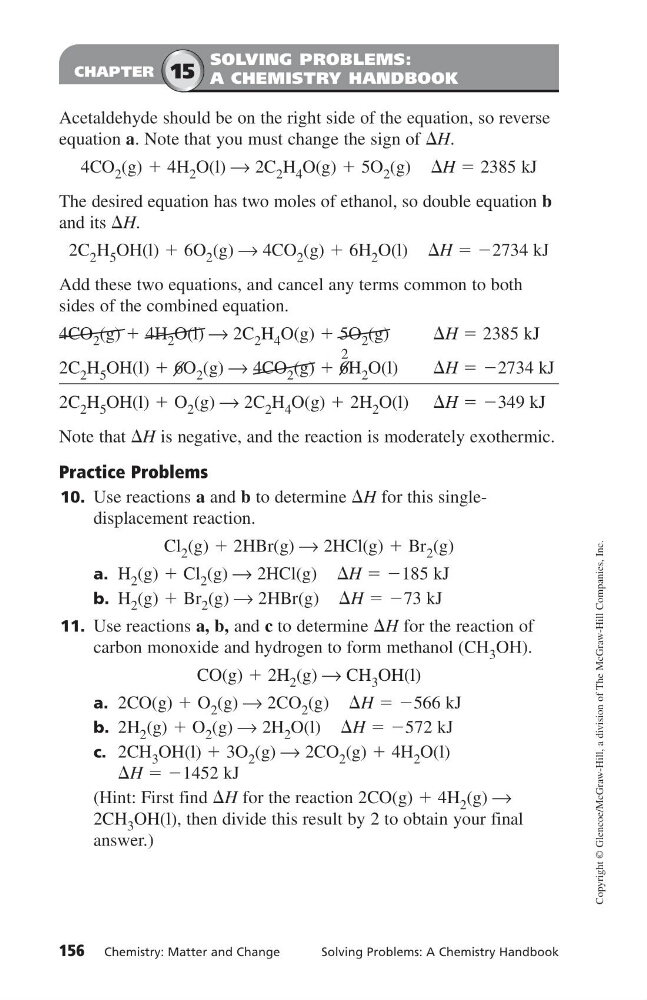
Acetaldehyde should be on the right side of the equation, so reverse
equation a. Note that you must change the sign of ⌬H.
4CO 2 (g) ϩ 4H 2 O(l) 0 2C 2 H 4 O(g) ϩ 5O 2 (g) ⌬H ϭ 2385 kJ
The desired equation has two moles of ethanol, so double equation b
and its ⌬H.
2C 2 H 5 OH(l) ϩ 6O 2 (g) 0 4CO 2 (g) ϩ 6H 2 O(l) ⌬H ϭ Ϫ2734 kJ
Add these two equations, and cancel any terms common to both
sides of the combined equation.
4CO 2 (g) ϩ 4H 2 O(l) 0 2C 2 H 4 O(g) ϩ 5O 2 (g)
⌬H ϭ 2385 kJ
2C 2 H 5 OH(l) ϩ 6O 2 (g) 0 4CO 2 (g) ϩ 6H 2 O(l)
⌬H ϭ Ϫ2734 kJ
2C 2 H 5 OH(l) ϩ O 2 (g) 0 2C 2 H 4 O(g) ϩ 2H 2 O(l) ⌬H ϭ Ϫ349 kJ
Note that ⌬H is negative, and the reaction is moderately exothermic.
Practice Problems
10. Use reactions a and b to determine ⌬H for this singledisplacement reaction.
Cl 2 (g) ϩ 2HBr(g) 0 2HCl(g) ϩ Br 2 (g)
a. H 2 (g) ϩ Cl 2 (g) 0 2HCl(g) ⌬H ϭ Ϫ185 kJ
b. H 2 (g) ϩ Br 2 (g) 0 2HBr(g) ⌬H ϭ Ϫ73 kJ
11. Use reactions a, b, and c to determine ⌬H for the reaction of
carbon monoxide and hydrogen to form methanol (CH 3 OH).
CO(g) ϩ 2H 2 (g) 0 CH 3 OH(l)
a. 2CO(g) ϩ O 2 (g) 0 2CO 2 (g) ⌬H ϭ Ϫ566 kJ
b. 2H 2 (g) ϩ O 2 (g) 0 2H 2 O(l) ⌬H ϭ Ϫ572 kJ
c. 2CH 3 OH(l) ϩ 3O 2 (g) 0 2CO 2 (g) ϩ 4H 2 O(l)
⌬H ϭ Ϫ1452 kJ
(Hint: First find ⌬H for the reaction 2CO(g) ϩ 4H 2 (g) 0
2CH 3 OH(l), then divide this result by 2 to obtain your final
answer.)
2
156 Chemistry: Matter and Change
Solving Problems: A Chemistry Handbook
SOLVING PROBLEMS:
A CHEMISTRY HANDBOOK
CHAPTER 15
Acetaldehyde should be on the right side of the equation, so reverse
equation a. Note that you must change the sign of ⌬H.
4CO 2 (g) ϩ 4H 2 O(l) 0 2C 2 H 4 O(g) ϩ 5O 2 (g) ⌬H ϭ 2385 kJ
The desired equation has two moles of ethanol, so double equation b
and its ⌬H.
2C 2 H 5 OH(l) ϩ 6O 2 (g) 0 4CO 2 (g) ϩ 6H 2 O(l) ⌬H ϭ Ϫ2734 kJ
Add these two equations, and cancel any terms common to both
sides of the combined equation.
4CO 2 (g) ϩ 4H 2 O(l) 0 2C 2 H 4 O(g) ϩ 5O 2 (g)
⌬H ϭ 2385 kJ
2C 2 H 5 OH(l) ϩ 6O 2 (g) 0 4CO 2 (g) ϩ 6H 2 O(l)
⌬H ϭ Ϫ2734 kJ
2C 2 H 5 OH(l) ϩ O 2 (g) 0 2C 2 H 4 O(g) ϩ 2H 2 O(l) ⌬H ϭ Ϫ349 kJ
Note that ⌬H is negative, and the reaction is moderately exothermic.
Practice Problems
10. Use reactions a and b to determine ⌬H for this singledisplacement reaction.
Cl 2 (g) ϩ 2HBr(g) 0 2HCl(g) ϩ Br 2 (g)
a. H 2 (g) ϩ Cl 2 (g) 0 2HCl(g) ⌬H ϭ Ϫ185 kJ
b. H 2 (g) ϩ Br 2 (g) 0 2HBr(g) ⌬H ϭ Ϫ73 kJ
11. Use reactions a, b, and c to determine ⌬H for the reaction of
carbon monoxide and hydrogen to form methanol (CH 3 OH).
CO(g) ϩ 2H 2 (g) 0 CH 3 OH(l)
a. 2CO(g) ϩ O 2 (g) 0 2CO 2 (g) ⌬H ϭ Ϫ566 kJ
b. 2H 2 (g) ϩ O 2 (g) 0 2H 2 O(l) ⌬H ϭ Ϫ572 kJ
c. 2CH 3 OH(l) ϩ 3O 2 (g) 0 2CO 2 (g) ϩ 4H 2 O(l)
⌬H ϭ Ϫ1452 kJ
(Hint: First find ⌬H for the reaction 2CO(g) ϩ 4H 2 (g) 0
2CH 3 OH(l), then divide this result by 2 to obtain your final
answer.)
2