

Copyright © Glencoe/McGraw-Hill, a division of The McGraw-Hill Companies, Inc.
Solving Problems: A Chemistry Handbook
Chemistry: Matter and Change
155
SOLVING PROBLEMS:
A CHEMISTRY HANDBOOK
CHAPTER 15
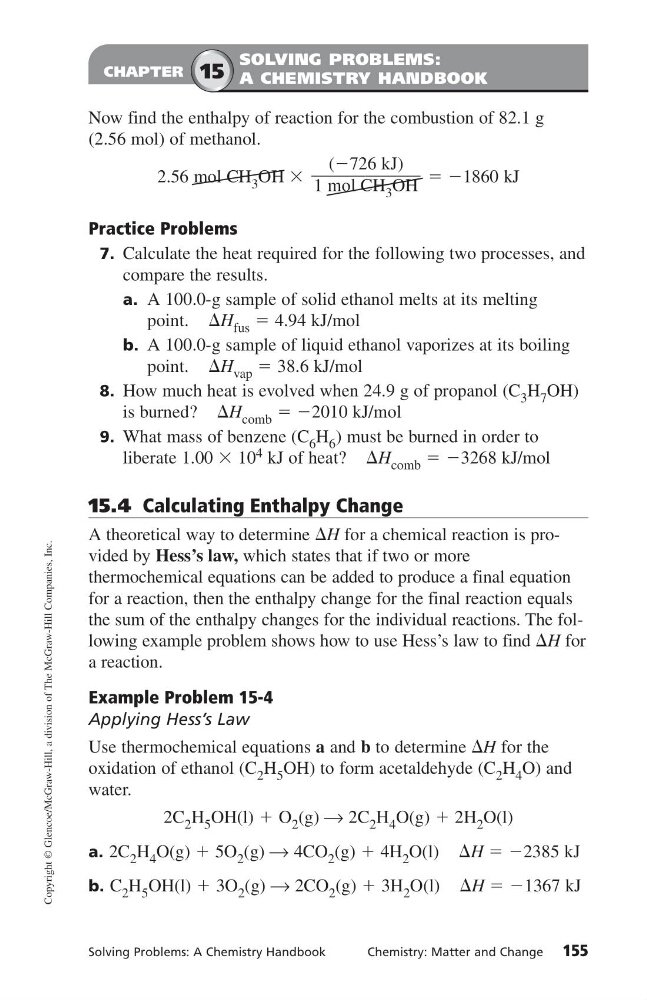
Now find the enthalpy of reaction for the combustion of 82.1 g
(2.56 mol) of methanol.
2.56 mol CH 3 OH ϫ
ϭ Ϫ 1860 kJ
Practice Problems
7. Calculate the heat required for the following two processes, and
compare the results.
a. A 100.0-g sample of solid ethanol melts at its melting
point. ⌬H fus ϭ 4.94 kJ/mol
b. A 100.0-g sample of liquid ethanol vaporizes at its boiling
point. ⌬H vap ϭ 38.6 kJ/mol
8. How much heat is evolved when 24.9 g of propanol (C 3 H 7 OH)
is burned? ⌬H comb ϭ Ϫ2010 kJ/mol
9. What mass of benzene (C 6 H 6 ) must be burned in order to
liberate 1.00 ϫ 10 4 kJ of heat? ⌬H comb ϭ Ϫ3268 kJ/mol
15.4 Calculating Enthalpy Change
A theoretical way to determine ⌬H for a chemical reaction is provided by Hess’s law, which states that if two or more
thermochemical equations can be added to produce a final equation
for a reaction, then the enthalpy change for the final reaction equals
the sum of the enthalpy changes for the individual reactions. The following example problem shows how to use Hess’s law to find ⌬H for
a reaction.
Example Problem 15-4
Applying Hess’s Law
Use thermochemical equations a and b to determine ⌬H for the
oxidation of ethanol (C 2 H 5 OH) to form acetaldehyde (C 2 H 4 O) and
water.
2C 2 H 5 OH(l) ϩ O 2 (g) 0 2C 2 H 4 O(g) ϩ 2H 2 O(l)
a. 2C 2 H 4 O(g) ϩ 5O 2 (g) 0 4CO 2 (g) ϩ 4H 2 O(l) ⌬H ϭ Ϫ2385 kJ
b. C 2 H 5 OH(l) ϩ 3O 2 (g) 0 2CO 2 (g) ϩ 3H 2 O(l) ⌬H ϭ Ϫ1367 kJ
(Ϫ726 kJ)
ᎏᎏ
1 mol CH 3 OH
Solving Problems: A Chemistry Handbook
Chemistry: Matter and Change
155
SOLVING PROBLEMS:
A CHEMISTRY HANDBOOK
CHAPTER 15
Now find the enthalpy of reaction for the combustion of 82.1 g
(2.56 mol) of methanol.
2.56 mol CH 3 OH ϫ
ϭ Ϫ 1860 kJ
Practice Problems
7. Calculate the heat required for the following two processes, and
compare the results.
a. A 100.0-g sample of solid ethanol melts at its melting
point. ⌬H fus ϭ 4.94 kJ/mol
b. A 100.0-g sample of liquid ethanol vaporizes at its boiling
point. ⌬H vap ϭ 38.6 kJ/mol
8. How much heat is evolved when 24.9 g of propanol (C 3 H 7 OH)
is burned? ⌬H comb ϭ Ϫ2010 kJ/mol
9. What mass of benzene (C 6 H 6 ) must be burned in order to
liberate 1.00 ϫ 10 4 kJ of heat? ⌬H comb ϭ Ϫ3268 kJ/mol
15.4 Calculating Enthalpy Change
A theoretical way to determine ⌬H for a chemical reaction is provided by Hess’s law, which states that if two or more
thermochemical equations can be added to produce a final equation
for a reaction, then the enthalpy change for the final reaction equals
the sum of the enthalpy changes for the individual reactions. The following example problem shows how to use Hess’s law to find ⌬H for
a reaction.
Example Problem 15-4
Applying Hess’s Law
Use thermochemical equations a and b to determine ⌬H for the
oxidation of ethanol (C 2 H 5 OH) to form acetaldehyde (C 2 H 4 O) and
water.
2C 2 H 5 OH(l) ϩ O 2 (g) 0 2C 2 H 4 O(g) ϩ 2H 2 O(l)
a. 2C 2 H 4 O(g) ϩ 5O 2 (g) 0 4CO 2 (g) ϩ 4H 2 O(l) ⌬H ϭ Ϫ2385 kJ
b. C 2 H 5 OH(l) ϩ 3O 2 (g) 0 2CO 2 (g) ϩ 3H 2 O(l) ⌬H ϭ Ϫ1367 kJ
(Ϫ726 kJ)
ᎏᎏ
1 mol CH 3 OH