

Copyright © Glencoe/McGraw-Hill, a division of The McGraw-Hill Companies, Inc.
Solving Problems: A Chemistry Handbook
Chemistry: Matter and Change
107
SOLVING PROBLEMS:
A CHEMISTRY HANDBOOK
CHAPTER 11
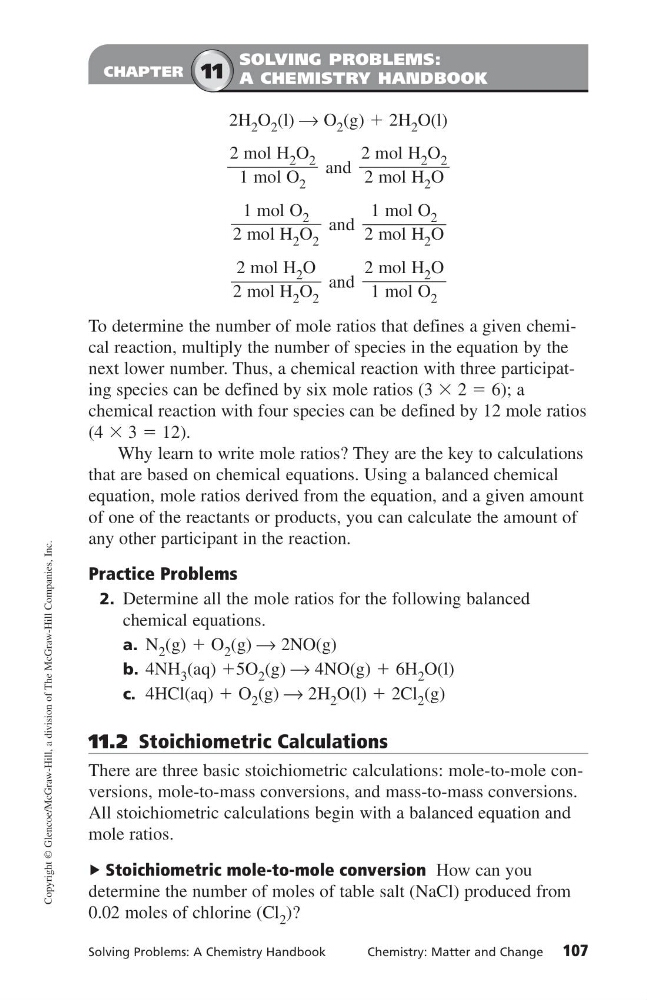
2H 2 O 2 (l) 0 O 2 (g) ϩ 2H 2 O(l)
and
and
and
To determine the number of mole ratios that defines a given chemical reaction, multiply the number of species in the equation by the
next lower number. Thus, a chemical reaction with three participating species can be defined by six mole ratios (3 ϫ 2 ϭ 6); a
chemical reaction with four species can be defined by 12 mole ratios
(4 ϫ 3 ϭ 12).
Why learn to write mole ratios? They are the key to calculations
that are based on chemical equations. Using a balanced chemical
equation, mole ratios derived from the equation, and a given amount
of one of the reactants or products, you can calculate the amount of
any other participant in the reaction.
Practice Problems
2. Determine all the mole ratios for the following balanced
chemical equations.
a. N 2 (g) ϩ O 2 (g) 0 2NO(g)
b. 4NH 3 (aq) ϩ5O 2 (g) 0 4NO(g) ϩ 6H 2 O(l)
c. 4HCl(aq) ϩ O 2 (g) 0 2H 2 O(l) ϩ 2Cl 2 (g)
11.2 Stoichiometric Calculations
There are three basic stoichiometric calculations: mole-to-mole conversions, mole-to-mass conversions, and mass-to-mass conversions.
All stoichiometric calculations begin with a balanced equation and
mole ratios.
Stoichiometric mole-to-mole conversion How can you
determine the number of moles of table salt (NaCl) produced from
0.02 moles of chlorine (Cl 2 )?
▲
2 mol H 2 O
ᎏᎏ
1 mol O 2
2 mol H 2 O
ᎏᎏ
2 mol H 2 O 2
1 mol O 2
ᎏᎏ
2 mol H 2 O
1 mol O 2
ᎏᎏ
2 mol H 2 O 2
2 mol H 2 O 2
ᎏᎏ
2 mol H 2 O
2 mol H 2 O 2
ᎏᎏ
1 mol O 2
Solving Problems: A Chemistry Handbook
Chemistry: Matter and Change
107
SOLVING PROBLEMS:
A CHEMISTRY HANDBOOK
CHAPTER 11
2H 2 O 2 (l) 0 O 2 (g) ϩ 2H 2 O(l)
and
and
and
To determine the number of mole ratios that defines a given chemical reaction, multiply the number of species in the equation by the
next lower number. Thus, a chemical reaction with three participating species can be defined by six mole ratios (3 ϫ 2 ϭ 6); a
chemical reaction with four species can be defined by 12 mole ratios
(4 ϫ 3 ϭ 12).
Why learn to write mole ratios? They are the key to calculations
that are based on chemical equations. Using a balanced chemical
equation, mole ratios derived from the equation, and a given amount
of one of the reactants or products, you can calculate the amount of
any other participant in the reaction.
Practice Problems
2. Determine all the mole ratios for the following balanced
chemical equations.
a. N 2 (g) ϩ O 2 (g) 0 2NO(g)
b. 4NH 3 (aq) ϩ5O 2 (g) 0 4NO(g) ϩ 6H 2 O(l)
c. 4HCl(aq) ϩ O 2 (g) 0 2H 2 O(l) ϩ 2Cl 2 (g)
11.2 Stoichiometric Calculations
There are three basic stoichiometric calculations: mole-to-mole conversions, mole-to-mass conversions, and mass-to-mass conversions.
All stoichiometric calculations begin with a balanced equation and
mole ratios.
Stoichiometric mole-to-mole conversion How can you
determine the number of moles of table salt (NaCl) produced from
0.02 moles of chlorine (Cl 2 )?
▲
2 mol H 2 O
ᎏᎏ
1 mol O 2
2 mol H 2 O
ᎏᎏ
2 mol H 2 O 2
1 mol O 2
ᎏᎏ
2 mol H 2 O
1 mol O 2
ᎏᎏ
2 mol H 2 O 2
2 mol H 2 O 2
ᎏᎏ
2 mol H 2 O
2 mol H 2 O 2
ᎏᎏ
1 mol O 2