

Copyright © Glencoe/McGraw-Hill, a division of The McGraw-Hill Companies, Inc.
106 Chemistry: Matter and Change
Solving Problems: A Chemistry Handbook
SOLVING PROBLEMS:
A CHEMISTRY HANDBOOK
CHAPTER 11
4NH 3 ϩ5O 2 0 4NO ϩ 6H 2 O
The coefficients represent both the numbers of particles and the
numbers of moles interacting in the chemical reaction.
4 molecules NH 3 ϩ 5 molecules O 2 0
4 molecules NO ϩ 6 molecules H 2 O
4 moles NH 3 ϩ 5 moles O 2 0 4 moles NO ϩ 6 moles H 2 O
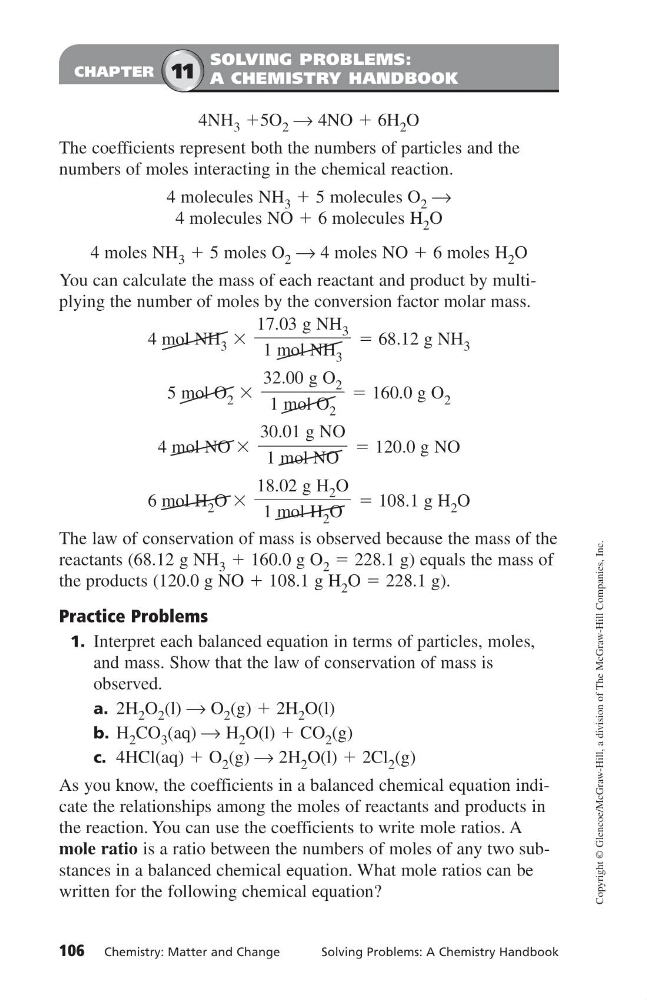
You can calculate the mass of each reactant and product by multiplying the number of moles by the conversion factor molar mass.
4 mol NH 3 ϫ
ϭ68.12 g NH 3
5 mol O 2 ϫ
ϭ160.0 g O 2
4 mol NO ϫ
ϭ120.0 g NO
6 mol H 2 O ϫ
ϭ108.1 g H 2 O
The law of conservation of mass is observed because the mass of the
reactants (68.12 g NH 3 ϩ 160.0 g O 2 ϭ 228.1 g) equals the mass of
the products (120.0 g NO ϩ 108.1 g H 2 O ϭ 228.1 g).
Practice Problems
1. Interpret each balanced equation in terms of particles, moles,
and mass. Show that the law of conservation of mass is
observed.
a. 2H 2 O 2 (l) 0 O 2 (g) ϩ 2H 2 O(l)
b. H 2 CO 3 (aq) 0 H 2 O(l) ϩ CO 2 (g)
c. 4HCl(aq) ϩ O 2 (g) 0 2H 2 O(l) ϩ 2Cl 2 (g)
As you know, the coefficients in a balanced chemical equation indicate the relationships among the moles of reactants and products in
the reaction. You can use the coefficients to write mole ratios. A
mole ratio is a ratio between the numbers of moles of any two substances in a balanced chemical equation. What mole ratios can be
written for the following chemical equation?
18.02 g H 2 O
ᎏᎏ
1 mol H 2 O
30.01 g NO
ᎏᎏ
1 mol NO
32.00 g O 2
ᎏᎏ
1 mol O 2
17.03 g NH 3
ᎏᎏ
1 mol NH 3
106 Chemistry: Matter and Change
Solving Problems: A Chemistry Handbook
SOLVING PROBLEMS:
A CHEMISTRY HANDBOOK
CHAPTER 11
4NH 3 ϩ5O 2 0 4NO ϩ 6H 2 O
The coefficients represent both the numbers of particles and the
numbers of moles interacting in the chemical reaction.
4 molecules NH 3 ϩ 5 molecules O 2 0
4 molecules NO ϩ 6 molecules H 2 O
4 moles NH 3 ϩ 5 moles O 2 0 4 moles NO ϩ 6 moles H 2 O
You can calculate the mass of each reactant and product by multiplying the number of moles by the conversion factor molar mass.
4 mol NH 3 ϫ
ϭ68.12 g NH 3
5 mol O 2 ϫ
ϭ160.0 g O 2
4 mol NO ϫ
ϭ120.0 g NO
6 mol H 2 O ϫ
ϭ108.1 g H 2 O
The law of conservation of mass is observed because the mass of the
reactants (68.12 g NH 3 ϩ 160.0 g O 2 ϭ 228.1 g) equals the mass of
the products (120.0 g NO ϩ 108.1 g H 2 O ϭ 228.1 g).
Practice Problems
1. Interpret each balanced equation in terms of particles, moles,
and mass. Show that the law of conservation of mass is
observed.
a. 2H 2 O 2 (l) 0 O 2 (g) ϩ 2H 2 O(l)
b. H 2 CO 3 (aq) 0 H 2 O(l) ϩ CO 2 (g)
c. 4HCl(aq) ϩ O 2 (g) 0 2H 2 O(l) ϩ 2Cl 2 (g)
As you know, the coefficients in a balanced chemical equation indicate the relationships among the moles of reactants and products in
the reaction. You can use the coefficients to write mole ratios. A
mole ratio is a ratio between the numbers of moles of any two substances in a balanced chemical equation. What mole ratios can be
written for the following chemical equation?
18.02 g H 2 O
ᎏᎏ
1 mol H 2 O
30.01 g NO
ᎏᎏ
1 mol NO
32.00 g O 2
ᎏᎏ
1 mol O 2
17.03 g NH 3
ᎏᎏ
1 mol NH 3