

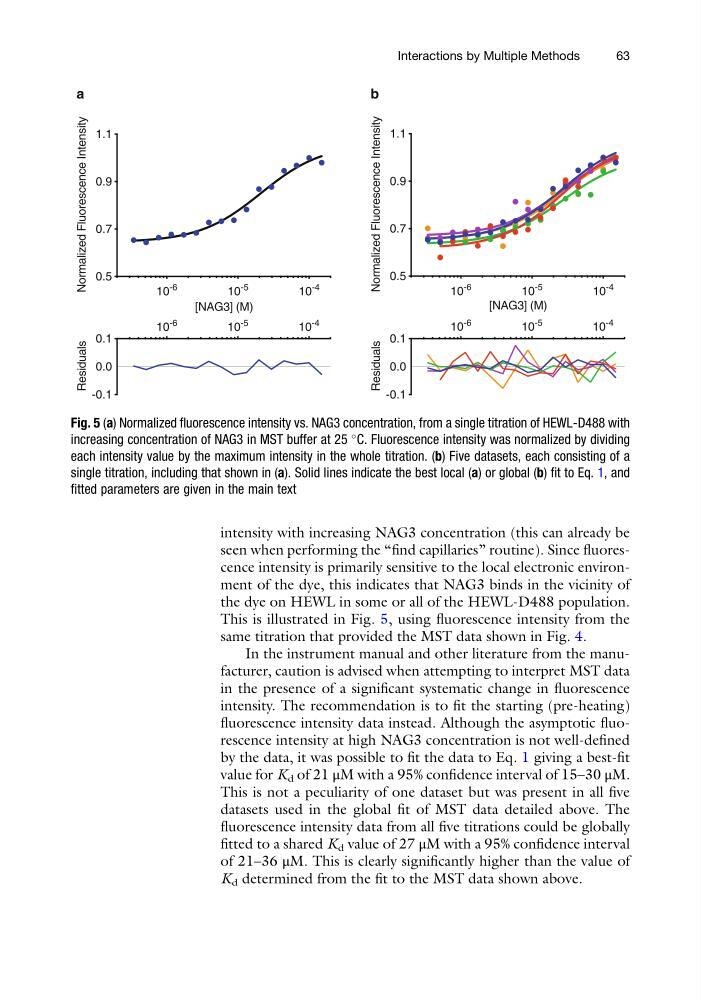
intensity with increasing NAG3 concentration (this can already be
seen when performing the “find capillaries” routine). Since fluorescence intensity is primarily sensitive to the local electronic environment of the dye, this indicates that NAG3 binds in the vicinity of
the dye on HEWL in some or all of the HEWL-D488 population.
This is illustrated in Fig. 5, using fluorescence intensity from the
same titration that provided the MST data shown in Fig. 4.
In the instrument manual and other literature from the manufacturer, caution is advised when attempting to interpret MST data
in the presence of a significant systematic change in fluorescence
intensity. The recommendation is to fit the starting (pre-heating)
fluorescence intensity data instead. Although the asymptotic fluorescence intensity at high NAG3 concentration is not well-defined
by the data, it was possible to fit the data to Eq. 1 giving a best-fit
value for K d of 21 μM with a 95% confidence interval of 15–30 μM.
This is not a peculiarity of one dataset but was present in all five
datasets used in the global fit of MST data detailed above. The
fluorescence intensity data from all five titrations could be globally
fitted to a shared K d value of 27 μM with a 95% confidence interval
of 21–36 μM. This is clearly significantly higher than the value of
K d determined from the fit to the MST data shown above.
10
-6
10
-5
10
-4
0.5
0.7
0.9
1.1
[NAG3] (M)
Normalized Fluorescence Intensity
10
-6
10
-5
10
-4
-0.1
0.0
0.1
Residuals
10
-6
10
-5
10
-4
0.5
0.7
0.9
1.1
[NAG3] (M)
Normalized Fluorescence Intensity
10
-6
10
-5
10
-4
-0.1
0.0
0.1
Residuals
a
b
Fig. 5 (a) Normalized fluorescence intensity vs. NAG3 concentration, from a single titration of HEWL-D488 with
increasing concentration of NAG3 in MST buffer at 25
C. Fluorescence intensity was normalized by dividing
each intensity value by the maximum intensity in the whole titration. (b) Five datasets, each consisting of a
single titration, including that shown in (a). Solid lines indicate the best local (a) or global (b) fit to Eq. 1, and
fitted parameters are given in the main text
Interactions by Multiple Methods
63
seen when performing the “find capillaries” routine). Since fluorescence intensity is primarily sensitive to the local electronic environment of the dye, this indicates that NAG3 binds in the vicinity of
the dye on HEWL in some or all of the HEWL-D488 population.
This is illustrated in Fig. 5, using fluorescence intensity from the
same titration that provided the MST data shown in Fig. 4.
In the instrument manual and other literature from the manufacturer, caution is advised when attempting to interpret MST data
in the presence of a significant systematic change in fluorescence
intensity. The recommendation is to fit the starting (pre-heating)
fluorescence intensity data instead. Although the asymptotic fluorescence intensity at high NAG3 concentration is not well-defined
by the data, it was possible to fit the data to Eq. 1 giving a best-fit
value for K d of 21 μM with a 95% confidence interval of 15–30 μM.
This is not a peculiarity of one dataset but was present in all five
datasets used in the global fit of MST data detailed above. The
fluorescence intensity data from all five titrations could be globally
fitted to a shared K d value of 27 μM with a 95% confidence interval
of 21–36 μM. This is clearly significantly higher than the value of
K d determined from the fit to the MST data shown above.
10
-6
10
-5
10
-4
0.5
0.7
0.9
1.1
[NAG3] (M)
Normalized Fluorescence Intensity
10
-6
10
-5
10
-4
-0.1
0.0
0.1
Residuals
10
-6
10
-5
10
-4
0.5
0.7
0.9
1.1
[NAG3] (M)
Normalized Fluorescence Intensity
10
-6
10
-5
10
-4
-0.1
0.0
0.1
Residuals
a
b
Fig. 5 (a) Normalized fluorescence intensity vs. NAG3 concentration, from a single titration of HEWL-D488 with
increasing concentration of NAG3 in MST buffer at 25
C. Fluorescence intensity was normalized by dividing
each intensity value by the maximum intensity in the whole titration. (b) Five datasets, each consisting of a
single titration, including that shown in (a). Solid lines indicate the best local (a) or global (b) fit to Eq. 1, and
fitted parameters are given in the main text
Interactions by Multiple Methods
63