

the RNA is retained. Ideally, more than 95% of the RNA sample
should remain intact during the time course of the crystallization
experiment.
3.4 RNA Synthesis
RNA for crystallization experiments can be obtained from two
sources: chemical synthesis and in vitro runoff transcription using
T7 RNA polymerase, which is routinely used to produce milligram
quantities of RNA. Short RNAs can be synthesized chemically and
purchased from companies such as Integrated DNA Technologies
Inc. (https://www.idtdna.com) and IBA LifeSciences GmbH
(https://www.iba-lifesciences.com). Furthermore, nucleotide
modifications can be site-specifically incorporated during chemical
synthesis and can be exploited in structure determination and
functional studies. However, chemical synthesis is limited to
RNAs up to 30 nucleotides in length—any longer and abortive
products accumulate with each cycle of nucleotide addition
[15]. Larger RNAs can be generated by in vitro transcription
using bacteriophage RNA polymerases [16]. Typically, the RNA is
dissolved in Ambion RNAse-free water at 4 mM final stock concentration and stored at À80
C in single-use aliquots.
3.5 Determining
the RNA Concentration
The quantification of nucleic acids is typically preformed using a
spectrophotometer by measuring absorbance at 260 nm. The ratio
of absorbance at 260 nm and 280 nm can be used to assess the
purity of large nucleic acid molecules (both DNA and RNA). A
ratio of ~2.0 is generally accepted as “pure” for RNA, whereas a
value below 1.8 usually indicates the presence of contaminants. The
UV spectrum features a prominent peak at 260 nm and a characteristic trough at 230 nm (see Fig. 2). However, the UV spectrum for
shorter oligonucleotides is highly dependent on base composition,
base order, and sequence length, which influence the final absorbance of the oligonucleotide undergoing quantification. Therefore,
oligo-specific conversion factors must be applied in the calculation,
otherwise the accuracy of the results can vary by as much as 5–10%.
Furthermore, corrections for modifications such as 5
0 or 3
0 fluorophores must be applied when determining the concentration of
RNA since many of these modifications absorb light in the UV/visible regions that can affect quantification results.
To determine stock concentrations of RNA, the Beer-Lambert
Law can be used:
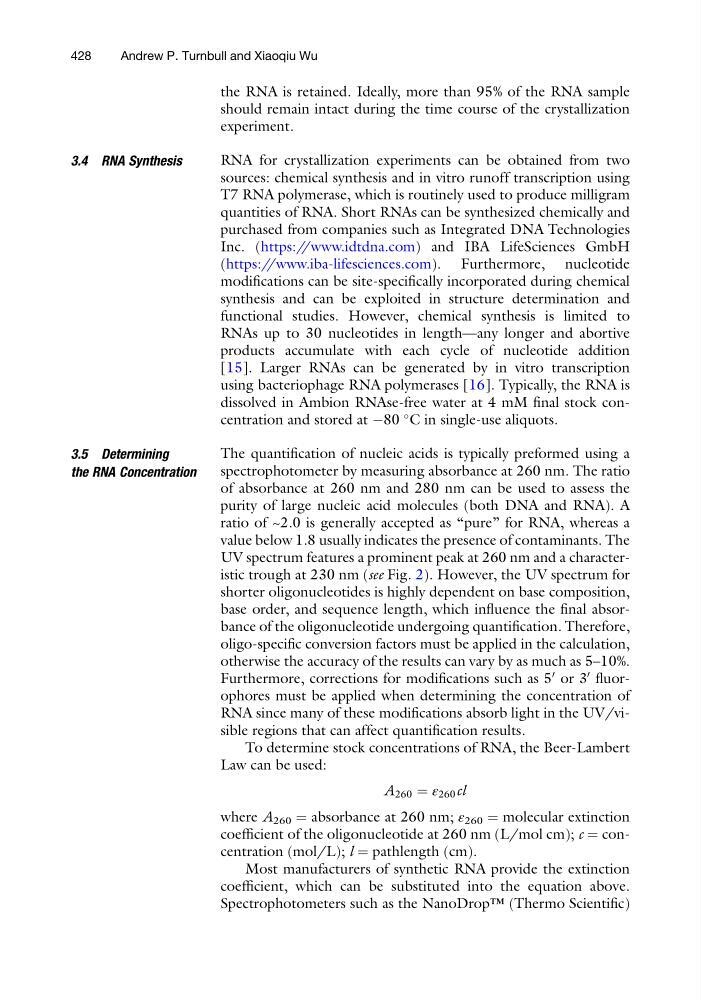
A 260 ¼ ε 260 cl
where A 260 ¼ absorbance at 260 nm; ε 260 ¼ molecular extinction
coefficient of the oligonucleotide at 260 nm (L/mol cm); c ¼ concentration (mol/L); l ¼ pathlength (cm).
Most manufacturers of synthetic RNA provide the extinction
coefficient, which can be substituted into the equation above.
Spectrophotometers such as the NanoDrop™ (Thermo Scientific)
428
Andrew P. Turnbull and Xiaoqiu Wu
should remain intact during the time course of the crystallization
experiment.
3.4 RNA Synthesis
RNA for crystallization experiments can be obtained from two
sources: chemical synthesis and in vitro runoff transcription using
T7 RNA polymerase, which is routinely used to produce milligram
quantities of RNA. Short RNAs can be synthesized chemically and
purchased from companies such as Integrated DNA Technologies
Inc. (https://www.idtdna.com) and IBA LifeSciences GmbH
(https://www.iba-lifesciences.com). Furthermore, nucleotide
modifications can be site-specifically incorporated during chemical
synthesis and can be exploited in structure determination and
functional studies. However, chemical synthesis is limited to
RNAs up to 30 nucleotides in length—any longer and abortive
products accumulate with each cycle of nucleotide addition
[15]. Larger RNAs can be generated by in vitro transcription
using bacteriophage RNA polymerases [16]. Typically, the RNA is
dissolved in Ambion RNAse-free water at 4 mM final stock concentration and stored at À80
C in single-use aliquots.
3.5 Determining
the RNA Concentration
The quantification of nucleic acids is typically preformed using a
spectrophotometer by measuring absorbance at 260 nm. The ratio
of absorbance at 260 nm and 280 nm can be used to assess the
purity of large nucleic acid molecules (both DNA and RNA). A
ratio of ~2.0 is generally accepted as “pure” for RNA, whereas a
value below 1.8 usually indicates the presence of contaminants. The
UV spectrum features a prominent peak at 260 nm and a characteristic trough at 230 nm (see Fig. 2). However, the UV spectrum for
shorter oligonucleotides is highly dependent on base composition,
base order, and sequence length, which influence the final absorbance of the oligonucleotide undergoing quantification. Therefore,
oligo-specific conversion factors must be applied in the calculation,
otherwise the accuracy of the results can vary by as much as 5–10%.
Furthermore, corrections for modifications such as 5
0 or 3
0 fluorophores must be applied when determining the concentration of
RNA since many of these modifications absorb light in the UV/visible regions that can affect quantification results.
To determine stock concentrations of RNA, the Beer-Lambert
Law can be used:
A 260 ¼ ε 260 cl
where A 260 ¼ absorbance at 260 nm; ε 260 ¼ molecular extinction
coefficient of the oligonucleotide at 260 nm (L/mol cm); c ¼ concentration (mol/L); l ¼ pathlength (cm).
Most manufacturers of synthetic RNA provide the extinction
coefficient, which can be substituted into the equation above.
Spectrophotometers such as the NanoDrop™ (Thermo Scientific)
428
Andrew P. Turnbull and Xiaoqiu Wu