

4. UV detector for “inline” use (see Note 3).
5. Refractive index detector for “inline” use (Wyatt OptiLab rEX;
see Note 4).
6. Static light scattering detector for “inline” use (Wyatt DAWN
EOS or DAWN HELEOS II).
7. Computer and software for data collection; preferably software
capable of collecting data from all three detectors simultaneously (Wyatt ASTRA software).
2.1.2 SEC Column
1. High-performance size-exclusion chromatography column
appropriate for fractionating the samples analyzed
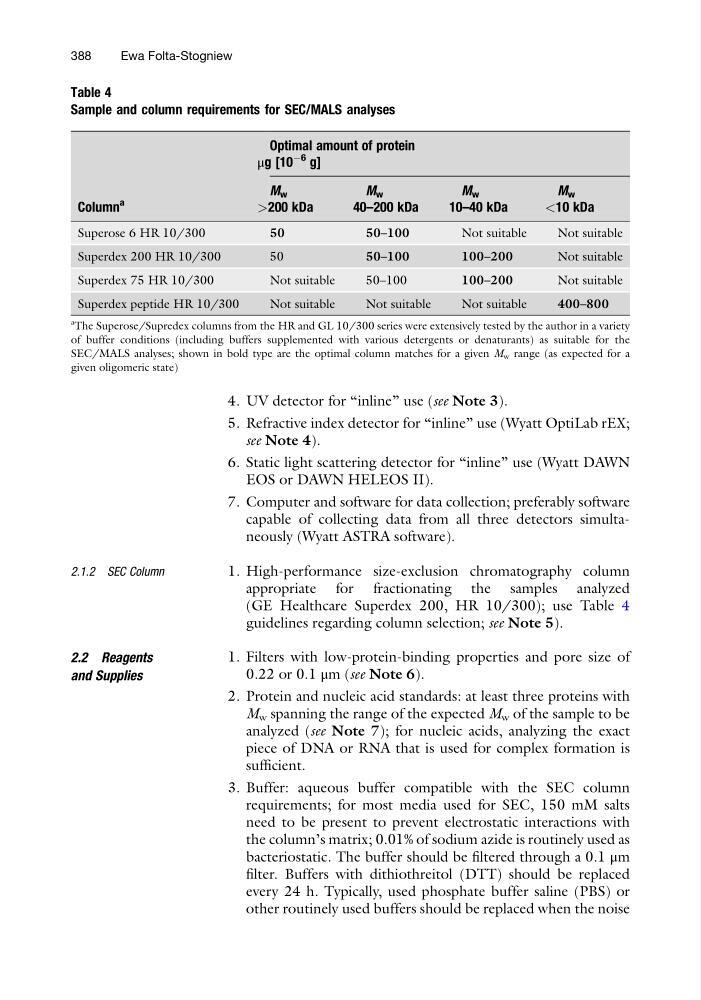
(GE Healthcare Superdex 200, HR 10/300); use Table 4
guidelines regarding column selection; see Note 5).
2.2 Reagents
and Supplies
1. Filters with low-protein-binding properties and pore size of
0.22 or 0.1 μm (see Note 6).
2. Protein and nucleic acid standards: at least three proteins with
M w spanning the range of the expected M w of the sample to be
analyzed (see Note 7); for nucleic acids, analyzing the exact
piece of DNA or RNA that is used for complex formation is
sufficient.
3. Buffer: aqueous buffer compatible with the SEC column
requirements; for most media used for SEC, 150 mM salts
need to be present to prevent electrostatic interactions with
the column’s matrix; 0.01% of sodium azide is routinely used as
bacteriostatic. The buffer should be filtered through a 0.1 μm
filter. Buffers with dithiothreitol (DTT) should be replaced
every 24 h. Typically, used phosphate buffer saline (PBS) or
other routinely used buffers should be replaced when the noise
Table 4
Sample and column requirements for SEC/MALS analyses
Column
a
Optimal amount of protein
μg [10
À6 g]
M w
>200 kDa
M w
40–200 kDa
M w
10–40 kDa
M w
<10 kDa
Superose 6 HR 10/300
50
50–100
Not suitable
Not suitable
Superdex 200 HR 10/300
50
50–100
100–200
Not suitable
Superdex 75 HR 10/300
Not suitable
50–100
100–200
Not suitable
Superdex peptide HR 10/300
Not suitable
Not suitable
Not suitable
400–800
a
The Superose/Supredex columns from the HR and GL 10/300 series were extensively tested by the author in a variety
of buffer conditions (including buffers supplemented with various detergents or denaturants) as suitable for the
SEC/MALS analyses; shown in bold type are the optimal column matches for a given M w range (as expected for a
given oligomeric state)
388
Ewa Folta-Stogniew
5. Refractive index detector for “inline” use (Wyatt OptiLab rEX;
see Note 4).
6. Static light scattering detector for “inline” use (Wyatt DAWN
EOS or DAWN HELEOS II).
7. Computer and software for data collection; preferably software
capable of collecting data from all three detectors simultaneously (Wyatt ASTRA software).
2.1.2 SEC Column
1. High-performance size-exclusion chromatography column
appropriate for fractionating the samples analyzed
(GE Healthcare Superdex 200, HR 10/300); use Table 4
guidelines regarding column selection; see Note 5).
2.2 Reagents
and Supplies
1. Filters with low-protein-binding properties and pore size of
0.22 or 0.1 μm (see Note 6).
2. Protein and nucleic acid standards: at least three proteins with
M w spanning the range of the expected M w of the sample to be
analyzed (see Note 7); for nucleic acids, analyzing the exact
piece of DNA or RNA that is used for complex formation is
sufficient.
3. Buffer: aqueous buffer compatible with the SEC column
requirements; for most media used for SEC, 150 mM salts
need to be present to prevent electrostatic interactions with
the column’s matrix; 0.01% of sodium azide is routinely used as
bacteriostatic. The buffer should be filtered through a 0.1 μm
filter. Buffers with dithiothreitol (DTT) should be replaced
every 24 h. Typically, used phosphate buffer saline (PBS) or
other routinely used buffers should be replaced when the noise
Table 4
Sample and column requirements for SEC/MALS analyses
Column
a
Optimal amount of protein
μg [10
À6 g]
M w
>200 kDa
M w
40–200 kDa
M w
10–40 kDa
M w
<10 kDa
Superose 6 HR 10/300
50
50–100
Not suitable
Not suitable
Superdex 200 HR 10/300
50
50–100
100–200
Not suitable
Superdex 75 HR 10/300
Not suitable
50–100
100–200
Not suitable
Superdex peptide HR 10/300
Not suitable
Not suitable
Not suitable
400–800
a
The Superose/Supredex columns from the HR and GL 10/300 series were extensively tested by the author in a variety
of buffer conditions (including buffers supplemented with various detergents or denaturants) as suitable for the
SEC/MALS analyses; shown in bold type are the optimal column matches for a given M w range (as expected for a
given oligomeric state)
388
Ewa Folta-Stogniew