

which the first turnover occurs, usually milliseconds to seconds, by
using flash photolysis or rapid mixing techniques like stopped-flow.
While steady state kinetics experiments always provide the same
information, irrespective of the substrate or product that is monitored, in pre-steady state assays, different methods for detecting
substrates, intermediates, or products are combined to dissect the
individual steps in the pathway of an enzyme reaction. The use of a
phosphate biosensor enables the direct measurement of when and
how fast P i is released.
MDCC-PBP has been widely applied to study the kinetic
mechanisms of nucleotide hydrolyzing enzymes, in particular for
motor proteins like myosins [30–35], kinesins [36–38], or DNA
and RNA helicases [39–42], but also for many others, e.g.,
GTPases of the Ras and dynamin superfamilies [43, 44] or GTPases
involved in protein synthesis at the ribosome [45–47]. While many
of these examples, as well as the description in this chapter, focus on
the use of MDCC-PBP to specifically measure the P i release step,
the biosensor has also been used to monitor nucleotide hydrolysis
in general and relate hydrolysis to mechanical events, such as force
generation in muscle fibers [2, 3] or DNA translocation. Interesting examples include the measurement of translocation rates of
helicases as well as the coupling ratio that is the number of nucleoside triphosphates hydrolyzed per base translocated [48–50].
3.2.1 General Principle
To measure the transient kinetics of P i release, e.g., for an ATPase
or GTPase reaction, a stopped-flow instrument is used to rapidly
mix the enzyme and substrate (within <2 ms) in the presence of the
P i biosensor, and the fluorescence change is recorded over the
subsequent milliseconds or seconds. It is critical that one considers
the rate of P i binding to the P i biosensor, which should be much
faster (>10-fold) than the reaction under study in order to measure
P i release kinetics accurately. At 22
C, the observed rate constant
for P i binding to MDCC-PBP is higher than 300 s
À1 at P i or
MDCC-PBP concentrations >2 μM [1], and rate constants above
1000 s
À1 have been measured at >50 μM (Martin Webb, personal
communication) (see Note 11). Hence, at 10 μM MDCC-PBP, a
commonly used concentration for these experiments, P i release rate
constants up to 30 s
À1 can be easily measured and up to 100 s
À1 is
measurable if the MDCC-PBP concentration is increased to
>50 μM (see Note 12). Since MDCC-PBP binds P i tightly and is
E ATP
E + ATP
E ADP P i
E ADP
E + ADP
H 2 O
P i
1
2
3
4
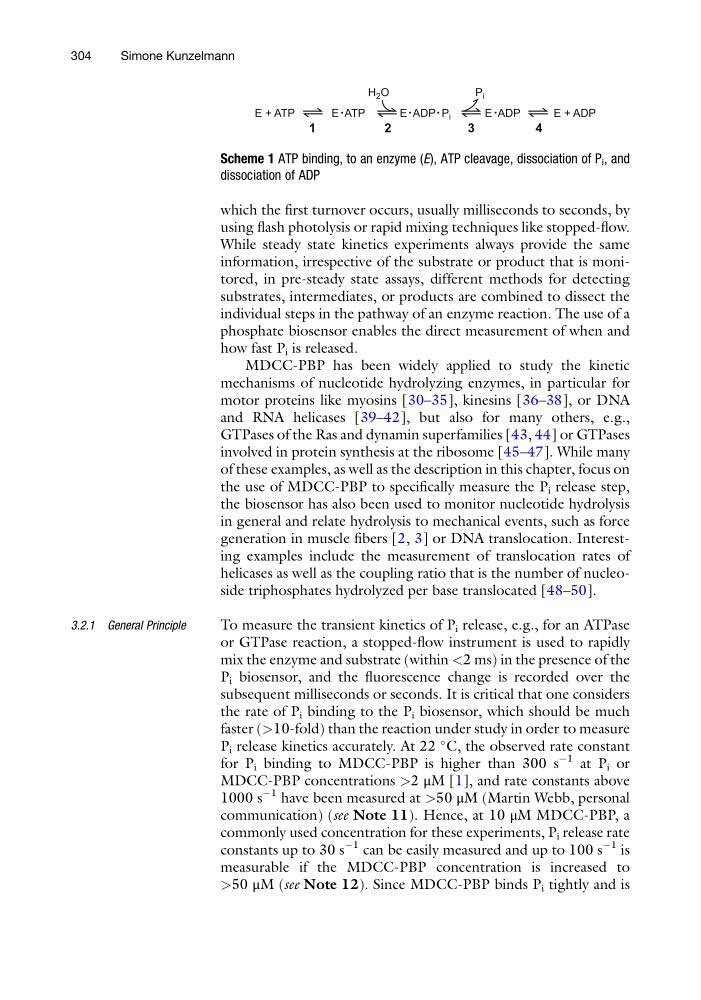
Scheme 1 ATP binding, to an enzyme (E), ATP cleavage, dissociation of P i , and
dissociation of ADP
304
Simone Kunzelmann
using flash photolysis or rapid mixing techniques like stopped-flow.
While steady state kinetics experiments always provide the same
information, irrespective of the substrate or product that is monitored, in pre-steady state assays, different methods for detecting
substrates, intermediates, or products are combined to dissect the
individual steps in the pathway of an enzyme reaction. The use of a
phosphate biosensor enables the direct measurement of when and
how fast P i is released.
MDCC-PBP has been widely applied to study the kinetic
mechanisms of nucleotide hydrolyzing enzymes, in particular for
motor proteins like myosins [30–35], kinesins [36–38], or DNA
and RNA helicases [39–42], but also for many others, e.g.,
GTPases of the Ras and dynamin superfamilies [43, 44] or GTPases
involved in protein synthesis at the ribosome [45–47]. While many
of these examples, as well as the description in this chapter, focus on
the use of MDCC-PBP to specifically measure the P i release step,
the biosensor has also been used to monitor nucleotide hydrolysis
in general and relate hydrolysis to mechanical events, such as force
generation in muscle fibers [2, 3] or DNA translocation. Interesting examples include the measurement of translocation rates of
helicases as well as the coupling ratio that is the number of nucleoside triphosphates hydrolyzed per base translocated [48–50].
3.2.1 General Principle
To measure the transient kinetics of P i release, e.g., for an ATPase
or GTPase reaction, a stopped-flow instrument is used to rapidly
mix the enzyme and substrate (within <2 ms) in the presence of the
P i biosensor, and the fluorescence change is recorded over the
subsequent milliseconds or seconds. It is critical that one considers
the rate of P i binding to the P i biosensor, which should be much
faster (>10-fold) than the reaction under study in order to measure
P i release kinetics accurately. At 22
C, the observed rate constant
for P i binding to MDCC-PBP is higher than 300 s
À1 at P i or
MDCC-PBP concentrations >2 μM [1], and rate constants above
1000 s
À1 have been measured at >50 μM (Martin Webb, personal
communication) (see Note 11). Hence, at 10 μM MDCC-PBP, a
commonly used concentration for these experiments, P i release rate
constants up to 30 s
À1 can be easily measured and up to 100 s
À1 is
measurable if the MDCC-PBP concentration is increased to
>50 μM (see Note 12). Since MDCC-PBP binds P i tightly and is
E ATP
E + ATP
E ADP P i
E ADP
E + ADP
H 2 O
P i
1
2
3
4
Scheme 1 ATP binding, to an enzyme (E), ATP cleavage, dissociation of P i , and
dissociation of ADP
304
Simone Kunzelmann