

3. Reaction buffer: 50 mM Tris–HCl pH 7.5 4
C; 70 mM KCl;
30 mM NH 4 Cl; 7 mM MgCl 2 ; filtered and degassed prior to
use (see Note 1).
4. Ultrapure water—filtered and degassed prior to use.
5. 30% ethanol—filtered and degassed prior to use.
6. 3 mL syringes (BD Luer-Lok™ Tip 3 mL syringe).
7. Disposable
needles
(BD
PrecisionGlide™
needle;
20G Â 1½ in.).
3 Methods
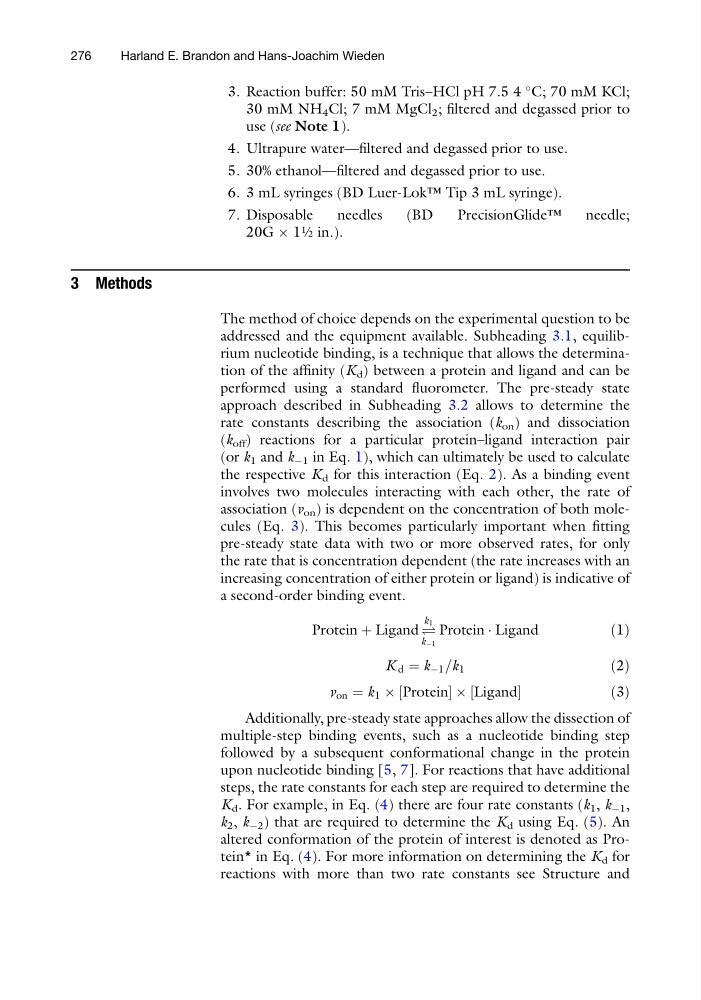
The method of choice depends on the experimental question to be
addressed and the equipment available. Subheading 3.1, equilibrium nucleotide binding, is a technique that allows the determination of the affinity (K d ) between a protein and ligand and can be
performed using a standard fluorometer. The pre-steady state
approach described in Subheading 3.2 allows to determine the
rate constants describing the association (k on ) and dissociation
(k off ) reactions for a particular protein–ligand interaction pair
(or k 1 and k À1 in Eq. 1), which can ultimately be used to calculate
the respective K d for this interaction (Eq. 2). As a binding event
involves two molecules interacting with each other, the rate of
association (v on ) is dependent on the concentration of both molecules (Eq. 3). This becomes particularly important when fitting
pre-steady state data with two or more observed rates, for only
the rate that is concentration dependent (the rate increases with an
increasing concentration of either protein or ligand) is indicative of
a second-order binding event.
Protein þ Ligand Ð
k 1
k À1
Protein Á Ligand
ð1Þ
K d ¼ k À1 =k 1
ð2Þ
v on ¼ k 1 Â Protein
½
 Ligand
½
ð3Þ
Additionally, pre-steady state approaches allow the dissection of
multiple-step binding events, such as a nucleotide binding step
followed by a subsequent conformational change in the protein
upon nucleotide binding [5, 7]. For reactions that have additional
steps, the rate constants for each step are required to determine the
K d . For example, in Eq. (4) there are four rate constants (k 1 , k À1 ,
k 2 , k À2 ) that are required to determine the K d using Eq. (5). An
altered conformation of the protein of interest is denoted as Protein* in Eq. (4). For more information on determining the K d for
reactions with more than two rate constants see Structure and
276
Harland E. Brandon and Hans-Joachim Wieden
C; 70 mM KCl;
30 mM NH 4 Cl; 7 mM MgCl 2 ; filtered and degassed prior to
use (see Note 1).
4. Ultrapure water—filtered and degassed prior to use.
5. 30% ethanol—filtered and degassed prior to use.
6. 3 mL syringes (BD Luer-Lok™ Tip 3 mL syringe).
7. Disposable
needles
(BD
PrecisionGlide™
needle;
20G Â 1½ in.).
3 Methods
The method of choice depends on the experimental question to be
addressed and the equipment available. Subheading 3.1, equilibrium nucleotide binding, is a technique that allows the determination of the affinity (K d ) between a protein and ligand and can be
performed using a standard fluorometer. The pre-steady state
approach described in Subheading 3.2 allows to determine the
rate constants describing the association (k on ) and dissociation
(k off ) reactions for a particular protein–ligand interaction pair
(or k 1 and k À1 in Eq. 1), which can ultimately be used to calculate
the respective K d for this interaction (Eq. 2). As a binding event
involves two molecules interacting with each other, the rate of
association (v on ) is dependent on the concentration of both molecules (Eq. 3). This becomes particularly important when fitting
pre-steady state data with two or more observed rates, for only
the rate that is concentration dependent (the rate increases with an
increasing concentration of either protein or ligand) is indicative of
a second-order binding event.
Protein þ Ligand Ð
k 1
k À1
Protein Á Ligand
ð1Þ
K d ¼ k À1 =k 1
ð2Þ
v on ¼ k 1 Â Protein
½
 Ligand
½
ð3Þ
Additionally, pre-steady state approaches allow the dissection of
multiple-step binding events, such as a nucleotide binding step
followed by a subsequent conformational change in the protein
upon nucleotide binding [5, 7]. For reactions that have additional
steps, the rate constants for each step are required to determine the
K d . For example, in Eq. (4) there are four rate constants (k 1 , k À1 ,
k 2 , k À2 ) that are required to determine the K d using Eq. (5). An
altered conformation of the protein of interest is denoted as Protein* in Eq. (4). For more information on determining the K d for
reactions with more than two rate constants see Structure and
276
Harland E. Brandon and Hans-Joachim Wieden