

4 Notes
1. It is essential to use 384-well polypropylene source microplates
that are Echo
® -qualified, such as 384 PP plates catalog number
P-05525 from Labcyte. During manufacture, these plates are
generated using a molding process that results in a higher
consistency of plate flatness and base thickness, which supports
consistent acoustic dispensing. Alternative plate types are not
suitable for firing from an Echo
® . The use of 1536-well plates is
not currently possible with this technology. Since the rate of
charging is inversely proportional to the surface area, a 1536well plate charges four times more quickly than a 384-well plate
and hence the speed of polarity switching approaches the scan
speed of the instrument. Improvements in instrument sensitivity that would support the use of 1536-well plates are in
progress, and this plate format may be supported in the future.
2. For 384-well plates, the use of 0.3/0.1 mm microvalves for the
Certus Flex is recommended for the highest accuracy and
precision combined with medium dispensing speed.
3. Several common buffers and detergents have been tested to
understand their ionization potential and ion suppression
effects in both positive and negative ion modes. Some buffers
such as 4-(2-hydroxyethyl)-1-piperazineethanesulfonic acid
(HEPES) caused severe signal suppression, whereas a combination of tris(hydroxymethyl)-aminomethane (Tris) and Triton
X-100 as the buffer–detergent system produced clean mass
–8
–7
Internal Std
Internal Std
–6
–5
–4
–8
–7
–6
–5
–4
log[Compound]
% Inhibition
% Inhibition
log[Compound]
0
1×10
6
2×10
6
0
20
40
60
80
100
120
Internal Std Cpd2
% inhibition Cpd2
Internal Std Cpd1
% inhibition Cpd1
0
20
40
60
80
100
120
140
3×10
6
4×10
6
0
1×10
6
2×10
6
3×10
6
4×10
6
a
b
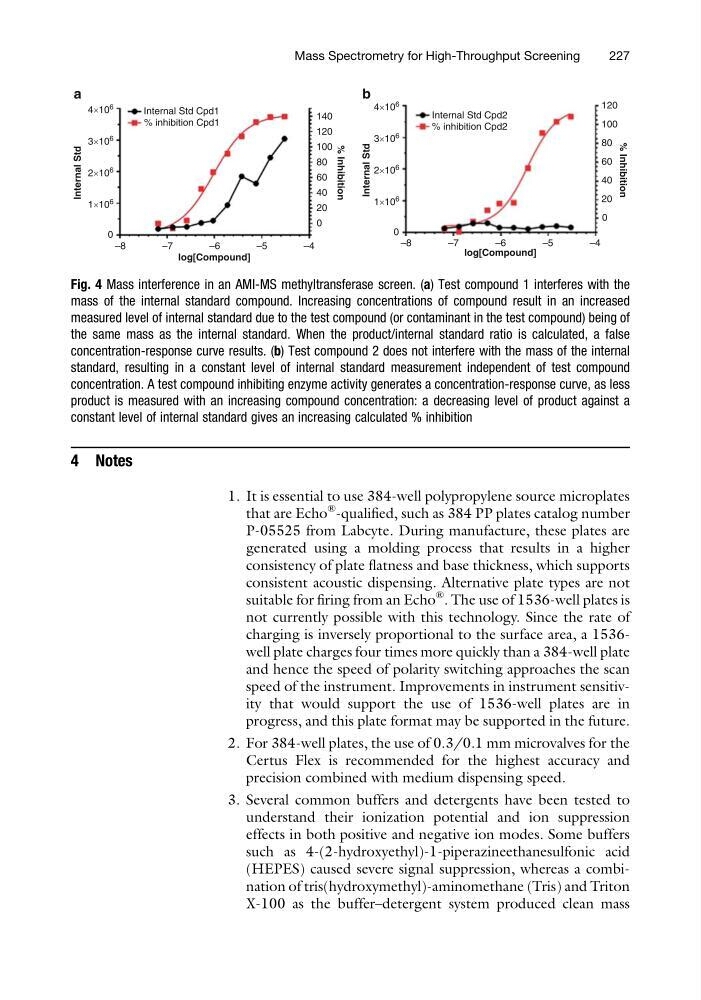
Fig. 4 Mass interference in an AMI-MS methyltransferase screen. (a) Test compound 1 interferes with the
mass of the internal standard compound. Increasing concentrations of compound result in an increased
measured level of internal standard due to the test compound (or contaminant in the test compound) being of
the same mass as the internal standard. When the product/internal standard ratio is calculated, a false
concentration-response curve results. (b) Test compound 2 does not interfere with the mass of the internal
standard, resulting in a constant level of internal standard measurement independent of test compound
concentration. A test compound inhibiting enzyme activity generates a concentration-response curve, as less
product is measured with an increasing compound concentration: a decreasing level of product against a
constant level of internal standard gives an increasing calculated % inhibition
Mass Spectrometry for High-Throughput Screening
227
1. It is essential to use 384-well polypropylene source microplates
that are Echo
® -qualified, such as 384 PP plates catalog number
P-05525 from Labcyte. During manufacture, these plates are
generated using a molding process that results in a higher
consistency of plate flatness and base thickness, which supports
consistent acoustic dispensing. Alternative plate types are not
suitable for firing from an Echo
® . The use of 1536-well plates is
not currently possible with this technology. Since the rate of
charging is inversely proportional to the surface area, a 1536well plate charges four times more quickly than a 384-well plate
and hence the speed of polarity switching approaches the scan
speed of the instrument. Improvements in instrument sensitivity that would support the use of 1536-well plates are in
progress, and this plate format may be supported in the future.
2. For 384-well plates, the use of 0.3/0.1 mm microvalves for the
Certus Flex is recommended for the highest accuracy and
precision combined with medium dispensing speed.
3. Several common buffers and detergents have been tested to
understand their ionization potential and ion suppression
effects in both positive and negative ion modes. Some buffers
such as 4-(2-hydroxyethyl)-1-piperazineethanesulfonic acid
(HEPES) caused severe signal suppression, whereas a combination of tris(hydroxymethyl)-aminomethane (Tris) and Triton
X-100 as the buffer–detergent system produced clean mass
–8
–7
Internal Std
Internal Std
–6
–5
–4
–8
–7
–6
–5
–4
log[Compound]
% Inhibition
% Inhibition
log[Compound]
0
1×10
6
2×10
6
0
20
40
60
80
100
120
Internal Std Cpd2
% inhibition Cpd2
Internal Std Cpd1
% inhibition Cpd1
0
20
40
60
80
100
120
140
3×10
6
4×10
6
0
1×10
6
2×10
6
3×10
6
4×10
6
a
b
Fig. 4 Mass interference in an AMI-MS methyltransferase screen. (a) Test compound 1 interferes with the
mass of the internal standard compound. Increasing concentrations of compound result in an increased
measured level of internal standard due to the test compound (or contaminant in the test compound) being of
the same mass as the internal standard. When the product/internal standard ratio is calculated, a false
concentration-response curve results. (b) Test compound 2 does not interfere with the mass of the internal
standard, resulting in a constant level of internal standard measurement independent of test compound
concentration. A test compound inhibiting enzyme activity generates a concentration-response curve, as less
product is measured with an increasing compound concentration: a decreasing level of product against a
constant level of internal standard gives an increasing calculated % inhibition
Mass Spectrometry for High-Throughput Screening
227