

2 Materials
Prepare solutions using ultrapure water (prepared by purifying
deionized water, to attain a sensitivity of 18 MΩ cm at 25
C).
Prepare and store all reagents at room temperature (unless indicated otherwise). Follow all waste disposal regulations when disposing waste materials.
All reagents, unless otherwise stated, were purchased from
Thermo Fisher Scientific (Loughborough, UK) or Sigma-Aldrich
Corporation (Gillingham, UK). Lyophilized lipids were purchased
from Avanti Polar-Lipids (Alabaster, USA) with the exception
2-oleoyl-1-palmitoyl-sn-glycero-3-phosphocholine
(POPC),
which was purchased from Sigma-Aldrich Corporation. UV
Ozone cleaner ProCleaner Plus purchased from Bioforce Nanosciences (Salt Lake City, USA). Polycarbonate membranes for lipid
extrusion were purchased from GE Healthcare Whatman (Little
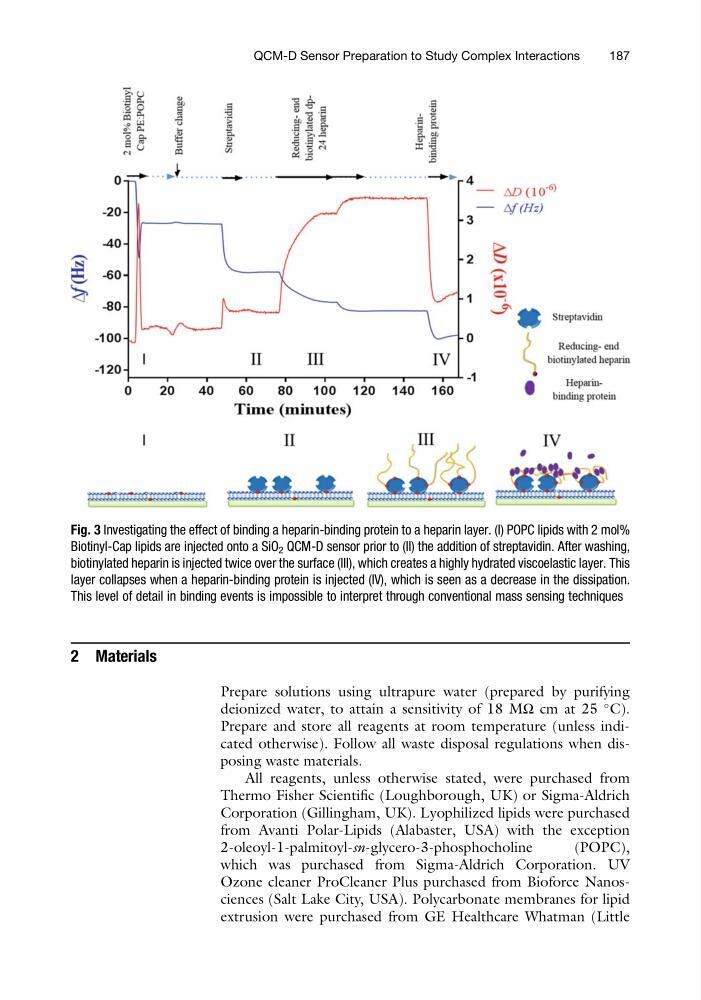
Fig. 3 Investigating the effect of binding a heparin-binding protein to a heparin layer. (I) POPC lipids with 2 mol%
Biotinyl-Cap lipids are injected onto a SiO 2 QCM-D sensor prior to (II) the addition of streptavidin. After washing,
biotinylated heparin is injected twice over the surface (III), which creates a highly hydrated viscoelastic layer. This
layer collapses when a heparin-binding protein is injected (IV), which is seen as a decrease in the dissipation.
This level of detail in binding events is impossible to interpret through conventional mass sensing techniques
QCM-D Sensor Preparation to Study Complex Interactions
187
Prepare solutions using ultrapure water (prepared by purifying
deionized water, to attain a sensitivity of 18 MΩ cm at 25
C).
Prepare and store all reagents at room temperature (unless indicated otherwise). Follow all waste disposal regulations when disposing waste materials.
All reagents, unless otherwise stated, were purchased from
Thermo Fisher Scientific (Loughborough, UK) or Sigma-Aldrich
Corporation (Gillingham, UK). Lyophilized lipids were purchased
from Avanti Polar-Lipids (Alabaster, USA) with the exception
2-oleoyl-1-palmitoyl-sn-glycero-3-phosphocholine
(POPC),
which was purchased from Sigma-Aldrich Corporation. UV
Ozone cleaner ProCleaner Plus purchased from Bioforce Nanosciences (Salt Lake City, USA). Polycarbonate membranes for lipid
extrusion were purchased from GE Healthcare Whatman (Little
Fig. 3 Investigating the effect of binding a heparin-binding protein to a heparin layer. (I) POPC lipids with 2 mol%
Biotinyl-Cap lipids are injected onto a SiO 2 QCM-D sensor prior to (II) the addition of streptavidin. After washing,
biotinylated heparin is injected twice over the surface (III), which creates a highly hydrated viscoelastic layer. This
layer collapses when a heparin-binding protein is injected (IV), which is seen as a decrease in the dissipation.
This level of detail in binding events is impossible to interpret through conventional mass sensing techniques
QCM-D Sensor Preparation to Study Complex Interactions
187