

transients observed in flow experiments, whereas the latter is
generally used to describe relaxation (or small perturbation)
experiments. The half-life, t 1/2 , of the reaction is defined as the
time taken for the signal to change from S 0 to
(S eq À (S eq À S 0 )/2) and is related to the relaxation time and
observed rate through t 1/2 ¼ 0.693τ ¼ 0.693/k obs (Note: Ln
(0.5) ¼ À0.693).
4. Scattered light arises from three sources: Rayleigh scattering of
the exciting light (observed at the excitation wavelength λ Ex ),
Rayleigh scattering of the first harmonic of the exciting light
(observed at 2 Â λ Ex ), and Raman scattering from the water.
The wavelength (in nanometers) for the Raman scattering peak
(λ R ) for water depends on the excitation wavelength according
to λ R ¼ λ Ex /(1 À 0.00034 λ Ex ).
5. In more complex systems, the observable processes may occur
on very different time scales and it is then generally more
appropriate to collect data with a logarithmic time base which
allows data to be collected at longer time intervals as the
reaction proceeds. Although the time constant will need to be
set as less than the fastest process, the data can sometimes be
collected in the oversampling mode (collecting and averaging
blocks of data) to improve the S/N for long time points.
6. Thus, for example, if the ligand (L) and the complex (PL) are
fluorescent, but the protein is not, then the protein should be
the component used in excess. This may not be possible in all
cases, and the ligand will then have to be the component in
excess. In this case, it may be advantageous to use resonance
energy transfer if a suitable donor/acceptor pair is available
with a combination of intrinsic and/or extrinsic fluorophores.
For example, the emission spectrum of tryptophan overlaps the
excitation spectrum of 2
0 (3
0 )-O-(N-methylanthraniloyl)-adenine nucleotides and this has been taken advantage of in
stopped-flow studies of the myosin subfragment 1 ATPase
mechanism [22]. By exciting the tryptophan at 280 nm and
observing the methylanthraniloyl emission, the bound fluorophore is preferentially excited over free fluorophore. This
allows much higher concentrations of the excess fluorophore
to be used compared to the situation where the methylanthraniloyl is excited directly.
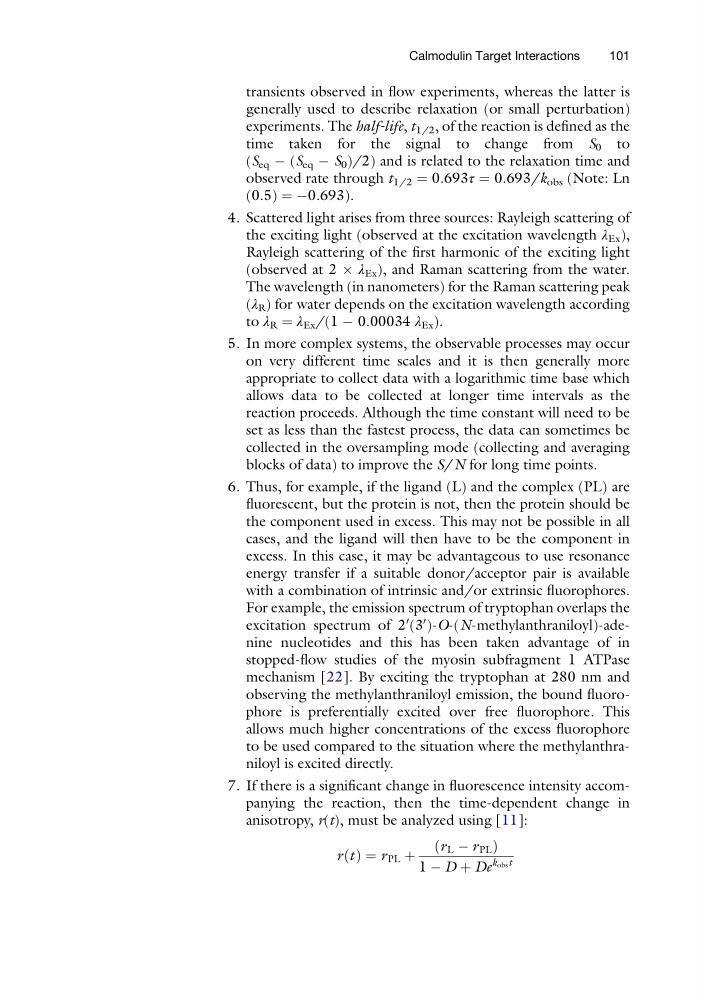
7. If there is a significant change in fluorescence intensity accompanying the reaction, then the time-dependent change in
anisotropy, r(t), must be analyzed using [11]:
r t
ð Þ ¼ r PL þ
r L À r PL
ð
Þ
1 À D þ De
k obs t
Calmodulin Target Interactions
101
generally used to describe relaxation (or small perturbation)
experiments. The half-life, t 1/2 , of the reaction is defined as the
time taken for the signal to change from S 0 to
(S eq À (S eq À S 0 )/2) and is related to the relaxation time and
observed rate through t 1/2 ¼ 0.693τ ¼ 0.693/k obs (Note: Ln
(0.5) ¼ À0.693).
4. Scattered light arises from three sources: Rayleigh scattering of
the exciting light (observed at the excitation wavelength λ Ex ),
Rayleigh scattering of the first harmonic of the exciting light
(observed at 2 Â λ Ex ), and Raman scattering from the water.
The wavelength (in nanometers) for the Raman scattering peak
(λ R ) for water depends on the excitation wavelength according
to λ R ¼ λ Ex /(1 À 0.00034 λ Ex ).
5. In more complex systems, the observable processes may occur
on very different time scales and it is then generally more
appropriate to collect data with a logarithmic time base which
allows data to be collected at longer time intervals as the
reaction proceeds. Although the time constant will need to be
set as less than the fastest process, the data can sometimes be
collected in the oversampling mode (collecting and averaging
blocks of data) to improve the S/N for long time points.
6. Thus, for example, if the ligand (L) and the complex (PL) are
fluorescent, but the protein is not, then the protein should be
the component used in excess. This may not be possible in all
cases, and the ligand will then have to be the component in
excess. In this case, it may be advantageous to use resonance
energy transfer if a suitable donor/acceptor pair is available
with a combination of intrinsic and/or extrinsic fluorophores.
For example, the emission spectrum of tryptophan overlaps the
excitation spectrum of 2
0 (3
0 )-O-(N-methylanthraniloyl)-adenine nucleotides and this has been taken advantage of in
stopped-flow studies of the myosin subfragment 1 ATPase
mechanism [22]. By exciting the tryptophan at 280 nm and
observing the methylanthraniloyl emission, the bound fluorophore is preferentially excited over free fluorophore. This
allows much higher concentrations of the excess fluorophore
to be used compared to the situation where the methylanthraniloyl is excited directly.
7. If there is a significant change in fluorescence intensity accompanying the reaction, then the time-dependent change in
anisotropy, r(t), must be analyzed using [11]:
r t
ð Þ ¼ r PL þ
r L À r PL
ð
Þ
1 À D þ De
k obs t
Calmodulin Target Interactions
101