

The observed rate for the fast process (k obs (F)) should vary
linearly with [L tot ], and the observed rate for the slow process
(k obs (S)) should vary hyperbolically with [L tot ] [15] (see Note 13):
k obs F
ð Þ ¼ k 1 L tot
½
þk À1
ð9Þ
k obs S
ð Þ ¼
k 2 L tot
½
K d1 þ L tot
½
þ k À2
ð10Þ
What will actually be observed experimentally will depend on
the relative contributions of the different species to the optical
signal being monitored, as well as on the values of the individual
rate constants [10, 11]. Only in the most favorable cases where two
easily resolvable kinetic events are observed over a wide range of
[L tot ] values (with the bimolecular step always remaining very much
faster than the isomerization for all [L tot ]) will it be possible to
extract all four rate constants by analysis of Eqs. 9 and 10 (see Note
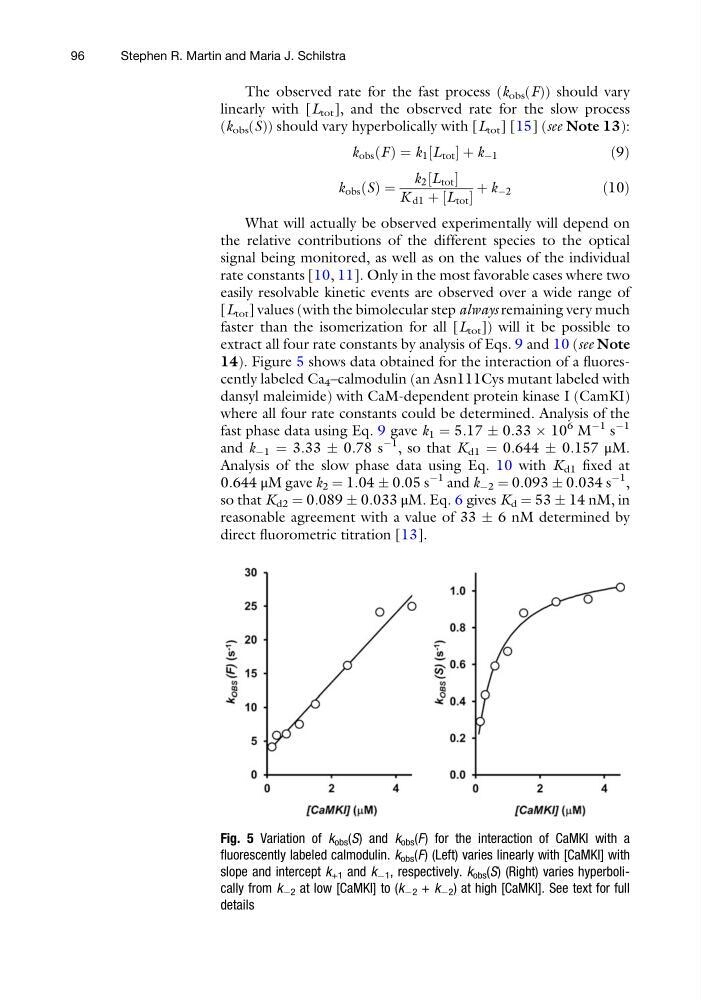
14). Figure 5 shows data obtained for the interaction of a fluorescently labeled Ca 4 –calmodulin (an Asn111Cys mutant labeled with
dansyl maleimide) with CaM-dependent protein kinase I (CamKI)
where all four rate constants could be determined. Analysis of the
fast phase data using Eq. 9 gave k 1 ¼ 5.17 Æ 0.33 Â 10
6 M
À1 s
À1
and k À1 ¼ 3.33 Æ 0.78 s
À1 , so that K d1 ¼ 0.644 Æ 0.157 μM.
Analysis of the slow phase data using Eq. 10 with K d1 fixed at
0.644 μM gave k 2 ¼ 1.04 Æ 0.05 s
À1 and k À2 ¼ 0.093 Æ 0.034 s
À1 ,
so that K d2 ¼ 0.089 Æ 0.033 μM. Eq. 6 gives K d ¼ 53 Æ 14 nM, in
reasonable agreement with a value of 33 Æ 6 nM determined by
direct fluorometric titration [13].
Fig. 5 Variation of k obs (S) and k obs (F) for the interaction of CaMKI with a
fluorescently labeled calmodulin. k obs (F) (Left) varies linearly with [CaMKI] with
slope and intercept k +1 and k À1 , respectively. k obs (S) (Right) varies hyperbolically from k À2 at low [CaMKI] to (k À2 + k À2 ) at high [CaMKI]. See text for full
details
96
Stephen R. Martin and Maria J. Schilstra
linearly with [L tot ], and the observed rate for the slow process
(k obs (S)) should vary hyperbolically with [L tot ] [15] (see Note 13):
k obs F
ð Þ ¼ k 1 L tot
½
þk À1
ð9Þ
k obs S
ð Þ ¼
k 2 L tot
½
K d1 þ L tot
½
þ k À2
ð10Þ
What will actually be observed experimentally will depend on
the relative contributions of the different species to the optical
signal being monitored, as well as on the values of the individual
rate constants [10, 11]. Only in the most favorable cases where two
easily resolvable kinetic events are observed over a wide range of
[L tot ] values (with the bimolecular step always remaining very much
faster than the isomerization for all [L tot ]) will it be possible to
extract all four rate constants by analysis of Eqs. 9 and 10 (see Note
14). Figure 5 shows data obtained for the interaction of a fluorescently labeled Ca 4 –calmodulin (an Asn111Cys mutant labeled with
dansyl maleimide) with CaM-dependent protein kinase I (CamKI)
where all four rate constants could be determined. Analysis of the
fast phase data using Eq. 9 gave k 1 ¼ 5.17 Æ 0.33 Â 10
6 M
À1 s
À1
and k À1 ¼ 3.33 Æ 0.78 s
À1 , so that K d1 ¼ 0.644 Æ 0.157 μM.
Analysis of the slow phase data using Eq. 10 with K d1 fixed at
0.644 μM gave k 2 ¼ 1.04 Æ 0.05 s
À1 and k À2 ¼ 0.093 Æ 0.034 s
À1 ,
so that K d2 ¼ 0.089 Æ 0.033 μM. Eq. 6 gives K d ¼ 53 Æ 14 nM, in
reasonable agreement with a value of 33 Æ 6 nM determined by
direct fluorometric titration [13].
Fig. 5 Variation of k obs (S) and k obs (F) for the interaction of CaMKI with a
fluorescently labeled calmodulin. k obs (F) (Left) varies linearly with [CaMKI] with
slope and intercept k +1 and k À1 , respectively. k obs (S) (Right) varies hyperbolically from k À2 at low [CaMKI] to (k À2 + k À2 ) at high [CaMKI]. See text for full
details
96
Stephen R. Martin and Maria J. Schilstra