

3.1.2 Alternative
Approach
An accurate value for k À1 (0.8 Æ 0.15 s
À1 ) was determined using
the methods described in Subheading 3.2 in which the fluorescently labeled peptide was displaced by the addition of a large
concentration of the corresponding unlabeled peptide. The ratio
of the kinetic constants then gave a K d of 70 Æ 14 nM, in good
agreement with a value of 60 Æ 9 nM determined by direct fluorometric titration.
3.2 Competitive
Binding
As noted in Subheading 3.1, it is not always possible to determine
accurate dissociation rate constants from the intercept of a plot of
k obs vs. [X tot ] if the dissociation rate is very slow. Likewise, it might
not be possible to measure very fast association rate constants if
the concentrations required for a good S/N ratio are such that the
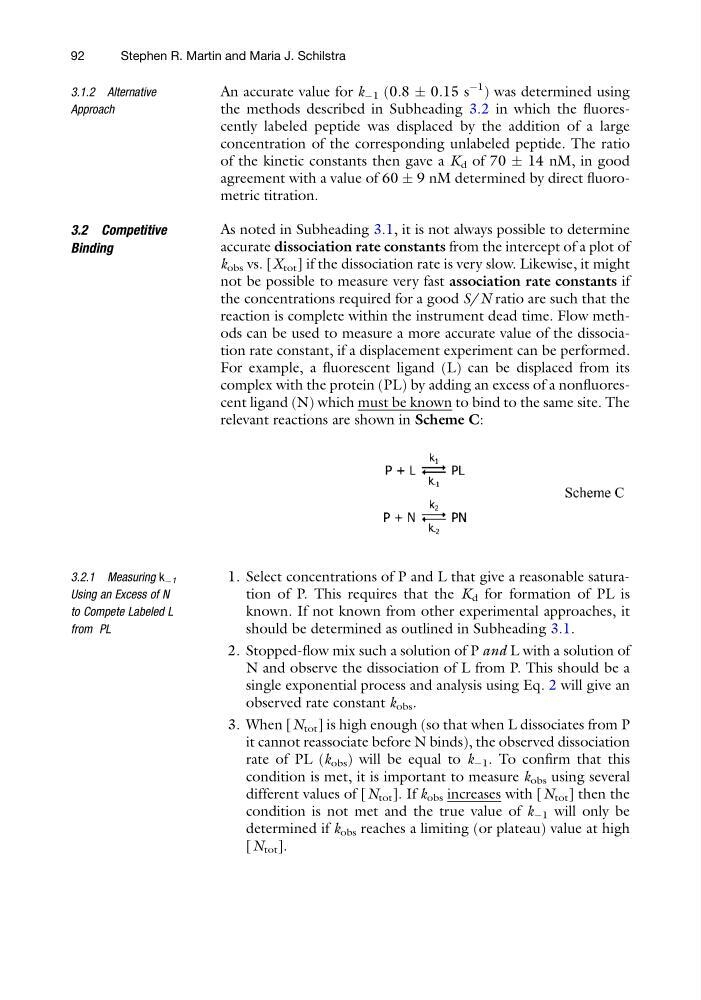
reaction is complete within the instrument dead time. Flow methods can be used to measure a more accurate value of the dissociation rate constant, if a displacement experiment can be performed.
For example, a fluorescent ligand (L) can be displaced from its
complex with the protein (PL) by adding an excess of a nonfluorescent ligand (N) which must be known to bind to the same site. The
relevant reactions are shown in Scheme C:
3.2.1 Measuring k À1
Using an Excess of N
to Compete Labeled L
from PL
1. Select concentrations of P and L that give a reasonable saturation of P. This requires that the K d for formation of PL is
known. If not known from other experimental approaches, it
should be determined as outlined in Subheading 3.1.
2. Stopped-flow mix such a solution of P and L with a solution of
N and observe the dissociation of L from P. This should be a
single exponential process and analysis using Eq. 2 will give an
observed rate constant k obs .
3. When [N tot ] is high enough (so that when L dissociates from P
it cannot reassociate before N binds), the observed dissociation
rate of PL (k obs ) will be equal to k À1 . To confirm that this
condition is met, it is important to measure k obs using several
different values of [N tot ]. If k obs increases with [N tot ] then the
condition is not met and the true value of k À1 will only be
determined if k obs reaches a limiting (or plateau) value at high
[N tot ].
92
Stephen R. Martin and Maria J. Schilstra
Approach
An accurate value for k À1 (0.8 Æ 0.15 s
À1 ) was determined using
the methods described in Subheading 3.2 in which the fluorescently labeled peptide was displaced by the addition of a large
concentration of the corresponding unlabeled peptide. The ratio
of the kinetic constants then gave a K d of 70 Æ 14 nM, in good
agreement with a value of 60 Æ 9 nM determined by direct fluorometric titration.
3.2 Competitive
Binding
As noted in Subheading 3.1, it is not always possible to determine
accurate dissociation rate constants from the intercept of a plot of
k obs vs. [X tot ] if the dissociation rate is very slow. Likewise, it might
not be possible to measure very fast association rate constants if
the concentrations required for a good S/N ratio are such that the
reaction is complete within the instrument dead time. Flow methods can be used to measure a more accurate value of the dissociation rate constant, if a displacement experiment can be performed.
For example, a fluorescent ligand (L) can be displaced from its
complex with the protein (PL) by adding an excess of a nonfluorescent ligand (N) which must be known to bind to the same site. The
relevant reactions are shown in Scheme C:
3.2.1 Measuring k À1
Using an Excess of N
to Compete Labeled L
from PL
1. Select concentrations of P and L that give a reasonable saturation of P. This requires that the K d for formation of PL is
known. If not known from other experimental approaches, it
should be determined as outlined in Subheading 3.1.
2. Stopped-flow mix such a solution of P and L with a solution of
N and observe the dissociation of L from P. This should be a
single exponential process and analysis using Eq. 2 will give an
observed rate constant k obs .
3. When [N tot ] is high enough (so that when L dissociates from P
it cannot reassociate before N binds), the observed dissociation
rate of PL (k obs ) will be equal to k À1 . To confirm that this
condition is met, it is important to measure k obs using several
different values of [N tot ]. If k obs increases with [N tot ] then the
condition is not met and the true value of k À1 will only be
determined if k obs reaches a limiting (or plateau) value at high
[N tot ].
92
Stephen R. Martin and Maria J. Schilstra