

TRI Releases (Millions of Pounds)
1,600
1,400
1,200
1,000
800
600
400
200
0
1988
1989
1990
1991
1992
1993
1994
1995
1996
1,496
1,423
1,265
1,016
898
804
748
672
601
1992 goal - 1,002 million pounds
1995 goal
748 million pounds
174
Toxic Chemicals
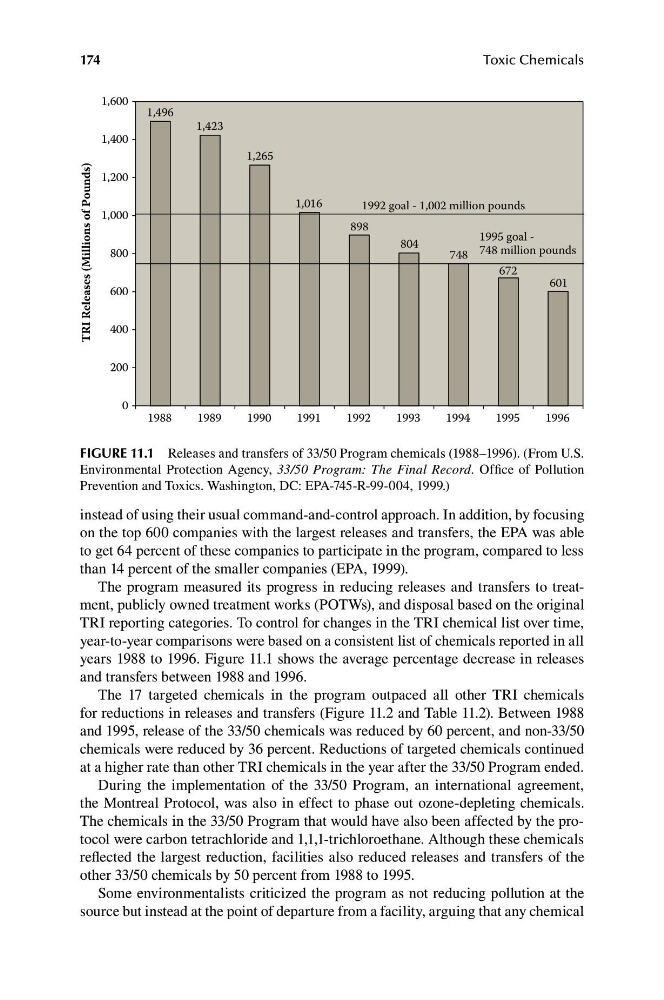
FIGURE 11.1 Releases and transfers of 33/50 Program chemicals (1988–1996). (From U.S.
Environmental Protection Agency, 33/50 Program: The Final Record. Office of Pollution
Prevention and Toxics. Washington, DC: EPA-745-R-99-004, 1999.)
instead of using their usual command-and-control approach. In addition, by focusing
on the top 600 companies with the largest releases and transfers, the EPA was able
to get 64 percent of these companies to participate in the program, compared to less
than 14 percent of the smaller companies (EPA, 1999).
The program measured its progress in reducing releases and transfers to treatment, publicly owned treatment works (POTWs), and disposal based on the original
TRI reporting categories. To control for changes in the TRI chemical list over time,
year-to-year comparisons were based on a consistent list of chemicals reported in all
years 1988 to 1996. Figure 11.1 shows the average percentage decrease in releases
and transfers between 1988 and 1996.
The 17 targeted chemicals in the program outpaced all other TRI chemicals
for reductions in releases and transfers (Figure 11.2 and Table 11.2). Between 1988
and 1995, release of the 33/50 chemicals was reduced by 60 percent, and non-33/50
chemicals were reduced by 36 percent. Reductions of targeted chemicals continued
at a higher rate than other TRI chemicals in the year after the 33/50 Program ended.
During the implementation of the 33/50 Program, an international agreement,
the Montreal Protocol, was also in effect to phase out ozone-depleting chemicals.
The chemicals in the 33/50 Program that would have also been affected by the protocol were carbon tetrachloride and 1,1,1-trichloroethane. Although these chemicals
reflected the largest reduction, facilities also reduced releases and transfers of the
other 33/50 chemicals by 50 percent from 1988 to 1995.
Some environmentalists criticized the program as not reducing pollution at the
source but instead at the point of departure from a facility, arguing that any chemical
1,600
1,400
1,200
1,000
800
600
400
200
0
1988
1989
1990
1991
1992
1993
1994
1995
1996
1,496
1,423
1,265
1,016
898
804
748
672
601
1992 goal - 1,002 million pounds
1995 goal
748 million pounds
174
Toxic Chemicals
FIGURE 11.1 Releases and transfers of 33/50 Program chemicals (1988–1996). (From U.S.
Environmental Protection Agency, 33/50 Program: The Final Record. Office of Pollution
Prevention and Toxics. Washington, DC: EPA-745-R-99-004, 1999.)
instead of using their usual command-and-control approach. In addition, by focusing
on the top 600 companies with the largest releases and transfers, the EPA was able
to get 64 percent of these companies to participate in the program, compared to less
than 14 percent of the smaller companies (EPA, 1999).
The program measured its progress in reducing releases and transfers to treatment, publicly owned treatment works (POTWs), and disposal based on the original
TRI reporting categories. To control for changes in the TRI chemical list over time,
year-to-year comparisons were based on a consistent list of chemicals reported in all
years 1988 to 1996. Figure 11.1 shows the average percentage decrease in releases
and transfers between 1988 and 1996.
The 17 targeted chemicals in the program outpaced all other TRI chemicals
for reductions in releases and transfers (Figure 11.2 and Table 11.2). Between 1988
and 1995, release of the 33/50 chemicals was reduced by 60 percent, and non-33/50
chemicals were reduced by 36 percent. Reductions of targeted chemicals continued
at a higher rate than other TRI chemicals in the year after the 33/50 Program ended.
During the implementation of the 33/50 Program, an international agreement,
the Montreal Protocol, was also in effect to phase out ozone-depleting chemicals.
The chemicals in the 33/50 Program that would have also been affected by the protocol were carbon tetrachloride and 1,1,1-trichloroethane. Although these chemicals
reflected the largest reduction, facilities also reduced releases and transfers of the
other 33/50 chemicals by 50 percent from 1988 to 1995.
Some environmentalists criticized the program as not reducing pollution at the
source but instead at the point of departure from a facility, arguing that any chemical