

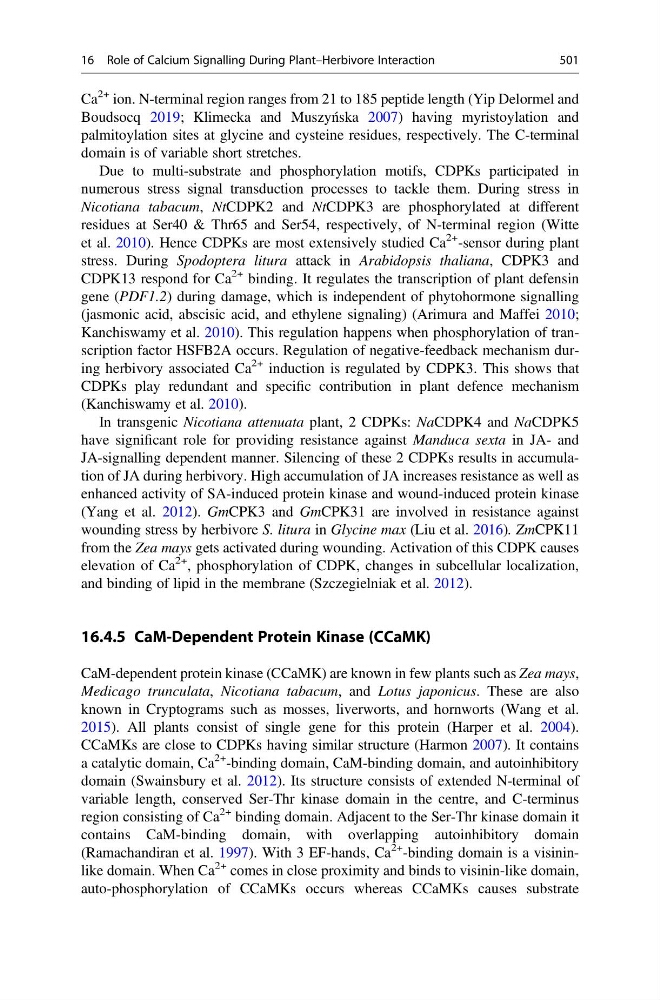
Ca
2+ ion. N-terminal region ranges from 21 to 185 peptide length (Yip Delormel and
Boudsocq 2019; Klimecka and Muszyńska 2007) having myristoylation and
palmitoylation sites at glycine and cysteine residues, respectively. The C-terminal
domain is of variable short stretches.
Due to multi-substrate and phosphorylation motifs, CDPKs participated in
numerous stress signal transduction processes to tackle them. During stress in
Nicotiana tabacum, NtCDPK2 and NtCDPK3 are phosphorylated at different
residues at Ser40 & Thr65 and Ser54, respectively, of N-terminal region (Witte
et al. 2010). Hence CDPKs are most extensively studied Ca
2+ -sensor during plant
stress. During Spodoptera litura attack in Arabidopsis thaliana, CDPK3 and
CDPK13 respond for Ca
2+ binding. It regulates the transcription of plant defensin
gene (PDF1.2) during damage, which is independent of phytohormone signalling
(jasmonic acid, abscisic acid, and ethylene signaling) (Arimura and Maffei 2010;
Kanchiswamy et al. 2010). This regulation happens when phosphorylation of transcription factor HSFB2A occurs. Regulation of negative-feedback mechanism during herbivory associated Ca
2+ induction is regulated by CDPK3. This shows that
CDPKs play redundant and specific contribution in plant defence mechanism
(Kanchiswamy et al. 2010).
In transgenic Nicotiana attenuata plant, 2 CDPKs: NaCDPK4 and NaCDPK5
have significant role for providing resistance against Manduca sexta in JA- and
JA-signalling dependent manner. Silencing of these 2 CDPKs results in accumulation of JA during herbivory. High accumulation of JA increases resistance as well as
enhanced activity of SA-induced protein kinase and wound-induced protein kinase
(Yang et al. 2012). GmCPK3 and GmCPK31 are involved in resistance against
wounding stress by herbivore S. litura in Glycine max (Liu et al. 2016). ZmCPK11
from the Zea mays gets activated during wounding. Activation of this CDPK causes
elevation of Ca
2+ , phosphorylation of CDPK, changes in subcellular localization,
and binding of lipid in the membrane (Szczegielniak et al. 2012).
16.4.5 CaM-Dependent Protein Kinase (CCaMK)
CaM-dependent protein kinase (CCaMK) are known in few plants such as Zea mays,
Medicago trunculata, Nicotiana tabacum, and Lotus japonicus. These are also
known in Cryptograms such as mosses, liverworts, and hornworts (Wang et al.
2015). All plants consist of single gene for this protein (Harper et al. 2004).
CCaMKs are close to CDPKs having similar structure (Harmon 2007). It contains
a catalytic domain, Ca
2+ -binding domain, CaM-binding domain, and autoinhibitory
domain (Swainsbury et al. 2012). Its structure consists of extended N-terminal of
variable length, conserved Ser-Thr kinase domain in the centre, and C-terminus
region consisting of Ca
2+ binding domain. Adjacent to the Ser-Thr kinase domain it
contains CaM-binding domain, with overlapping autoinhibitory domain
(Ramachandiran et al. 1997). With 3 EF-hands, Ca
2+ -binding domain is a visininlike domain. When Ca
2+ comes in close proximity and binds to visinin-like domain,
auto-phosphorylation of CCaMKs occurs whereas CCaMKs causes substrate
16 Role of Calcium Signalling During Plant–Herbivore Interaction
501
2+ ion. N-terminal region ranges from 21 to 185 peptide length (Yip Delormel and
Boudsocq 2019; Klimecka and Muszyńska 2007) having myristoylation and
palmitoylation sites at glycine and cysteine residues, respectively. The C-terminal
domain is of variable short stretches.
Due to multi-substrate and phosphorylation motifs, CDPKs participated in
numerous stress signal transduction processes to tackle them. During stress in
Nicotiana tabacum, NtCDPK2 and NtCDPK3 are phosphorylated at different
residues at Ser40 & Thr65 and Ser54, respectively, of N-terminal region (Witte
et al. 2010). Hence CDPKs are most extensively studied Ca
2+ -sensor during plant
stress. During Spodoptera litura attack in Arabidopsis thaliana, CDPK3 and
CDPK13 respond for Ca
2+ binding. It regulates the transcription of plant defensin
gene (PDF1.2) during damage, which is independent of phytohormone signalling
(jasmonic acid, abscisic acid, and ethylene signaling) (Arimura and Maffei 2010;
Kanchiswamy et al. 2010). This regulation happens when phosphorylation of transcription factor HSFB2A occurs. Regulation of negative-feedback mechanism during herbivory associated Ca
2+ induction is regulated by CDPK3. This shows that
CDPKs play redundant and specific contribution in plant defence mechanism
(Kanchiswamy et al. 2010).
In transgenic Nicotiana attenuata plant, 2 CDPKs: NaCDPK4 and NaCDPK5
have significant role for providing resistance against Manduca sexta in JA- and
JA-signalling dependent manner. Silencing of these 2 CDPKs results in accumulation of JA during herbivory. High accumulation of JA increases resistance as well as
enhanced activity of SA-induced protein kinase and wound-induced protein kinase
(Yang et al. 2012). GmCPK3 and GmCPK31 are involved in resistance against
wounding stress by herbivore S. litura in Glycine max (Liu et al. 2016). ZmCPK11
from the Zea mays gets activated during wounding. Activation of this CDPK causes
elevation of Ca
2+ , phosphorylation of CDPK, changes in subcellular localization,
and binding of lipid in the membrane (Szczegielniak et al. 2012).
16.4.5 CaM-Dependent Protein Kinase (CCaMK)
CaM-dependent protein kinase (CCaMK) are known in few plants such as Zea mays,
Medicago trunculata, Nicotiana tabacum, and Lotus japonicus. These are also
known in Cryptograms such as mosses, liverworts, and hornworts (Wang et al.
2015). All plants consist of single gene for this protein (Harper et al. 2004).
CCaMKs are close to CDPKs having similar structure (Harmon 2007). It contains
a catalytic domain, Ca
2+ -binding domain, CaM-binding domain, and autoinhibitory
domain (Swainsbury et al. 2012). Its structure consists of extended N-terminal of
variable length, conserved Ser-Thr kinase domain in the centre, and C-terminus
region consisting of Ca
2+ binding domain. Adjacent to the Ser-Thr kinase domain it
contains CaM-binding domain, with overlapping autoinhibitory domain
(Ramachandiran et al. 1997). With 3 EF-hands, Ca
2+ -binding domain is a visininlike domain. When Ca
2+ comes in close proximity and binds to visinin-like domain,
auto-phosphorylation of CCaMKs occurs whereas CCaMKs causes substrate
16 Role of Calcium Signalling During Plant–Herbivore Interaction
501