

flavonoids/AMF such as naringenin—F. mosseae, increased antioxidants efficiently
and attenuated oxidative loads, with the greatest redox stability attained by elevation
recycling of reduced glutathione and ascorbate facilitating the higher activity of
scavenging antioxidants (Garg and Singla 2015). AMF act by upregulating the
antioxidant enzymes as well as by modulating the level of glycine, betaine, proline,
and phenols expressed as response to abiotic stress such as salinity (Hashem et al.
2016). The intervention of AMF is very important to maintain physiological plant
function at stable level. Moreover, Bencherif et al. (2019b) explained the positive
role played by native inoculum and native co-inoculum to increase phosphorus and
nitrogen uptake from natural saline soils on T. articulata. On the other hand, positive
correlation between AMF and polyphenolic compounds was recorded on T. gallica
studied in natural semiarid soil (Bencherif et al. 2019c). Taken together, these
studies suggested that T. articulata and T. gallica have specific rhizosphere adapted
to different abiotic stress and play an important role in plant adaptation to these
environments, which allow the creating specific combinations based on native AMF
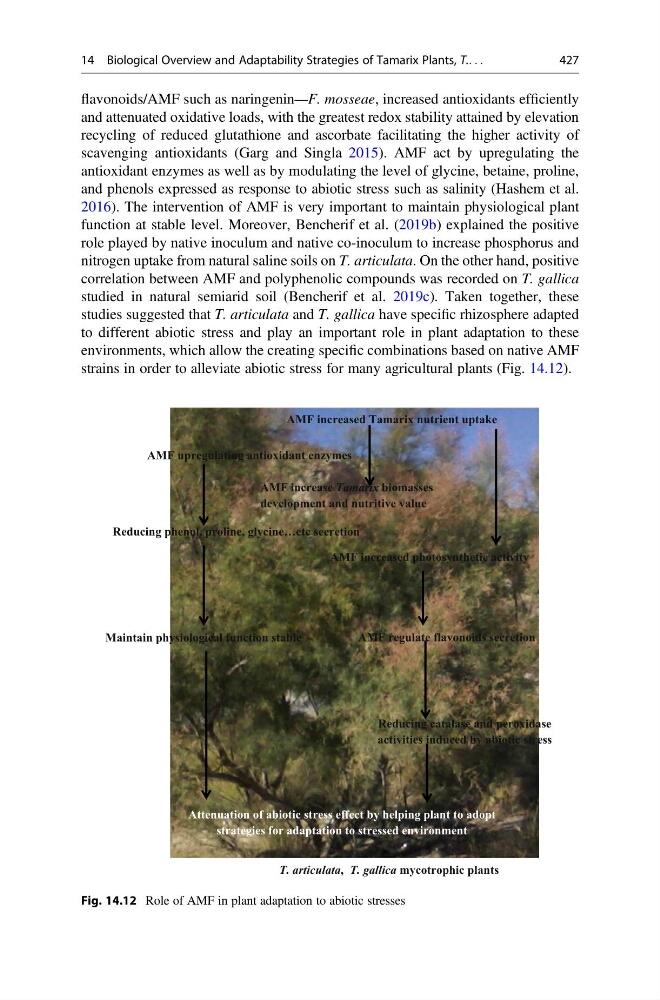
strains in order to alleviate abiotic stress for many agricultural plants (Fig. 14.12).
T. articulata, T. gallica mycotrophic plants
AMF regulate flavonoids secretion
AMF increase Tamarix biomasses
development and nutritive value
AMF increased photosynthetic activity
AMF increased Tamarix nutrient uptake
Reducing catalase and peroxidase
activities induced by abiotic stress
AMF upregulating antioxidant enzymes
Reducing phenol, proline, glycine…etc secretion
Maintain physiological function stable
Attenuation of abiotic stress effect by helping plant to adopt
strategies for adaptation to stressed environment
Fig. 14.12 Role of AMF in plant adaptation to abiotic stresses
14 Biological Overview and Adaptability Strategies of Tamarix Plants, T.. . .
427
and attenuated oxidative loads, with the greatest redox stability attained by elevation
recycling of reduced glutathione and ascorbate facilitating the higher activity of
scavenging antioxidants (Garg and Singla 2015). AMF act by upregulating the
antioxidant enzymes as well as by modulating the level of glycine, betaine, proline,
and phenols expressed as response to abiotic stress such as salinity (Hashem et al.
2016). The intervention of AMF is very important to maintain physiological plant
function at stable level. Moreover, Bencherif et al. (2019b) explained the positive
role played by native inoculum and native co-inoculum to increase phosphorus and
nitrogen uptake from natural saline soils on T. articulata. On the other hand, positive
correlation between AMF and polyphenolic compounds was recorded on T. gallica
studied in natural semiarid soil (Bencherif et al. 2019c). Taken together, these
studies suggested that T. articulata and T. gallica have specific rhizosphere adapted
to different abiotic stress and play an important role in plant adaptation to these
environments, which allow the creating specific combinations based on native AMF
strains in order to alleviate abiotic stress for many agricultural plants (Fig. 14.12).
T. articulata, T. gallica mycotrophic plants
AMF regulate flavonoids secretion
AMF increase Tamarix biomasses
development and nutritive value
AMF increased photosynthetic activity
AMF increased Tamarix nutrient uptake
Reducing catalase and peroxidase
activities induced by abiotic stress
AMF upregulating antioxidant enzymes
Reducing phenol, proline, glycine…etc secretion
Maintain physiological function stable
Attenuation of abiotic stress effect by helping plant to adopt
strategies for adaptation to stressed environment
Fig. 14.12 Role of AMF in plant adaptation to abiotic stresses
14 Biological Overview and Adaptability Strategies of Tamarix Plants, T.. . .
427