

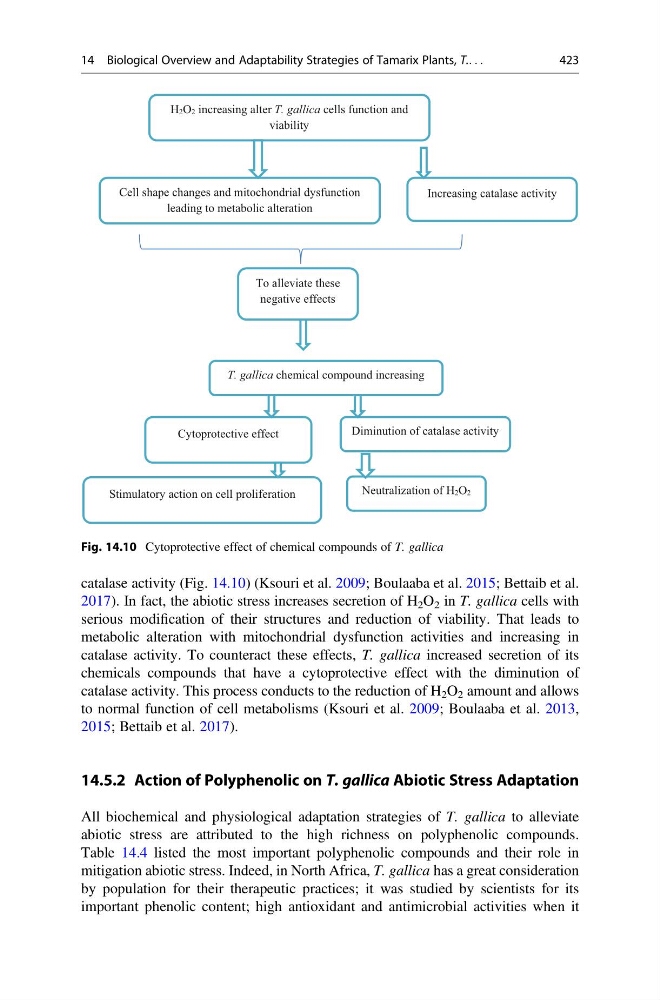
catalase activity (Fig. 14.10) (Ksouri et al. 2009; Boulaaba et al. 2015; Bettaib et al.
2017). In fact, the abiotic stress increases secretion of H 2 O 2 in T. gallica cells with
serious modification of their structures and reduction of viability. That leads to
metabolic alteration with mitochondrial dysfunction activities and increasing in
catalase activity. To counteract these effects, T. gallica increased secretion of its
chemicals compounds that have a cytoprotective effect with the diminution of
catalase activity. This process conducts to the reduction of H 2 O 2 amount and allows
to normal function of cell metabolisms (Ksouri et al. 2009; Boulaaba et al. 2013,
2015; Bettaib et al. 2017).
14.5.2 Action of Polyphenolic on T. gallica Abiotic Stress Adaptation
All biochemical and physiological adaptation strategies of T. gallica to alleviate
abiotic stress are attributed to the high richness on polyphenolic compounds.
Table 14.4 listed the most important polyphenolic compounds and their role in
mitigation abiotic stress. Indeed, in North Africa, T. gallica has a great consideration
by population for their therapeutic practices; it was studied by scientists for its
important phenolic content; high antioxidant and antimicrobial activities when it
H2O2 increasing alter T. gallica cells function and
viability
Cell shape changes and mitochondrial dysfunction
leading to metabolic alteration
Cytoprotective effect
T. gallica chemical compound increasing
Stimulatory action on cell proliferation
Increasing catalase activity
Diminution of catalase activity
Neutralization of H2O2
To alleviate these
negative effects
Fig. 14.10 Cytoprotective effect of chemical compounds of T. gallica
14 Biological Overview and Adaptability Strategies of Tamarix Plants, T.. . .
423
2017). In fact, the abiotic stress increases secretion of H 2 O 2 in T. gallica cells with
serious modification of their structures and reduction of viability. That leads to
metabolic alteration with mitochondrial dysfunction activities and increasing in
catalase activity. To counteract these effects, T. gallica increased secretion of its
chemicals compounds that have a cytoprotective effect with the diminution of
catalase activity. This process conducts to the reduction of H 2 O 2 amount and allows
to normal function of cell metabolisms (Ksouri et al. 2009; Boulaaba et al. 2013,
2015; Bettaib et al. 2017).
14.5.2 Action of Polyphenolic on T. gallica Abiotic Stress Adaptation
All biochemical and physiological adaptation strategies of T. gallica to alleviate
abiotic stress are attributed to the high richness on polyphenolic compounds.
Table 14.4 listed the most important polyphenolic compounds and their role in
mitigation abiotic stress. Indeed, in North Africa, T. gallica has a great consideration
by population for their therapeutic practices; it was studied by scientists for its
important phenolic content; high antioxidant and antimicrobial activities when it
H2O2 increasing alter T. gallica cells function and
viability
Cell shape changes and mitochondrial dysfunction
leading to metabolic alteration
Cytoprotective effect
T. gallica chemical compound increasing
Stimulatory action on cell proliferation
Increasing catalase activity
Diminution of catalase activity
Neutralization of H2O2
To alleviate these
negative effects
Fig. 14.10 Cytoprotective effect of chemical compounds of T. gallica
14 Biological Overview and Adaptability Strategies of Tamarix Plants, T.. . .
423