

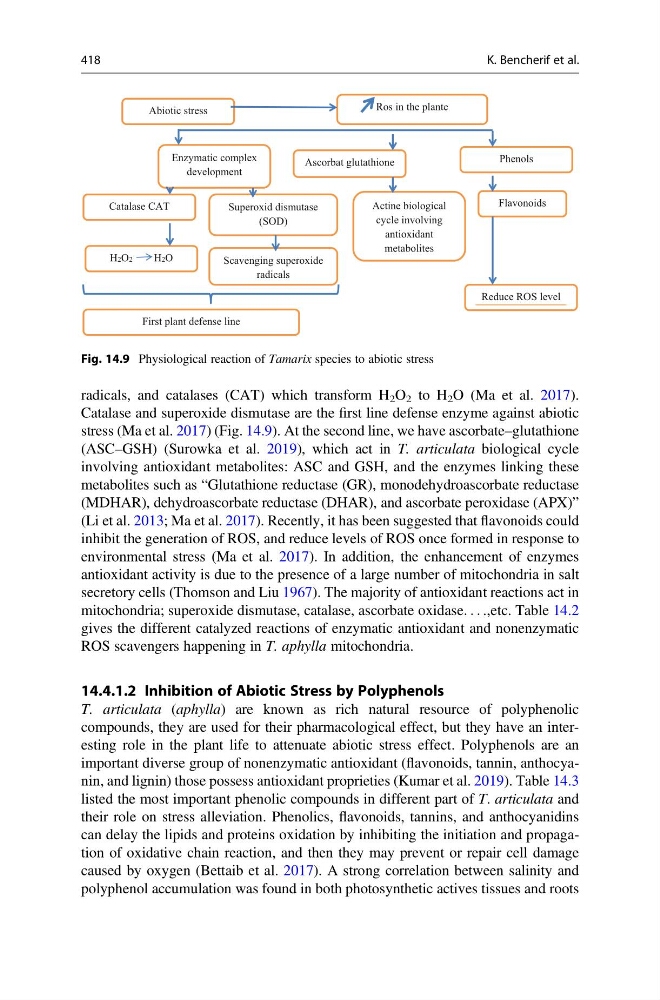
radicals, and catalases (CAT) which transform H 2 O 2 to H 2 O (Ma et al. 2017).
Catalase and superoxide dismutase are the first line defense enzyme against abiotic
stress (Ma et al. 2017) (Fig. 14.9). At the second line, we have ascorbate–glutathione
(ASC–GSH) (Surowka et al. 2019), which act in T. articulata biological cycle
involving antioxidant metabolites: ASC and GSH, and the enzymes linking these
metabolites such as “Glutathione reductase (GR), monodehydroascorbate reductase
(MDHAR), dehydroascorbate reductase (DHAR), and ascorbate peroxidase (APX)”
(Li et al. 2013; Ma et al. 2017). Recently, it has been suggested that flavonoids could
inhibit the generation of ROS, and reduce levels of ROS once formed in response to
environmental stress (Ma et al. 2017). In addition, the enhancement of enzymes
antioxidant activity is due to the presence of a large number of mitochondria in salt
secretory cells (Thomson and Liu 1967). The majority of antioxidant reactions act in
mitochondria; superoxide dismutase, catalase, ascorbate oxidase. . . .,etc. Table 14.2
gives the different catalyzed reactions of enzymatic antioxidant and nonenzymatic
ROS scavengers happening in T. aphylla mitochondria.
14.4.1.2 Inhibition of Abiotic Stress by Polyphenols
T. articulata (aphylla) are known as rich natural resource of polyphenolic
compounds, they are used for their pharmacological effect, but they have an interesting role in the plant life to attenuate abiotic stress effect. Polyphenols are an
important diverse group of nonenzymatic antioxidant (flavonoids, tannin, anthocyanin, and lignin) those possess antioxidant proprieties (Kumar et al. 2019). Table 14.3
listed the most important phenolic compounds in different part of T. articulata and
their role on stress alleviation. Phenolics, flavonoids, tannins, and anthocyanidins
can delay the lipids and proteins oxidation by inhibiting the initiation and propagation of oxidative chain reaction, and then they may prevent or repair cell damage
caused by oxygen (Bettaib et al. 2017). A strong correlation between salinity and
polyphenol accumulation was found in both photosynthetic actives tissues and roots
Abiotic stress
Ros in the plante
Enzymatic complex
development
Ascorbat glutathione
Phenols
Catalase CAT
Superoxid dismutase
(SOD)
Actine biological
cycle involving
antioxidant
metabolites
Flavonoids
H2O2
H2O
Scavenging superoxide
radicals
Reduce ROS level
First plant defense line
Fig. 14.9 Physiological reaction of Tamarix species to abiotic stress
418
K. Bencherif et al.
Catalase and superoxide dismutase are the first line defense enzyme against abiotic
stress (Ma et al. 2017) (Fig. 14.9). At the second line, we have ascorbate–glutathione
(ASC–GSH) (Surowka et al. 2019), which act in T. articulata biological cycle
involving antioxidant metabolites: ASC and GSH, and the enzymes linking these
metabolites such as “Glutathione reductase (GR), monodehydroascorbate reductase
(MDHAR), dehydroascorbate reductase (DHAR), and ascorbate peroxidase (APX)”
(Li et al. 2013; Ma et al. 2017). Recently, it has been suggested that flavonoids could
inhibit the generation of ROS, and reduce levels of ROS once formed in response to
environmental stress (Ma et al. 2017). In addition, the enhancement of enzymes
antioxidant activity is due to the presence of a large number of mitochondria in salt
secretory cells (Thomson and Liu 1967). The majority of antioxidant reactions act in
mitochondria; superoxide dismutase, catalase, ascorbate oxidase. . . .,etc. Table 14.2
gives the different catalyzed reactions of enzymatic antioxidant and nonenzymatic
ROS scavengers happening in T. aphylla mitochondria.
14.4.1.2 Inhibition of Abiotic Stress by Polyphenols
T. articulata (aphylla) are known as rich natural resource of polyphenolic
compounds, they are used for their pharmacological effect, but they have an interesting role in the plant life to attenuate abiotic stress effect. Polyphenols are an
important diverse group of nonenzymatic antioxidant (flavonoids, tannin, anthocyanin, and lignin) those possess antioxidant proprieties (Kumar et al. 2019). Table 14.3
listed the most important phenolic compounds in different part of T. articulata and
their role on stress alleviation. Phenolics, flavonoids, tannins, and anthocyanidins
can delay the lipids and proteins oxidation by inhibiting the initiation and propagation of oxidative chain reaction, and then they may prevent or repair cell damage
caused by oxygen (Bettaib et al. 2017). A strong correlation between salinity and
polyphenol accumulation was found in both photosynthetic actives tissues and roots
Abiotic stress
Ros in the plante
Enzymatic complex
development
Ascorbat glutathione
Phenols
Catalase CAT
Superoxid dismutase
(SOD)
Actine biological
cycle involving
antioxidant
metabolites
Flavonoids
H2O2
H2O
Scavenging superoxide
radicals
Reduce ROS level
First plant defense line
Fig. 14.9 Physiological reaction of Tamarix species to abiotic stress
418
K. Bencherif et al.