

secreted solution and accumulate in the region of the wall protuberances. In addition,
T. articulata secretory cells observed a large number of mitochondria (Thomson and
Liu 1967), which indicated that the intercellular transportation of ions in the salt
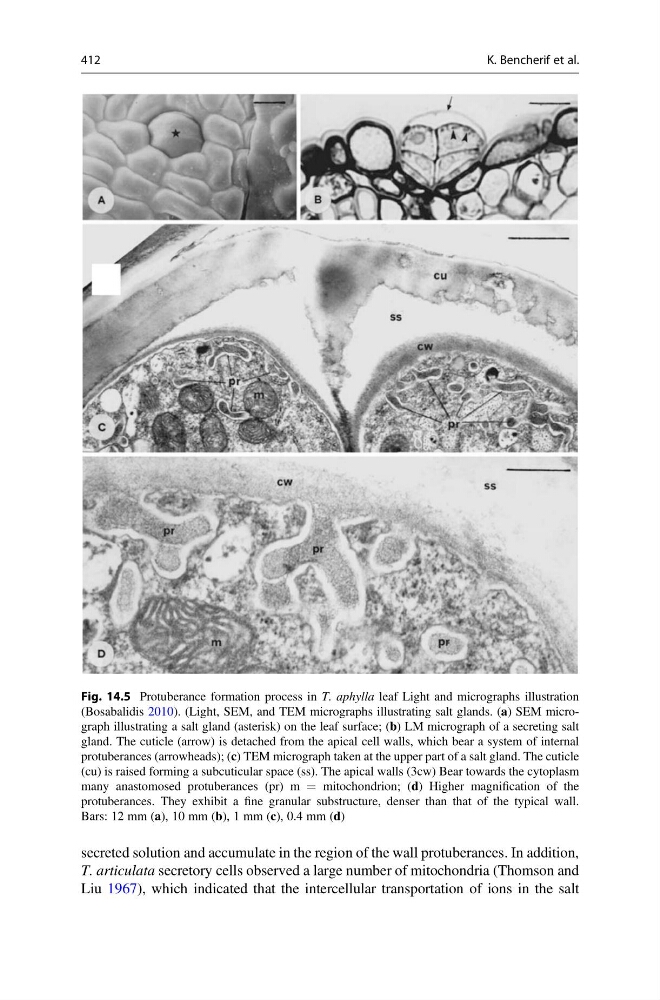
Fig. 14.5 Protuberance formation process in T. aphylla leaf Light and micrographs illustration
(Bosabalidis 2010). (Light, SEM, and TEM micrographs illustrating salt glands. (a) SEM micrograph illustrating a salt gland (asterisk) on the leaf surface; (b) LM micrograph of a secreting salt
gland. The cuticle (arrow) is detached from the apical cell walls, which bear a system of internal
protuberances (arrowheads); (c) TEM micrograph taken at the upper part of a salt gland. The cuticle
(cu) is raised forming a subcuticular space (ss). The apical walls (3cw) Bear towards the cytoplasm
many anastomosed protuberances (pr) m ¼ mitochondrion; (d) Higher magnification of the
protuberances. They exhibit a fine granular substructure, denser than that of the typical wall.
Bars: 12 mm (a), 10 mm (b), 1 mm (c), 0.4 mm (d)
412
K. Bencherif et al.
T. articulata secretory cells observed a large number of mitochondria (Thomson and
Liu 1967), which indicated that the intercellular transportation of ions in the salt
Fig. 14.5 Protuberance formation process in T. aphylla leaf Light and micrographs illustration
(Bosabalidis 2010). (Light, SEM, and TEM micrographs illustrating salt glands. (a) SEM micrograph illustrating a salt gland (asterisk) on the leaf surface; (b) LM micrograph of a secreting salt
gland. The cuticle (arrow) is detached from the apical cell walls, which bear a system of internal
protuberances (arrowheads); (c) TEM micrograph taken at the upper part of a salt gland. The cuticle
(cu) is raised forming a subcuticular space (ss). The apical walls (3cw) Bear towards the cytoplasm
many anastomosed protuberances (pr) m ¼ mitochondrion; (d) Higher magnification of the
protuberances. They exhibit a fine granular substructure, denser than that of the typical wall.
Bars: 12 mm (a), 10 mm (b), 1 mm (c), 0.4 mm (d)
412
K. Bencherif et al.