

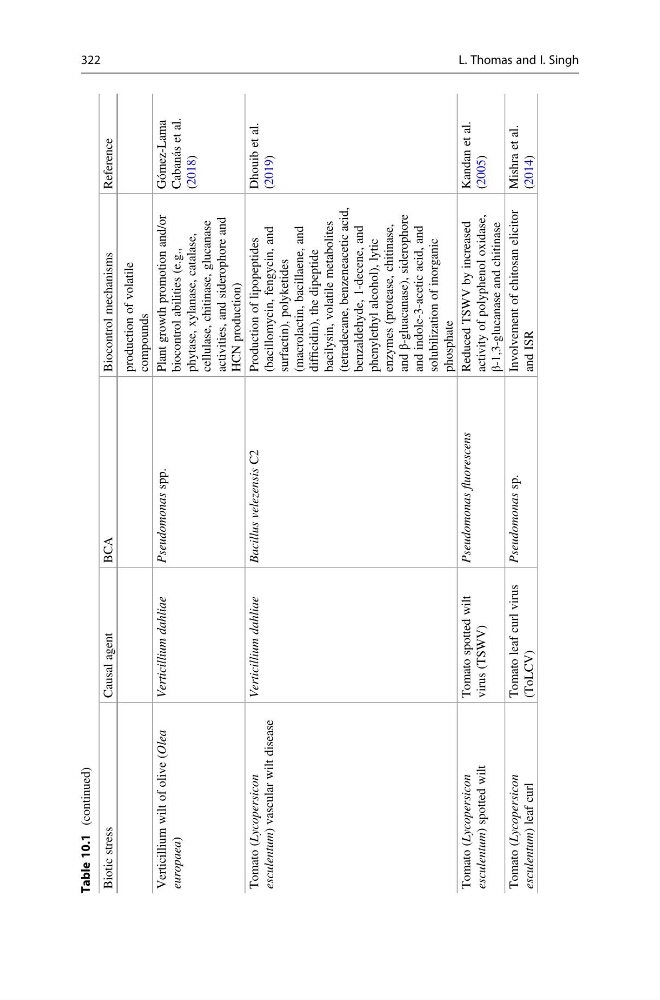
Table 10.1
(continued)
Biotic stress
Causal agent
BCA
Biocontrol mechanisms
Reference
production of volatile
compounds
Verticillium wilt of olive (Olea
europaea)
Verticillium dahliae
Pseudomonas
spp.
Plant growth promotion and/or
biocontrol abilities (e.g.,
phytase, xylanase, catalase,
cellulase, chitinase, glucanase
activities, and siderophore and
HCN production)
Gómez-Lama
Cabanás et al.
(2018)
Tomato (Lycopersicon
esculentum)
vascular wilt disease
Verticillium dahliae
Bacillus velezensis
C2
Production of lipopeptides
(bacillomycin, fengycin, and
surfactin), polyketides
(macrolactin, bacillaene, and
difficidin), the dipeptide
bacilysin, volatile metabolites
(tetradecane, benzeneacetic acid,
benzaldehyde, 1-decene, and
phenylethyl alcohol), lytic
enzymes (protease, chitinase,
and
β-gluacanase), siderophore
and indole-3-acetic acid, and
solubilization of inorganic
phosphate
Dhouib et al.
(2019)
Tomato (Lycopersicon
esculentum)
spotted wilt
Tomato spotted wilt
virus (TSWV)
Pseudomonas
fluorescens
Reduced TSWV by increased
activity of polyphenol oxidase,
β-1,3-glucanase and chitinase
Kandan et al.
(2005)
Tomato (Lycopersicon
esculentum)
leaf curl
Tomato leaf curl virus
(ToLCV)
Pseudomonas
sp.
Involvement of chitosan elicitor
and ISR
Mishra et al.
(2014)
322
L. Thomas and I. Singh
(continued)
Biotic stress
Causal agent
BCA
Biocontrol mechanisms
Reference
production of volatile
compounds
Verticillium wilt of olive (Olea
europaea)
Verticillium dahliae
Pseudomonas
spp.
Plant growth promotion and/or
biocontrol abilities (e.g.,
phytase, xylanase, catalase,
cellulase, chitinase, glucanase
activities, and siderophore and
HCN production)
Gómez-Lama
Cabanás et al.
(2018)
Tomato (Lycopersicon
esculentum)
vascular wilt disease
Verticillium dahliae
Bacillus velezensis
C2
Production of lipopeptides
(bacillomycin, fengycin, and
surfactin), polyketides
(macrolactin, bacillaene, and
difficidin), the dipeptide
bacilysin, volatile metabolites
(tetradecane, benzeneacetic acid,
benzaldehyde, 1-decene, and
phenylethyl alcohol), lytic
enzymes (protease, chitinase,
and
β-gluacanase), siderophore
and indole-3-acetic acid, and
solubilization of inorganic
phosphate
Dhouib et al.
(2019)
Tomato (Lycopersicon
esculentum)
spotted wilt
Tomato spotted wilt
virus (TSWV)
Pseudomonas
fluorescens
Reduced TSWV by increased
activity of polyphenol oxidase,
β-1,3-glucanase and chitinase
Kandan et al.
(2005)
Tomato (Lycopersicon
esculentum)
leaf curl
Tomato leaf curl virus
(ToLCV)
Pseudomonas
sp.
Involvement of chitosan elicitor
and ISR
Mishra et al.
(2014)
322
L. Thomas and I. Singh