

9.4
Approaches to Combat Salinity Stress
Salinity is one of the major problems affecting the plants and an immediate solution
to this is required. Phytohormone application and genetic engineering are the two
most effective strategies in this regard.
9.4.1 Phytohormone Treatment to Enhance Salinity Stress
Tolerance
Phytohormones are proposed to be effective signalling molecules in plants that play
a crucial role in salinity stress alleviation. Several reports have been published where
jasmonic acid (Qiu et al. 2014; Ahmad et al. 2018) and salicylic acid (Idrees et al.
2012; Liu et al. 2016) when exogenously supplied to plants resulted in reducing
damage by salinity.
9.4.1.1 Application of Phytohormones for Salinity Tolerance in Plants
Under In-Vitro Conditions
Several approaches have been adopted for producing salt-tolerant plants. One such
approach is by using phytohormones (Salicylic acid and Jasmonic acid) under
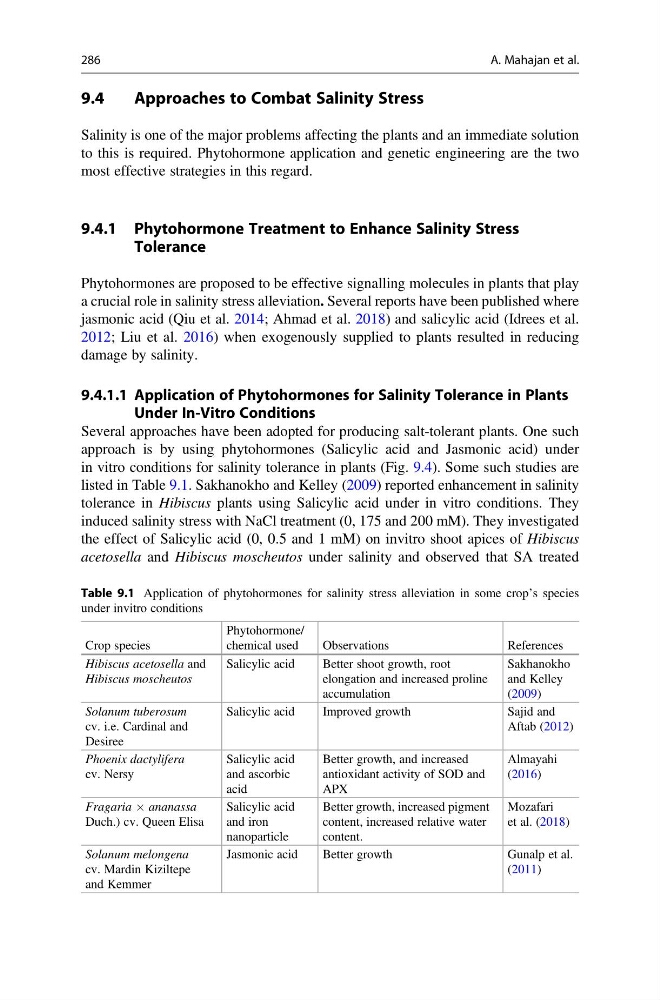
in vitro conditions for salinity tolerance in plants (Fig. 9.4). Some such studies are
listed in Table 9.1. Sakhanokho and Kelley (2009) reported enhancement in salinity
tolerance in Hibiscus plants using Salicylic acid under in vitro conditions. They
induced salinity stress with NaCl treatment (0, 175 and 200 mM). They investigated
the effect of Salicylic acid (0, 0.5 and 1 mM) on invitro shoot apices of Hibiscus
acetosella and Hibiscus moscheutos under salinity and observed that SA treated
Table 9.1 Application of phytohormones for salinity stress alleviation in some crop’s species
under invitro conditions
Crop species
Phytohormone/
chemical used
Observations
References
Hibiscus acetosella and
Hibiscus moscheutos
Salicylic acid
Better shoot growth, root
elongation and increased proline
accumulation
Sakhanokho
and Kelley
(2009)
Solanum tuberosum
cv. i.e. Cardinal and
Desiree
Salicylic acid
Improved growth
Sajid and
Aftab (2012)
Phoenix dactylifera
cv. Nersy
Salicylic acid
and ascorbic
acid
Better growth, and increased
antioxidant activity of SOD and
APX
Almayahi
(2016)
Fragaria  ananassa
Duch.) cv. Queen Elisa
Salicylic acid
and iron
nanoparticle
Better growth, increased pigment
content, increased relative water
content.
Mozafari
et al. (2018)
Solanum melongena
cv. Mardin Kiziltepe
and Kemmer
Jasmonic acid
Better growth
Gunalp et al.
(2011)
286
A. Mahajan et al.
Approaches to Combat Salinity Stress
Salinity is one of the major problems affecting the plants and an immediate solution
to this is required. Phytohormone application and genetic engineering are the two
most effective strategies in this regard.
9.4.1 Phytohormone Treatment to Enhance Salinity Stress
Tolerance
Phytohormones are proposed to be effective signalling molecules in plants that play
a crucial role in salinity stress alleviation. Several reports have been published where
jasmonic acid (Qiu et al. 2014; Ahmad et al. 2018) and salicylic acid (Idrees et al.
2012; Liu et al. 2016) when exogenously supplied to plants resulted in reducing
damage by salinity.
9.4.1.1 Application of Phytohormones for Salinity Tolerance in Plants
Under In-Vitro Conditions
Several approaches have been adopted for producing salt-tolerant plants. One such
approach is by using phytohormones (Salicylic acid and Jasmonic acid) under
in vitro conditions for salinity tolerance in plants (Fig. 9.4). Some such studies are
listed in Table 9.1. Sakhanokho and Kelley (2009) reported enhancement in salinity
tolerance in Hibiscus plants using Salicylic acid under in vitro conditions. They
induced salinity stress with NaCl treatment (0, 175 and 200 mM). They investigated
the effect of Salicylic acid (0, 0.5 and 1 mM) on invitro shoot apices of Hibiscus
acetosella and Hibiscus moscheutos under salinity and observed that SA treated
Table 9.1 Application of phytohormones for salinity stress alleviation in some crop’s species
under invitro conditions
Crop species
Phytohormone/
chemical used
Observations
References
Hibiscus acetosella and
Hibiscus moscheutos
Salicylic acid
Better shoot growth, root
elongation and increased proline
accumulation
Sakhanokho
and Kelley
(2009)
Solanum tuberosum
cv. i.e. Cardinal and
Desiree
Salicylic acid
Improved growth
Sajid and
Aftab (2012)
Phoenix dactylifera
cv. Nersy
Salicylic acid
and ascorbic
acid
Better growth, and increased
antioxidant activity of SOD and
APX
Almayahi
(2016)
Fragaria  ananassa
Duch.) cv. Queen Elisa
Salicylic acid
and iron
nanoparticle
Better growth, increased pigment
content, increased relative water
content.
Mozafari
et al. (2018)
Solanum melongena
cv. Mardin Kiziltepe
and Kemmer
Jasmonic acid
Better growth
Gunalp et al.
(2011)
286
A. Mahajan et al.