

2007; Du et al. 2013; Qiu et al. 2014; Salimi et al. 2016; Fayez and Bazaid 2014;
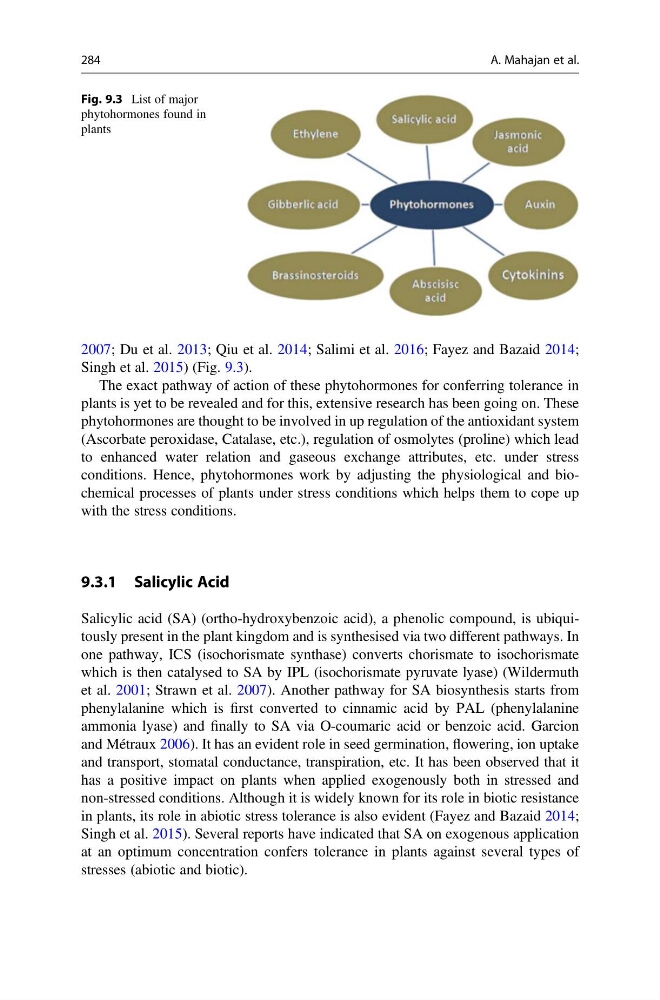
Singh et al. 2015) (Fig. 9.3).
The exact pathway of action of these phytohormones for conferring tolerance in
plants is yet to be revealed and for this, extensive research has been going on. These
phytohormones are thought to be involved in up regulation of the antioxidant system
(Ascorbate peroxidase, Catalase, etc.), regulation of osmolytes (proline) which lead
to enhanced water relation and gaseous exchange attributes, etc. under stress
conditions. Hence, phytohormones work by adjusting the physiological and biochemical processes of plants under stress conditions which helps them to cope up
with the stress conditions.
9.3.1 Salicylic Acid
Salicylic acid (SA) (ortho-hydroxybenzoic acid), a phenolic compound, is ubiquitously present in the plant kingdom and is synthesised via two different pathways. In
one pathway, ICS (isochorismate synthase) converts chorismate to isochorismate
which is then catalysed to SA by IPL (isochorismate pyruvate lyase) (Wildermuth
et al. 2001; Strawn et al. 2007). Another pathway for SA biosynthesis starts from
phenylalanine which is first converted to cinnamic acid by PAL (phenylalanine
ammonia lyase) and finally to SA via O-coumaric acid or benzoic acid. Garcion
and Métraux 2006). It has an evident role in seed germination, flowering, ion uptake
and transport, stomatal conductance, transpiration, etc. It has been observed that it
has a positive impact on plants when applied exogenously both in stressed and
non-stressed conditions. Although it is widely known for its role in biotic resistance
in plants, its role in abiotic stress tolerance is also evident (Fayez and Bazaid 2014;
Singh et al. 2015). Several reports have indicated that SA on exogenous application
at an optimum concentration confers tolerance in plants against several types of
stresses (abiotic and biotic).
Fig. 9.3 List of major
phytohormones found in
plants
284
A. Mahajan et al.
Singh et al. 2015) (Fig. 9.3).
The exact pathway of action of these phytohormones for conferring tolerance in
plants is yet to be revealed and for this, extensive research has been going on. These
phytohormones are thought to be involved in up regulation of the antioxidant system
(Ascorbate peroxidase, Catalase, etc.), regulation of osmolytes (proline) which lead
to enhanced water relation and gaseous exchange attributes, etc. under stress
conditions. Hence, phytohormones work by adjusting the physiological and biochemical processes of plants under stress conditions which helps them to cope up
with the stress conditions.
9.3.1 Salicylic Acid
Salicylic acid (SA) (ortho-hydroxybenzoic acid), a phenolic compound, is ubiquitously present in the plant kingdom and is synthesised via two different pathways. In
one pathway, ICS (isochorismate synthase) converts chorismate to isochorismate
which is then catalysed to SA by IPL (isochorismate pyruvate lyase) (Wildermuth
et al. 2001; Strawn et al. 2007). Another pathway for SA biosynthesis starts from
phenylalanine which is first converted to cinnamic acid by PAL (phenylalanine
ammonia lyase) and finally to SA via O-coumaric acid or benzoic acid. Garcion
and Métraux 2006). It has an evident role in seed germination, flowering, ion uptake
and transport, stomatal conductance, transpiration, etc. It has been observed that it
has a positive impact on plants when applied exogenously both in stressed and
non-stressed conditions. Although it is widely known for its role in biotic resistance
in plants, its role in abiotic stress tolerance is also evident (Fayez and Bazaid 2014;
Singh et al. 2015). Several reports have indicated that SA on exogenous application
at an optimum concentration confers tolerance in plants against several types of
stresses (abiotic and biotic).
Fig. 9.3 List of major
phytohormones found in
plants
284
A. Mahajan et al.