

showed significant increase in total root number when N supply was augmented
from 0 to 50, and from 50 to 500 μM (Ogawa et al. 2014). The variation observed
was ascribed to plasticity of the trait because of being influenced by other edaphic
factors. In another investigation, seminal root length increased by as much as 25%,
whereas lateral root density decreased under low Nitrogen condition in comparison
to control conditions after 16 days of N-deficiency stress (Sun et al. 2014, 2016).
Another plant where the effects of N-deficiency and toxicity have been well
studied is Arabidopsis thaliana. In a study, N was supplied either in a homogenous
(uniform across media) or heterogeneous (in patches of varying N-concentration)
manner. Under homogenous N-supply, primary root length decreases as
N-availability is increased, whereas lateral root density was found to remain
unchanged under varying N-supply (Linkohr et al. 2002). When N-supply was
administered in a heterogeneous manner, absolute primary root length was
unchanged from homogeneous N-supply except under extremely low N-condition
where the root length was reduced. However, under heterogeneous N-supply, lateral
root density increased as compared to homogeneous N-supply. The length of lateral
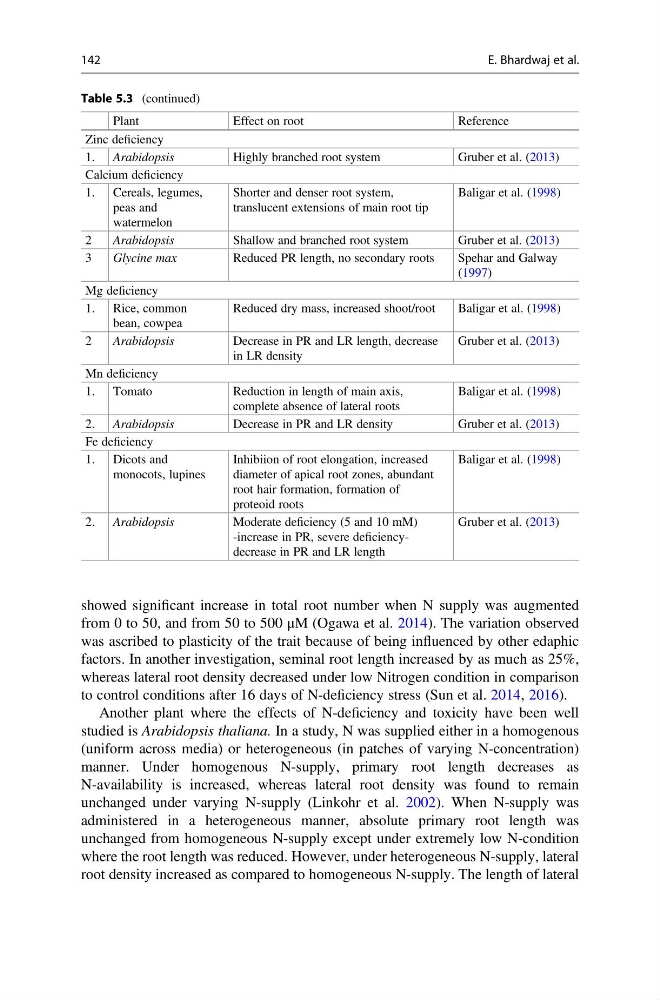
Table 5.3 (continued)
Plant
Effect on root
Reference
Zinc deficiency
1. Arabidopsis
Highly branched root system
Gruber et al. (2013)
Calcium deficiency
1. Cereals, legumes,
peas and
watermelon
Shorter and denser root system,
translucent extensions of main root tip
Baligar et al. (1998)
2
Arabidopsis
Shallow and branched root system
Gruber et al. (2013)
3
Glycine max
Reduced PR length, no secondary roots
Spehar and Galway
(1997)
Mg deficiency
1. Rice, common
bean, cowpea
Reduced dry mass, increased shoot/root
Baligar et al. (1998)
2
Arabidopsis
Decrease in PR and LR length, decrease
in LR density
Gruber et al. (2013)
Mn deficiency
1. Tomato
Reduction in length of main axis,
complete absence of lateral roots
Baligar et al. (1998)
2. Arabidopsis
Decrease in PR and LR density
Gruber et al. (2013)
Fe deficiency
1. Dicots and
monocots, lupines
Inhibiion of root elongation, increased
diameter of apical root zones, abundant
root hair formation, formation of
proteoid roots
Baligar et al. (1998)
2. Arabidopsis
Moderate deficiency (5 and 10 mM)
-increase in PR, severe deficiencydecrease in PR and LR length
Gruber et al. (2013)
142
E. Bhardwaj et al.
from 0 to 50, and from 50 to 500 μM (Ogawa et al. 2014). The variation observed
was ascribed to plasticity of the trait because of being influenced by other edaphic
factors. In another investigation, seminal root length increased by as much as 25%,
whereas lateral root density decreased under low Nitrogen condition in comparison
to control conditions after 16 days of N-deficiency stress (Sun et al. 2014, 2016).
Another plant where the effects of N-deficiency and toxicity have been well
studied is Arabidopsis thaliana. In a study, N was supplied either in a homogenous
(uniform across media) or heterogeneous (in patches of varying N-concentration)
manner. Under homogenous N-supply, primary root length decreases as
N-availability is increased, whereas lateral root density was found to remain
unchanged under varying N-supply (Linkohr et al. 2002). When N-supply was
administered in a heterogeneous manner, absolute primary root length was
unchanged from homogeneous N-supply except under extremely low N-condition
where the root length was reduced. However, under heterogeneous N-supply, lateral
root density increased as compared to homogeneous N-supply. The length of lateral
Table 5.3 (continued)
Plant
Effect on root
Reference
Zinc deficiency
1. Arabidopsis
Highly branched root system
Gruber et al. (2013)
Calcium deficiency
1. Cereals, legumes,
peas and
watermelon
Shorter and denser root system,
translucent extensions of main root tip
Baligar et al. (1998)
2
Arabidopsis
Shallow and branched root system
Gruber et al. (2013)
3
Glycine max
Reduced PR length, no secondary roots
Spehar and Galway
(1997)
Mg deficiency
1. Rice, common
bean, cowpea
Reduced dry mass, increased shoot/root
Baligar et al. (1998)
2
Arabidopsis
Decrease in PR and LR length, decrease
in LR density
Gruber et al. (2013)
Mn deficiency
1. Tomato
Reduction in length of main axis,
complete absence of lateral roots
Baligar et al. (1998)
2. Arabidopsis
Decrease in PR and LR density
Gruber et al. (2013)
Fe deficiency
1. Dicots and
monocots, lupines
Inhibiion of root elongation, increased
diameter of apical root zones, abundant
root hair formation, formation of
proteoid roots
Baligar et al. (1998)
2. Arabidopsis
Moderate deficiency (5 and 10 mM)
-increase in PR, severe deficiencydecrease in PR and LR length
Gruber et al. (2013)
142
E. Bhardwaj et al.