

75
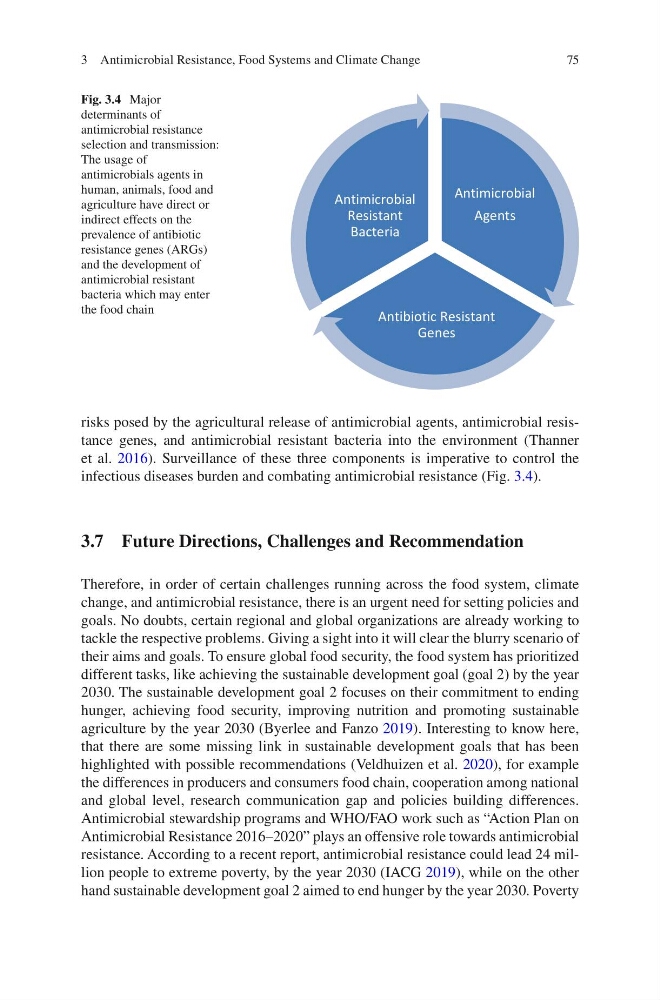
risks posed by the agricultural release of antimicrobial agents, antimicrobial resistance genes, and antimicrobial resistant bacteria into the environment (Thanner
et al. 2016). Surveillance of these three components is imperative to control the
infectious diseases burden and combating antimicrobial resistance (Fig. 3.4).
3.7 Future Directions, Challenges and Recommendation
Therefore, in order of certain challenges running across the food system, climate
change, and antimicrobial resistance, there is an urgent need for setting policies and
goals. No doubts, certain regional and global organizations are already working to
tackle the respective problems. Giving a sight into it will clear the blurry scenario of
their aims and goals. To ensure global food security, the food system has prioritized
different tasks, like achieving the sustainable development goal (goal 2) by the year
2030. The sustainable development goal 2 focuses on their commitment to ending
hunger, achieving food security, improving nutrition and promoting sustainable
agriculture by the year 2030 (Byerlee and Fanzo 2019). Interesting to know here,
that there are some missing link in sustainable development goals that has been
highlighted with possible recommendations (Veldhuizen et al. 2020), for example
the differences in producers and consumers food chain, cooperation among national
and global level, research communication gap and policies building differences.
Antimicrobial stewardship programs and WHO/FAO work such as “Action Plan on
Antimicrobial Resistance 2016–2020” plays an offensive role towards antimicrobial
resistance. According to a recent report, antimicrobial resistance could lead 24 million people to extreme poverty, by the year 2030 (IACG 2019), while on the other
hand sustainable development goal 2 aimed to end hunger by the year 2030. Poverty
Antimicrobial
Agents
Antibiotic Resistant
Genes
Antimicrobial
Resistant
Bacteria
Fig. 3.4 Major
determinants of
antimicrobial resistance
selection and transmission:
The usage of
antimicrobials agents in
human, animals, food and
agriculture have direct or
indirect effects on the
prevalence of antibiotic
resistance genes (ARGs)
and the development of
antimicrobial resistant
bacteria which may enter
the food chain
3 Antimicrobial Resistance, Food Systems and Climate Change
risks posed by the agricultural release of antimicrobial agents, antimicrobial resistance genes, and antimicrobial resistant bacteria into the environment (Thanner
et al. 2016). Surveillance of these three components is imperative to control the
infectious diseases burden and combating antimicrobial resistance (Fig. 3.4).
3.7 Future Directions, Challenges and Recommendation
Therefore, in order of certain challenges running across the food system, climate
change, and antimicrobial resistance, there is an urgent need for setting policies and
goals. No doubts, certain regional and global organizations are already working to
tackle the respective problems. Giving a sight into it will clear the blurry scenario of
their aims and goals. To ensure global food security, the food system has prioritized
different tasks, like achieving the sustainable development goal (goal 2) by the year
2030. The sustainable development goal 2 focuses on their commitment to ending
hunger, achieving food security, improving nutrition and promoting sustainable
agriculture by the year 2030 (Byerlee and Fanzo 2019). Interesting to know here,
that there are some missing link in sustainable development goals that has been
highlighted with possible recommendations (Veldhuizen et al. 2020), for example
the differences in producers and consumers food chain, cooperation among national
and global level, research communication gap and policies building differences.
Antimicrobial stewardship programs and WHO/FAO work such as “Action Plan on
Antimicrobial Resistance 2016–2020” plays an offensive role towards antimicrobial
resistance. According to a recent report, antimicrobial resistance could lead 24 million people to extreme poverty, by the year 2030 (IACG 2019), while on the other
hand sustainable development goal 2 aimed to end hunger by the year 2030. Poverty
Antimicrobial
Agents
Antibiotic Resistant
Genes
Antimicrobial
Resistant
Bacteria
Fig. 3.4 Major
determinants of
antimicrobial resistance
selection and transmission:
The usage of
antimicrobials agents in
human, animals, food and
agriculture have direct or
indirect effects on the
prevalence of antibiotic
resistance genes (ARGs)
and the development of
antimicrobial resistant
bacteria which may enter
the food chain
3 Antimicrobial Resistance, Food Systems and Climate Change