

74
3.6.2 Infectious Diseases: Impact on Food Security
The biodiversity of microorganisms has a significant relationship with the environment; the hazards of climate change affect the microbiota of terrestrial and marine
biomes (Harvell et al. 2002). Disease outbreaks and spread can only be controlled
by having comprehensive knowledge about the ecology of microbes with the host,
respective vectors and determining the role of the environment in its progression
(Altizer et al. 2013; Johnson et al. 2015). Different levels exist between the disease
emergence to progression, at which environmental factors decide the fate of intensity or adversity of disease. The rise in disease burden has been associated with the
increase of temperature, such as in the case of coral disease (Randall and Van
Woesik 2015). The agricultural growth and development depend on the climatic
conditions as well as other biotic and abiotic components, including the symbiosis
with microorganisms, sequestration, and liberation of several elements up to the
fixation of gases i.e. CO 2 . The species specific plant pathogen has a specific relationship and impact on the nourishment and propagation of crops in the natural
environment. There exist a wide range of microorganisms that have potential to
develop mild to deadly diseases in plants and cause severe harm to crops yield leading to the economic loses (Bebber et al. 2013).
Global food security and food production thus come under the threat of the antimicrobial resistance, alongside climate change. Both antimicrobial resistance and
climate change adversely affect sustainable agriculture practices. The vast plant
specific species of microbes and the diseases caused by them makes the whole food
web compromised in terms of their quality and quantity as well. Certain pathogens
have a distinct response with the climatic conditions, like food borne, water borne
and vector borne. The agriculture and human actions are directly influencing the
dispersal of microbes as in the case of agro-adopted pathogens (Croll and McDonald
2017), in accounting within the space and time of climate change across the different regions and boundaries i.e. trade. These agro-adopted pathogens are more resistant, more destructive in a sense of possessing resistance to their remedy and
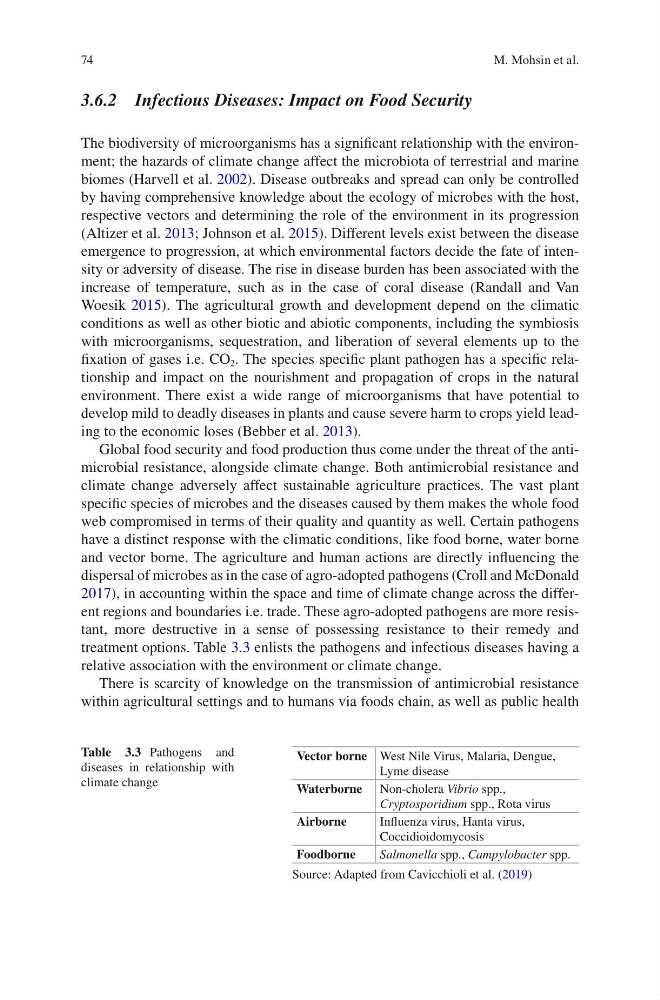
treatment options. Table 3.3 enlists the pathogens and infectious diseases having a
relative association with the environment or climate change.
There is scarcity of knowledge on the transmission of antimicrobial resistance
within agricultural settings and to humans via foods chain, as well as public health
Table 3.3 Pathogens and
diseases in relationship with
climate change
Vector borne West Nile Virus, Malaria, Dengue,
Lyme disease
Waterborne Non-cholera Vibrio spp.,
Cryptosporidium spp., Rota virus
Airborne
Influenza virus, Hanta virus,
Coccidioidomycosis
Foodborne
Salmonella spp., Campylobacter spp.
Source: Adapted from Cavicchioli et al. (2019)
M. Mohsin et al.
3.6.2 Infectious Diseases: Impact on Food Security
The biodiversity of microorganisms has a significant relationship with the environment; the hazards of climate change affect the microbiota of terrestrial and marine
biomes (Harvell et al. 2002). Disease outbreaks and spread can only be controlled
by having comprehensive knowledge about the ecology of microbes with the host,
respective vectors and determining the role of the environment in its progression
(Altizer et al. 2013; Johnson et al. 2015). Different levels exist between the disease
emergence to progression, at which environmental factors decide the fate of intensity or adversity of disease. The rise in disease burden has been associated with the
increase of temperature, such as in the case of coral disease (Randall and Van
Woesik 2015). The agricultural growth and development depend on the climatic
conditions as well as other biotic and abiotic components, including the symbiosis
with microorganisms, sequestration, and liberation of several elements up to the
fixation of gases i.e. CO 2 . The species specific plant pathogen has a specific relationship and impact on the nourishment and propagation of crops in the natural
environment. There exist a wide range of microorganisms that have potential to
develop mild to deadly diseases in plants and cause severe harm to crops yield leading to the economic loses (Bebber et al. 2013).
Global food security and food production thus come under the threat of the antimicrobial resistance, alongside climate change. Both antimicrobial resistance and
climate change adversely affect sustainable agriculture practices. The vast plant
specific species of microbes and the diseases caused by them makes the whole food
web compromised in terms of their quality and quantity as well. Certain pathogens
have a distinct response with the climatic conditions, like food borne, water borne
and vector borne. The agriculture and human actions are directly influencing the
dispersal of microbes as in the case of agro-adopted pathogens (Croll and McDonald
2017), in accounting within the space and time of climate change across the different regions and boundaries i.e. trade. These agro-adopted pathogens are more resistant, more destructive in a sense of possessing resistance to their remedy and
treatment options. Table 3.3 enlists the pathogens and infectious diseases having a
relative association with the environment or climate change.
There is scarcity of knowledge on the transmission of antimicrobial resistance
within agricultural settings and to humans via foods chain, as well as public health
Table 3.3 Pathogens and
diseases in relationship with
climate change
Vector borne West Nile Virus, Malaria, Dengue,
Lyme disease
Waterborne Non-cholera Vibrio spp.,
Cryptosporidium spp., Rota virus
Airborne
Influenza virus, Hanta virus,
Coccidioidomycosis
Foodborne
Salmonella spp., Campylobacter spp.
Source: Adapted from Cavicchioli et al. (2019)
M. Mohsin et al.