

42
evidence based interventions to tackle rising antimicrobial resistance (Aarestrup
et al. 2008; O’Neill 2016; Perry and Wright 2014).
Resistance surveillance and consumption of antimicrobials in both human and
non human area require investigation for estimating the patterns, extent, and magnitude of antimicrobial resistance at the regional, national, and international level
(Collignon and Voss 2015; WHO 2017). These surveillance programs should be
able to identify emerging trends in antimicrobial resistance of clinical significance
to animals and humans (ECDC 2017). Such surveillance should notify educational
efforts to reduce antimicrobial resistance, as well as use of antimicrobial policies
and antimicrobial stewardship programs (Aarestrup et al. 2008; O’Neill 2016;
WHO 2015). Frequent surveillance is also required to estimate the success of interventions and other parameters that are taken to curb antimicrobial resistance
(Torren-Edo et al. 2015). Resistance surveillance of One Health programs should
consist sampling of target bacteria from specimens collected from different human,
animal, and environmental settings including community settings, hospitals, farms,
veterinary clinics, food, and the environment (Torren-Edo et al. 2015; WHO 2017).
Surveillance of use of antimicrobial should also be performed in human, agricultural, and veterinary settings and should make available the estimates of antibiotic
intake in humans and animals at the national point along with suitable denominators
to facilitate nation wise comparisons (WHO 2017). To supply information that is
valuable for assessing and guiding prescription practices and antimicrobial use
behaviours, monitoring of antimicrobial use should also be performed at the level of
prescribing (e.g. hospitals, veterinary clinic, community, and farm) (DANMAP
2015; Speksnijder et al. 2015; WHO 2017). Data of surveillance should be interpreted and analyzed in an organized manner across sectors, along with the reports
available well on time. WHO has issued guidance on integrated and harmonized
surveillance of antimicrobial resistance and use of antimicrobial to assist developing and developed countries in executing their individual surveillance programs
enhancing worldwide surveillance activities, which are crucial for improved
Humans
Farm
Animals
One
Health
Environ
ment
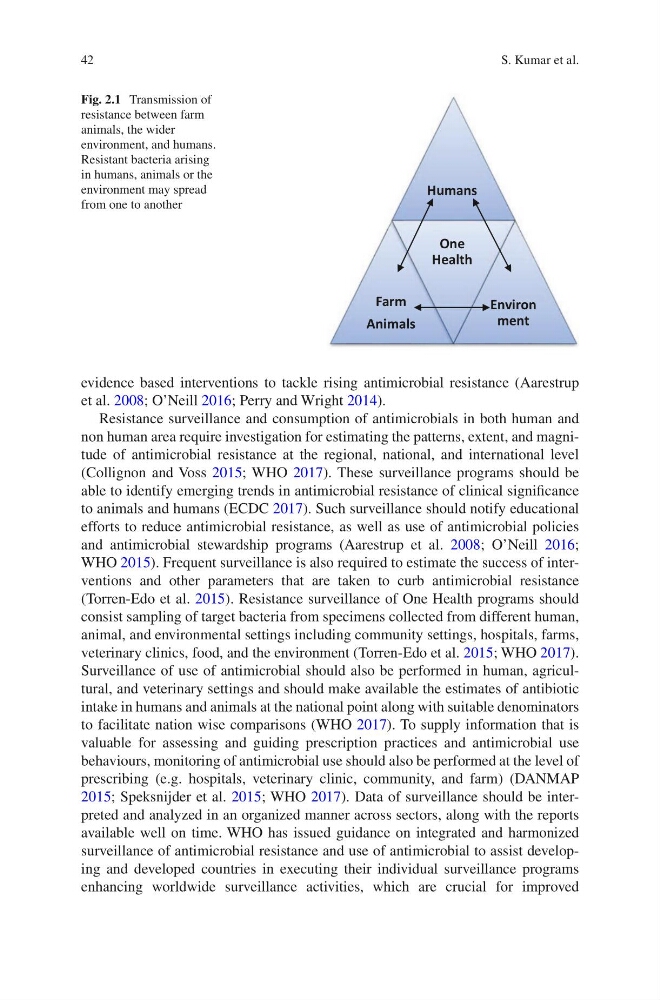
Fig. 2.1 Transmission of
resistance between farm
animals, the wider
environment, and humans.
Resistant bacteria arising
in humans, animals or the
environment may spread
from one to another
S. Kumar et al.
evidence based interventions to tackle rising antimicrobial resistance (Aarestrup
et al. 2008; O’Neill 2016; Perry and Wright 2014).
Resistance surveillance and consumption of antimicrobials in both human and
non human area require investigation for estimating the patterns, extent, and magnitude of antimicrobial resistance at the regional, national, and international level
(Collignon and Voss 2015; WHO 2017). These surveillance programs should be
able to identify emerging trends in antimicrobial resistance of clinical significance
to animals and humans (ECDC 2017). Such surveillance should notify educational
efforts to reduce antimicrobial resistance, as well as use of antimicrobial policies
and antimicrobial stewardship programs (Aarestrup et al. 2008; O’Neill 2016;
WHO 2015). Frequent surveillance is also required to estimate the success of interventions and other parameters that are taken to curb antimicrobial resistance
(Torren-Edo et al. 2015). Resistance surveillance of One Health programs should
consist sampling of target bacteria from specimens collected from different human,
animal, and environmental settings including community settings, hospitals, farms,
veterinary clinics, food, and the environment (Torren-Edo et al. 2015; WHO 2017).
Surveillance of use of antimicrobial should also be performed in human, agricultural, and veterinary settings and should make available the estimates of antibiotic
intake in humans and animals at the national point along with suitable denominators
to facilitate nation wise comparisons (WHO 2017). To supply information that is
valuable for assessing and guiding prescription practices and antimicrobial use
behaviours, monitoring of antimicrobial use should also be performed at the level of
prescribing (e.g. hospitals, veterinary clinic, community, and farm) (DANMAP
2015; Speksnijder et al. 2015; WHO 2017). Data of surveillance should be interpreted and analyzed in an organized manner across sectors, along with the reports
available well on time. WHO has issued guidance on integrated and harmonized
surveillance of antimicrobial resistance and use of antimicrobial to assist developing and developed countries in executing their individual surveillance programs
enhancing worldwide surveillance activities, which are crucial for improved
Humans
Farm
Animals
One
Health
Environ
ment
Fig. 2.1 Transmission of
resistance between farm
animals, the wider
environment, and humans.
Resistant bacteria arising
in humans, animals or the
environment may spread
from one to another
S. Kumar et al.