

220
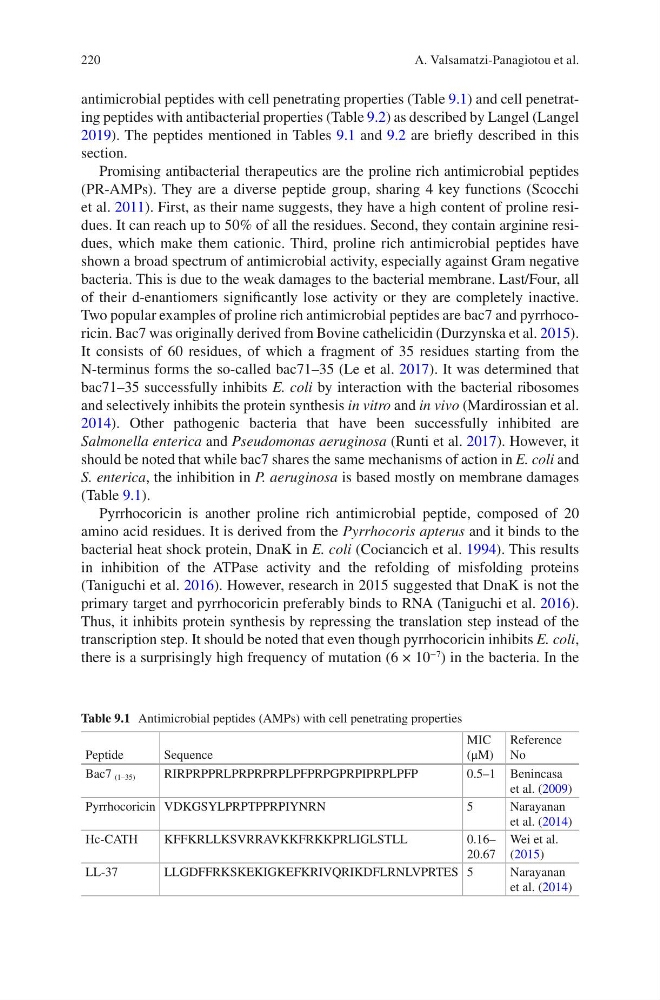
antimicrobial peptides with cell penetrating properties (Table 9.1) and cell penetrating peptides with antibacterial properties (Table 9.2) as described by Langel (Langel
2019). The peptides mentioned in Tables 9.1 and 9.2 are briefly described in this
section.
Promising antibacterial therapeutics are the proline rich antimicrobial peptides
(PR-AMPs). They are a diverse peptide group, sharing 4 key functions (Scocchi
et al. 2011). First, as their name suggests, they have a high content of proline residues. It can reach up to 50% of all the residues. Second, they contain arginine residues, which make them cationic. Third, proline rich antimicrobial peptides have
shown a broad spectrum of antimicrobial activity, especially against Gram negative
bacteria. This is due to the weak damages to the bacterial membrane. Last/Four, all
of their d-enantiomers significantly lose activity or they are completely inactive.
Two popular examples of proline rich antimicrobial peptides are bac7 and pyrrhocoricin. Bac7 was originally derived from Bovine cathelicidin (Durzynska et al. 2015).
It consists of 60 residues, of which a fragment of 35 residues starting from the
N-terminus forms the so-called bac71–35 (Le et al. 2017). It was determined that
bac71–35 successfully inhibits E. coli by interaction with the bacterial ribosomes
and selectively inhibits the protein synthesis in vitro and in vivo (Mardirossian et al.
2014). Other pathogenic bacteria that have been successfully inhibited are
Salmonella enterica and Pseudomonas aeruginosa (Runti et al. 2017). However, it
should be noted that while bac7 shares the same mechanisms of action in E. coli and
S. enterica, the inhibition in P. aeruginosa is based mostly on membrane damages
(Table 9.1).
Pyrrhocoricin is another proline rich antimicrobial peptide, composed of 20
amino acid residues. It is derived from the Pyrrhocoris apterus and it binds to the
bacterial heat shock protein, DnaK in E. coli (Cociancich et al. 1994). This results
in inhibition of the ATPase activity and the refolding of misfolding proteins
(Taniguchi et al. 2016). However, research in 2015 suggested that DnaK is not the
primary target and pyrrhocoricin preferably binds to RNA (Taniguchi et al. 2016).
Thus, it inhibits protein synthesis by repressing the translation step instead of the
transcription step. It should be noted that even though pyrrhocoricin inhibits E. coli,
there is a surprisingly high frequency of mutation (6 × 10
−7
) in the bacteria. In the
Table 9.1 Antimicrobial peptides (AMPs) with cell penetrating properties
Peptide
Sequence
MIC
(μM)
Reference
No
Bac7 (1–35)
RIRPRPPRLPRPRPRPLPFPRPGPRPIPRPLPFP
0.5–1 Benincasa
et al. (2009)
Pyrrhocoricin VDKGSYLPRPTPPRPIYNRN
5
Narayanan
et al. (2014)
Hc-CATH
KFFKRLLKSVRRAVKKFRKKPRLIGLSTLL
0.16–
20.67
Wei et al.
(2015)
LL-37
LLGDFFRKSKEKIGKEFKRIVQRIKDFLRNLVPRTES 5
Narayanan
et al. (2014)
A. Valsamatzi-Panagiotou et al.
antimicrobial peptides with cell penetrating properties (Table 9.1) and cell penetrating peptides with antibacterial properties (Table 9.2) as described by Langel (Langel
2019). The peptides mentioned in Tables 9.1 and 9.2 are briefly described in this
section.
Promising antibacterial therapeutics are the proline rich antimicrobial peptides
(PR-AMPs). They are a diverse peptide group, sharing 4 key functions (Scocchi
et al. 2011). First, as their name suggests, they have a high content of proline residues. It can reach up to 50% of all the residues. Second, they contain arginine residues, which make them cationic. Third, proline rich antimicrobial peptides have
shown a broad spectrum of antimicrobial activity, especially against Gram negative
bacteria. This is due to the weak damages to the bacterial membrane. Last/Four, all
of their d-enantiomers significantly lose activity or they are completely inactive.
Two popular examples of proline rich antimicrobial peptides are bac7 and pyrrhocoricin. Bac7 was originally derived from Bovine cathelicidin (Durzynska et al. 2015).
It consists of 60 residues, of which a fragment of 35 residues starting from the
N-terminus forms the so-called bac71–35 (Le et al. 2017). It was determined that
bac71–35 successfully inhibits E. coli by interaction with the bacterial ribosomes
and selectively inhibits the protein synthesis in vitro and in vivo (Mardirossian et al.
2014). Other pathogenic bacteria that have been successfully inhibited are
Salmonella enterica and Pseudomonas aeruginosa (Runti et al. 2017). However, it
should be noted that while bac7 shares the same mechanisms of action in E. coli and
S. enterica, the inhibition in P. aeruginosa is based mostly on membrane damages
(Table 9.1).
Pyrrhocoricin is another proline rich antimicrobial peptide, composed of 20
amino acid residues. It is derived from the Pyrrhocoris apterus and it binds to the
bacterial heat shock protein, DnaK in E. coli (Cociancich et al. 1994). This results
in inhibition of the ATPase activity and the refolding of misfolding proteins
(Taniguchi et al. 2016). However, research in 2015 suggested that DnaK is not the
primary target and pyrrhocoricin preferably binds to RNA (Taniguchi et al. 2016).
Thus, it inhibits protein synthesis by repressing the translation step instead of the
transcription step. It should be noted that even though pyrrhocoricin inhibits E. coli,
there is a surprisingly high frequency of mutation (6 × 10
−7
) in the bacteria. In the
Table 9.1 Antimicrobial peptides (AMPs) with cell penetrating properties
Peptide
Sequence
MIC
(μM)
Reference
No
Bac7 (1–35)
RIRPRPPRLPRPRPRPLPFPRPGPRPIPRPLPFP
0.5–1 Benincasa
et al. (2009)
Pyrrhocoricin VDKGSYLPRPTPPRPIYNRN
5
Narayanan
et al. (2014)
Hc-CATH
KFFKRLLKSVRRAVKKFRKKPRLIGLSTLL
0.16–
20.67
Wei et al.
(2015)
LL-37
LLGDFFRKSKEKIGKEFKRIVQRIKDFLRNLVPRTES 5
Narayanan
et al. (2014)
A. Valsamatzi-Panagiotou et al.