

183
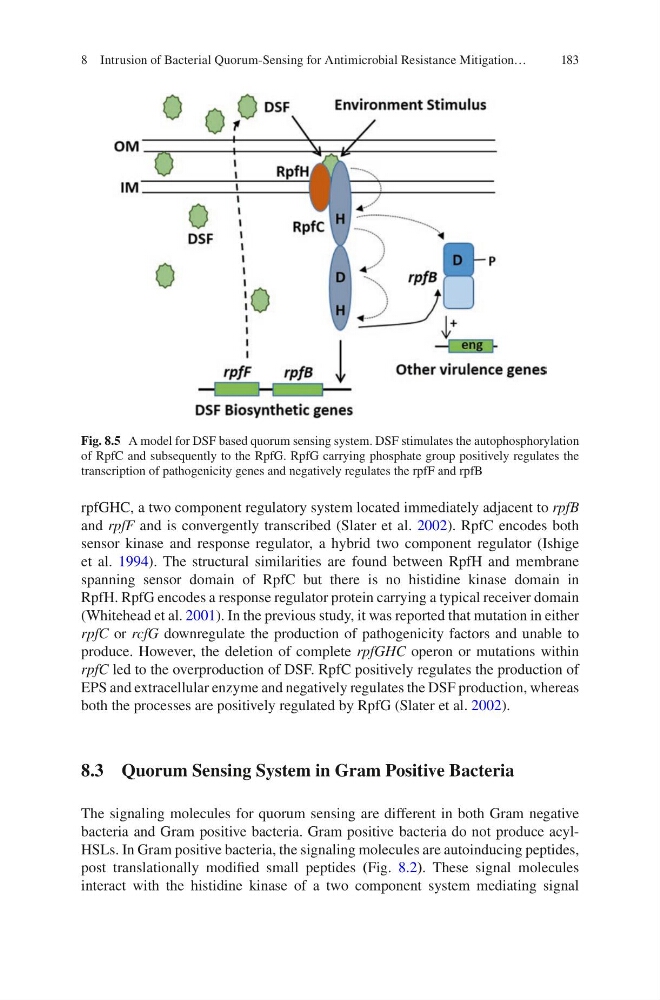
rpfGHC, a two component regulatory system located immediately adjacent to rpfB
and rpfF and is convergently transcribed (Slater et al. 2002). RpfC encodes both
sensor kinase and response regulator, a hybrid two component regulator (Ishige
et al. 1994). The structural similarities are found between RpfH and membrane
spanning sensor domain of RpfC but there is no histidine kinase domain in
RpfH. RpfG encodes a response regulator protein carrying a typical receiver domain
(Whitehead et al. 2001). In the previous study, it was reported that mutation in either
rpfC or rcfG downregulate the production of pathogenicity factors and unable to
produce. However, the deletion of complete rpfGHC operon or mutations within
rpfC led to the overproduction of DSF. RpfC positively regulates the production of
EPS and extracellular enzyme and negatively regulates the DSF production, whereas
both the processes are positively regulated by RpfG (Slater et al. 2002).
8.3 Quorum Sensing System in Gram Positive Bacteria
The signaling molecules for quorum sensing are different in both Gram negative
bacteria and Gram positive bacteria. Gram positive bacteria do not produce acylHSLs. In Gram positive bacteria, the signaling molecules are autoinducing peptides,
post translationally modified small peptides (Fig. 8.2). These signal molecules
interact with the histidine kinase of a two component system mediating signal
Fig. 8.5 A model for DSF based quorum sensing system. DSF stimulates the autophosphorylation
of RpfC and subsequently to the RpfG. RpfG carrying phosphate group positively regulates the
transcription of pathogenicity genes and negatively regulates the rpfF and rpfB
8 Intrusion of Bacterial Quorum-Sensing for Antimicrobial Resistance Mitigation…
rpfGHC, a two component regulatory system located immediately adjacent to rpfB
and rpfF and is convergently transcribed (Slater et al. 2002). RpfC encodes both
sensor kinase and response regulator, a hybrid two component regulator (Ishige
et al. 1994). The structural similarities are found between RpfH and membrane
spanning sensor domain of RpfC but there is no histidine kinase domain in
RpfH. RpfG encodes a response regulator protein carrying a typical receiver domain
(Whitehead et al. 2001). In the previous study, it was reported that mutation in either
rpfC or rcfG downregulate the production of pathogenicity factors and unable to
produce. However, the deletion of complete rpfGHC operon or mutations within
rpfC led to the overproduction of DSF. RpfC positively regulates the production of
EPS and extracellular enzyme and negatively regulates the DSF production, whereas
both the processes are positively regulated by RpfG (Slater et al. 2002).
8.3 Quorum Sensing System in Gram Positive Bacteria
The signaling molecules for quorum sensing are different in both Gram negative
bacteria and Gram positive bacteria. Gram positive bacteria do not produce acylHSLs. In Gram positive bacteria, the signaling molecules are autoinducing peptides,
post translationally modified small peptides (Fig. 8.2). These signal molecules
interact with the histidine kinase of a two component system mediating signal
Fig. 8.5 A model for DSF based quorum sensing system. DSF stimulates the autophosphorylation
of RpfC and subsequently to the RpfG. RpfG carrying phosphate group positively regulates the
transcription of pathogenicity genes and negatively regulates the rpfF and rpfB
8 Intrusion of Bacterial Quorum-Sensing for Antimicrobial Resistance Mitigation…