

182
acid methyl ester (3OH PAME) encoded by a phcB gene (Flavier et al. 1997a).
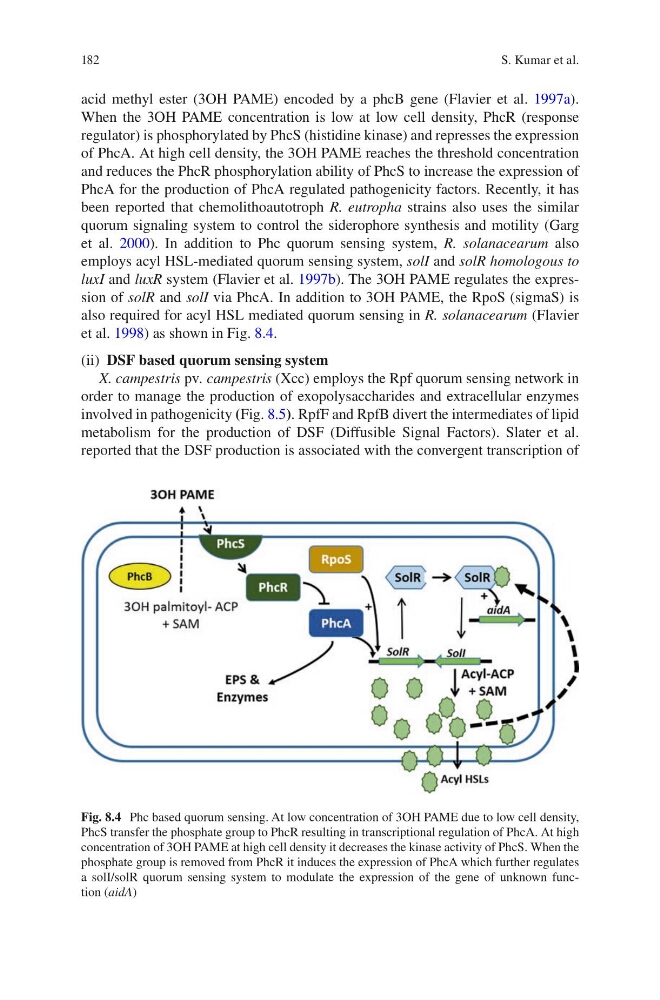
When the 3OH PAME concentration is low at low cell density, PhcR (response
regulator) is phosphorylated by PhcS (histidine kinase) and represses the expression
of PhcA. At high cell density, the 3OH PAME reaches the threshold concentration
and reduces the PhcR phosphorylation ability of PhcS to increase the expression of
PhcA for the production of PhcA regulated pathogenicity factors. Recently, it has
been reported that chemolithoautotroph R. eutropha strains also uses the similar
quorum signaling system to control the siderophore synthesis and motility (Garg
et al. 2000). In addition to Phc quorum sensing system, R. solanacearum also
employs acyl HSL-mediated quorum sensing system, solI and solR homologous to
luxI and luxR system (Flavier et al. 1997b). The 3OH PAME regulates the expression of solR and solI via PhcA. In addition to 3OH PAME, the RpoS (sigmaS) is
also required for acyl HSL mediated quorum sensing in R. solanacearum (Flavier
et al. 1998) as shown in Fig. 8.4.
(ii) DSF based quorum sensing system
X. campestris pv. campestris (Xcc) employs the Rpf quorum sensing network in
order to manage the production of exopolysaccharides and extracellular enzymes
involved in pathogenicity (Fig. 8.5). RpfF and RpfB divert the intermediates of lipid
metabolism for the production of DSF (Diffusible Signal Factors). Slater et al.
reported that the DSF production is associated with the convergent transcription of
Fig. 8.4 Phc based quorum sensing. At low concentration of 3OH PAME due to low cell density,
PhcS transfer the phosphate group to PhcR resulting in transcriptional regulation of PhcA. At high
concentration of 3OH PAME at high cell density it decreases the kinase activity of PhcS. When the
phosphate group is removed from PhcR it induces the expression of PhcA which further regulates
a solI/solR quorum sensing system to modulate the expression of the gene of unknown function (aidA)
S. Kumar et al.
acid methyl ester (3OH PAME) encoded by a phcB gene (Flavier et al. 1997a).
When the 3OH PAME concentration is low at low cell density, PhcR (response
regulator) is phosphorylated by PhcS (histidine kinase) and represses the expression
of PhcA. At high cell density, the 3OH PAME reaches the threshold concentration
and reduces the PhcR phosphorylation ability of PhcS to increase the expression of
PhcA for the production of PhcA regulated pathogenicity factors. Recently, it has
been reported that chemolithoautotroph R. eutropha strains also uses the similar
quorum signaling system to control the siderophore synthesis and motility (Garg
et al. 2000). In addition to Phc quorum sensing system, R. solanacearum also
employs acyl HSL-mediated quorum sensing system, solI and solR homologous to
luxI and luxR system (Flavier et al. 1997b). The 3OH PAME regulates the expression of solR and solI via PhcA. In addition to 3OH PAME, the RpoS (sigmaS) is
also required for acyl HSL mediated quorum sensing in R. solanacearum (Flavier
et al. 1998) as shown in Fig. 8.4.
(ii) DSF based quorum sensing system
X. campestris pv. campestris (Xcc) employs the Rpf quorum sensing network in
order to manage the production of exopolysaccharides and extracellular enzymes
involved in pathogenicity (Fig. 8.5). RpfF and RpfB divert the intermediates of lipid
metabolism for the production of DSF (Diffusible Signal Factors). Slater et al.
reported that the DSF production is associated with the convergent transcription of
Fig. 8.4 Phc based quorum sensing. At low concentration of 3OH PAME due to low cell density,
PhcS transfer the phosphate group to PhcR resulting in transcriptional regulation of PhcA. At high
concentration of 3OH PAME at high cell density it decreases the kinase activity of PhcS. When the
phosphate group is removed from PhcR it induces the expression of PhcA which further regulates
a solI/solR quorum sensing system to modulate the expression of the gene of unknown function (aidA)
S. Kumar et al.