

167
and Collins 2007). Certain enzymes like endolysins are bacteriophage encoded peptidoglycan hydrolases that degrades the cell wall of the host bacteria which is a
hallmark of the lytic multiplication cycle of the phage. Endolysins gain access to
their peptidoglycan substrate from within the bacterial cell with the help of cytoplasmic membrane perforating holin proteins. Both phages encoded polysaccharide
depolymerase DA7 and the purified endolysin LysK can synergistically disrupt and
eradicate wide range of biofilms formed by various strains of S. aureus (Olsen et al.
2018). Phages targeting efflux pump receptor sites increase the sensitivity towards
several classes of antibiotic helping in reduction of multi drug resistance. A lytic
bacteriophage, OMKO1, (family Myoviridae) of P. aeruginosa is reported to utilize
the outer membrane porin M (OprM) of the multi drug efflux systems MexAB and
MexXY as a receptor binding site (Chan et al. 2016). An alternate strategy using
cocktails of distinct phages owing to narrow host range are often used for minimizing laborious identification and evasion in pathogen. Such phage cocktail composed
of an equal amount of myovirus (ϕNH-4) and a podovirus (ϕMR299–2) can eradicate biofilms of both P. aeruginosa NH57388A (mucoid) and P. aeruginosa MR299
(nonmucoid) strains while growing on human cystic fibrosis bronchial epithelial
cell line (CFBE41o). The efficiency of such biofilm disruption is dependent on the
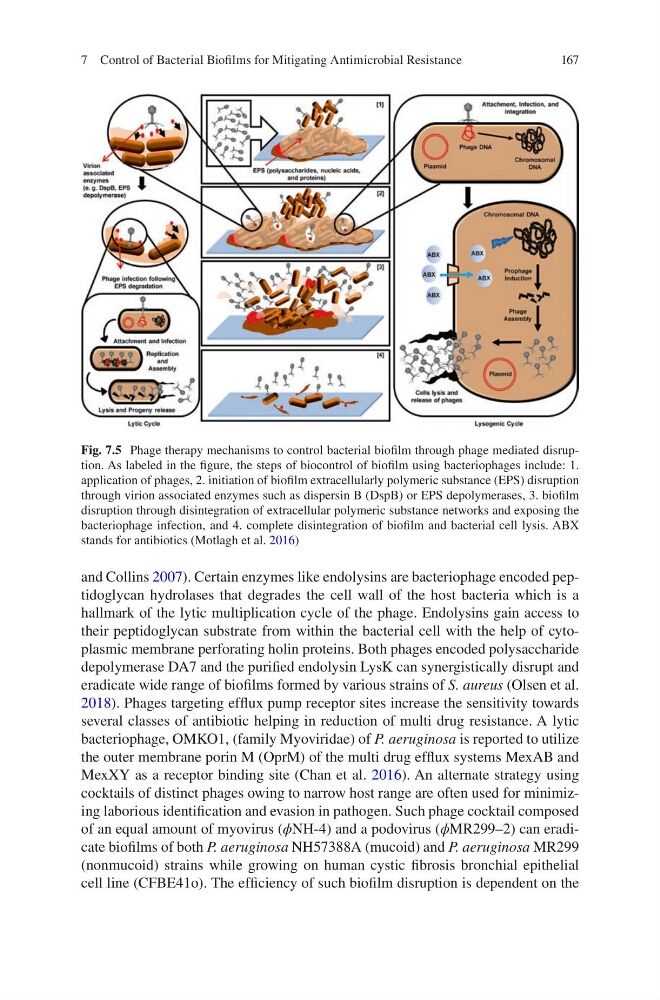
Fig. 7.5 Phage therapy mechanisms to control bacterial biofilm through phage mediated disruption. As labeled in the figure, the steps of biocontrol of biofilm using bacteriophages include: 1.
application of phages, 2. initiation of biofilm extracellularly polymeric substance (EPS) disruption
through virion associated enzymes such as dispersin B (DspB) or EPS depolymerases, 3. biofilm
disruption through disintegration of extracellular polymeric substance networks and exposing the
bacteriophage infection, and 4. complete disintegration of biofilm and bacterial cell lysis. ABX
stands for antibiotics (Motlagh et al. 2016)
7 Control of Bacterial Biofilms for Mitigating Antimicrobial Resistance
and Collins 2007). Certain enzymes like endolysins are bacteriophage encoded peptidoglycan hydrolases that degrades the cell wall of the host bacteria which is a
hallmark of the lytic multiplication cycle of the phage. Endolysins gain access to
their peptidoglycan substrate from within the bacterial cell with the help of cytoplasmic membrane perforating holin proteins. Both phages encoded polysaccharide
depolymerase DA7 and the purified endolysin LysK can synergistically disrupt and
eradicate wide range of biofilms formed by various strains of S. aureus (Olsen et al.
2018). Phages targeting efflux pump receptor sites increase the sensitivity towards
several classes of antibiotic helping in reduction of multi drug resistance. A lytic
bacteriophage, OMKO1, (family Myoviridae) of P. aeruginosa is reported to utilize
the outer membrane porin M (OprM) of the multi drug efflux systems MexAB and
MexXY as a receptor binding site (Chan et al. 2016). An alternate strategy using
cocktails of distinct phages owing to narrow host range are often used for minimizing laborious identification and evasion in pathogen. Such phage cocktail composed
of an equal amount of myovirus (ϕNH-4) and a podovirus (ϕMR299–2) can eradicate biofilms of both P. aeruginosa NH57388A (mucoid) and P. aeruginosa MR299
(nonmucoid) strains while growing on human cystic fibrosis bronchial epithelial
cell line (CFBE41o). The efficiency of such biofilm disruption is dependent on the
Fig. 7.5 Phage therapy mechanisms to control bacterial biofilm through phage mediated disruption. As labeled in the figure, the steps of biocontrol of biofilm using bacteriophages include: 1.
application of phages, 2. initiation of biofilm extracellularly polymeric substance (EPS) disruption
through virion associated enzymes such as dispersin B (DspB) or EPS depolymerases, 3. biofilm
disruption through disintegration of extracellular polymeric substance networks and exposing the
bacteriophage infection, and 4. complete disintegration of biofilm and bacterial cell lysis. ABX
stands for antibiotics (Motlagh et al. 2016)
7 Control of Bacterial Biofilms for Mitigating Antimicrobial Resistance