

Knowledge base: Knowledge base represents facts and rules. In an expert system,
knowledge base contains domain-specific and high-quality knowledge. The
knowledge base stores both factual and heuristic knowledge. Factual knowledge
is the knowledge that is widely shared and accepted by knowledge engineers or
scholars in the task domain. Heuristic knowledge, on the other hand, is less
rigorous, which is about practice, accurate judgment, one’s ability of evaluation,
or problem-solving by experiment. The knowledge representation process in the
expert system is in the form of IF-THEN-ELSE rules, which is commonly
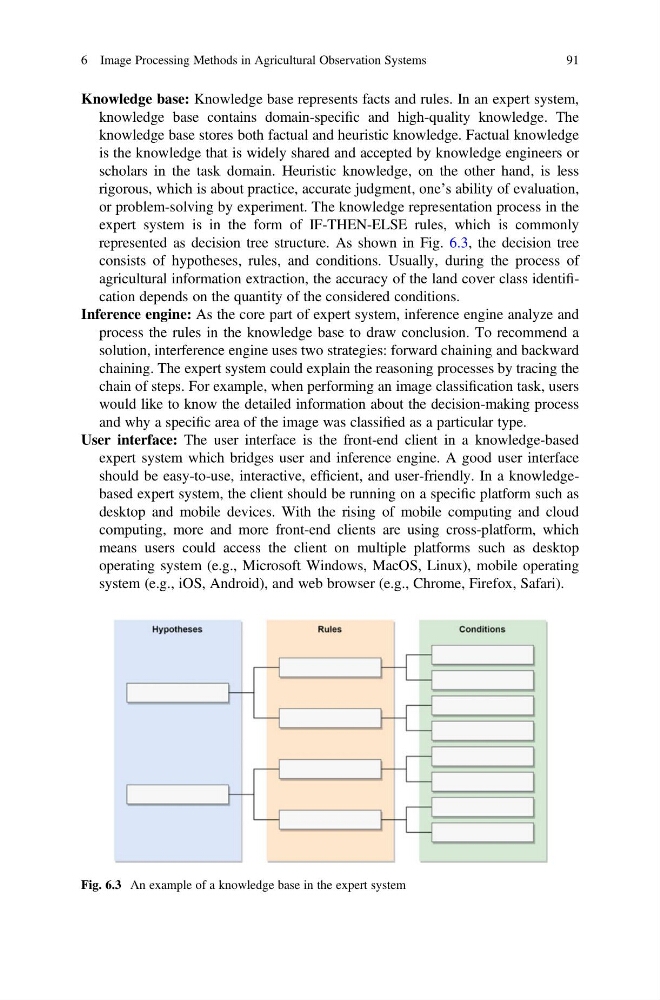
represented as decision tree structure. As shown in Fig. 6.3, the decision tree
consists of hypotheses, rules, and conditions. Usually, during the process of
agricultural information extraction, the accuracy of the land cover class identification depends on the quantity of the considered conditions.
Inference engine: As the core part of expert system, inference engine analyze and
process the rules in the knowledge base to draw conclusion. To recommend a
solution, interference engine uses two strategies: forward chaining and backward
chaining. The expert system could explain the reasoning processes by tracing the
chain of steps. For example, when performing an image classification task, users
would like to know the detailed information about the decision-making process
and why a specific area of the image was classified as a particular type.
User interface: The user interface is the front-end client in a knowledge-based
expert system which bridges user and inference engine. A good user interface
should be easy-to-use, interactive, efficient, and user-friendly. In a knowledgebased expert system, the client should be running on a specific platform such as
desktop and mobile devices. With the rising of mobile computing and cloud
computing, more and more front-end clients are using cross-platform, which
means users could access the client on multiple platforms such as desktop
operating system (e.g., Microsoft Windows, MacOS, Linux), mobile operating
system (e.g., iOS, Android), and web browser (e.g., Chrome, Firefox, Safari).
Fig. 6.3 An example of a knowledge base in the expert system
6 Image Processing Methods in Agricultural Observation Systems
91
knowledge base contains domain-specific and high-quality knowledge. The
knowledge base stores both factual and heuristic knowledge. Factual knowledge
is the knowledge that is widely shared and accepted by knowledge engineers or
scholars in the task domain. Heuristic knowledge, on the other hand, is less
rigorous, which is about practice, accurate judgment, one’s ability of evaluation,
or problem-solving by experiment. The knowledge representation process in the
expert system is in the form of IF-THEN-ELSE rules, which is commonly
represented as decision tree structure. As shown in Fig. 6.3, the decision tree
consists of hypotheses, rules, and conditions. Usually, during the process of
agricultural information extraction, the accuracy of the land cover class identification depends on the quantity of the considered conditions.
Inference engine: As the core part of expert system, inference engine analyze and
process the rules in the knowledge base to draw conclusion. To recommend a
solution, interference engine uses two strategies: forward chaining and backward
chaining. The expert system could explain the reasoning processes by tracing the
chain of steps. For example, when performing an image classification task, users
would like to know the detailed information about the decision-making process
and why a specific area of the image was classified as a particular type.
User interface: The user interface is the front-end client in a knowledge-based
expert system which bridges user and inference engine. A good user interface
should be easy-to-use, interactive, efficient, and user-friendly. In a knowledgebased expert system, the client should be running on a specific platform such as
desktop and mobile devices. With the rising of mobile computing and cloud
computing, more and more front-end clients are using cross-platform, which
means users could access the client on multiple platforms such as desktop
operating system (e.g., Microsoft Windows, MacOS, Linux), mobile operating
system (e.g., iOS, Android), and web browser (e.g., Chrome, Firefox, Safari).
Fig. 6.3 An example of a knowledge base in the expert system
6 Image Processing Methods in Agricultural Observation Systems
91